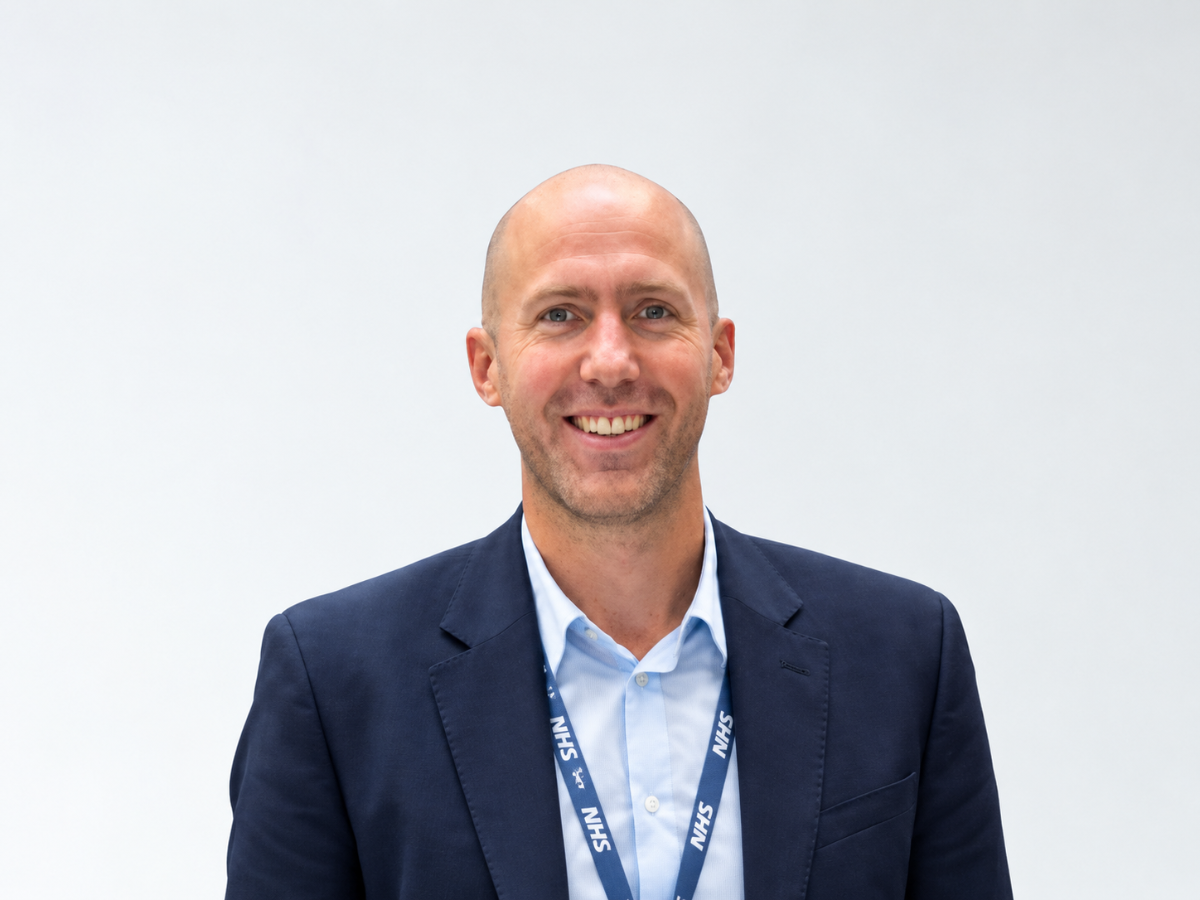
Will Roberts, Chief Operating Officer (COO) of Walsall Healthcare NHS Trust
A patient arriving at Walsall Manor Hospital today walks into an urgent and emergency care centre that cost £40 million and did not exist when Will Roberts rejoined the NHS in August 2020. He came back as Director of Operations after a spell advising on health management in New Zealand. Having taken up the role four years ago, he is now the Trust’s substantive Chief Operating Officer, appointed in November 2024 after a competitive selection, and the building is one of several accomplishments that may be counted to his credit.
That record now matters beyond Walsall. NHS England has awarded £25 million for a Community Diagnostic Centre in Bilston, to serve Wolverhampton and Walsall, with construction due to start in mid-2027 and finish by the end of 2028. Funding announcements of this kind attract attention because they are easy to photograph. What is less certain is who will take charge of the centre after it opens, and whether those supporting it are able to recruit the people it needs, manage its bookings and make full use of its capacity. Operational leadership often decides whether projects of this kind thrive or falter.
Roberts's career suggests he understands that. He began as a management trainee with degrees in physics and health economics, then worked at Great Ormond Street and at Lewisham and Greenwich, covering trauma and orthopaedics as well as theatres and critical care.That background puts him close to where elective recovery comes under most strain. Waiting lists fall when diagnostics, theatre capacity and bed flow advance together, and a manager who has worked across those areas is better placed to see where a hold-up starts.
The same conclusion follows from what else the Trust has accomplished. Walsall was the first NHS trust outside the specialist sector to bring in robot-assisted hip and knee replacement, a step that meant arranging procurement, staff training and theatre scheduling around a new piece of technology. For life sciences and health-tech businesses, that is a useful signal of an operator able to absorb innovation rather than simply buy it. The Trust has also ranked consistently high in the national NHS Staff Survey as a place colleagues would recommend to others. In a service still contending with workforce strain, retention is an operational asset. Diagnostic centres depend on radiographers, sonographers and physiologists, groups that are scarce nationally and mobile between employers.
Some caution is warranted. The announcement of the Bilston centre does not mention Roberts, and the bid was led by the City of Wolverhampton Council working with the Black Country Integrated Care Board and both Trusts. Walsall Healthcare now operates in a group with The Royal Wolverhampton, under a single Group Chief Executive, so credit for strategy and delivery is shared. The evidence available in public statements also concerns capital projects, innovation and staff sentiment. It tells us less about waiting times, which are the yardstick that patients and ministers will in the end use.
Even so, the picture is coherent. The Bilston scheme is intended to bring diagnosis together with primary care, family support and leisure services, an approach consistent with the government’s declared preference for prevention and for care delivered nearer to people’s homes. Integration of this kind asks a great deal of those who run it. Rotas, premises, referral pathways and council partners must all be brought into line, and no national programme can do that work for the trust.
Other NHS leaders can draw a modest lesson in succession from Walsall. Roberts moved from Director of Operations to Deputy COO and then to COO without leaving the organisation, so he is familiar with the site and its staff, and the Trust has avoided the upheaval of bringing in someone from outside. Policymakers could take away a related point. Community diagnostic centres were funded on the assumption that longer opening hours and local access will reduce waits, but that assumption is sound only where a trust has enough managerial depth to make it work.
Money for buildings can be found within one spending round. Capability has to be accumulated over a period of years. Walsall appears to have a chief operating officer whose record suggests he can open a major facility and keep the workforce around it. Should the Bilston centre be regarded as a success once it is up and running in 2029, much of the reason will be found in the unglamorous operational work being done at present.