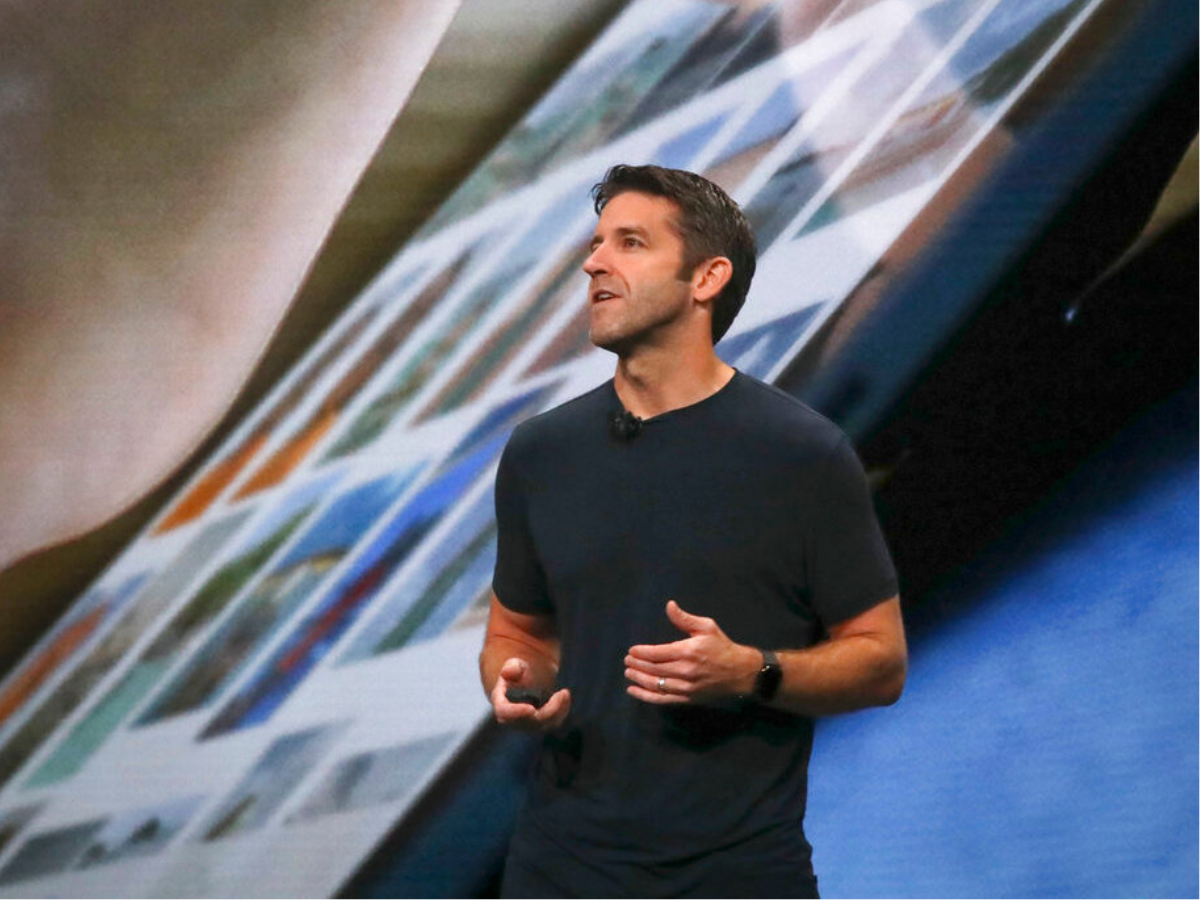
On 1 September 2026, Apple will undergo its most significant leadership change in fifteen years. Tim Cook, the operations chief turned global strategist who transformed Apple into the world's most valuable company, will move into an executive chairman role. His replacement is John Ternus, the 54-year-old Senior Vice President of Hardware Engineering who has spent a quarter century working inside Cupertino. The handover marks the end of one era and the opening of a rather more uncertain one.
Cook's record is difficult to argue with. Under his stewardship, Apple's market capitalisation rose roughly tenfold, crossing £2.94 trillion earlier this year. He took a company defined by its founder's artistic temperament and turned it into a logistics and financial machine of unusual precision. The question now is whether Ternus, a man Cook once described as having "the mind of an engineer," can match that performance in a period considerably less forgiving than the one Cook inherited.
Ternus joined Apple in 1997, working under Steve Jobs before becoming one of Cook's most trusted lieutenants. He oversaw the transition to Apple Silicon, directing the development of the M-series chips that gave Apple's Mac line a significant performance and efficiency advantage over competitors. He also led hardware development on the iPad and was the principal engineer behind the MacBook Neo, launched earlier this year. His record is one of methodical execution. What it is not, at least publicly, is one of strategic reinvention or political manoeuvring.
That distinction matters because the two most pressing challenges Ternus faces are not principally engineering problems.
Apple's position in artificial intelligence is the more immediate concern. Microsoft and Google have moved aggressively into generative AI, embedding it across their product lines. Apple, by contrast, has struggled. The current iteration of Siri relies on Google's Gemini model, a fact that sits uncomfortably alongside Apple's long-stated commitment to vertical integration and user privacy. Ternus's first major test arrives at WWDC 2026, where Apple is expected to outline how it intends to develop AI capabilities that work within its closed ecosystem. The company's privacy architecture, historically an asset, now complicates the data pipelines that AI systems require. How Ternus resolves that tension will define much of his first year.
The geopolitical situation adds further pressure. Apple manufactures the substantial majority of its products in China. Cook spent years managing that relationship with considerable skill, including direct dealings with successive US administrations and, more recently, with Donald Trump, who has pushed for American manufacturing to be returned stateside. Ternus has no comparable political track record. Tariff threats and US-China trade friction have not abated, and the secondary disruption from Middle Eastern instability has affected component supply chains across the industry. These are not problems that can be resolved in a hardware lab.
Beyond the immediate crises sits a structural challenge: the smartphone market is saturated. The iPhone remains Apple's largest revenue source, but the category no longer grows in the way it once did. Ternus is expected to make significant bets on adjacent hardware, including foldable devices and AI-enabled wearables. There has been persistent speculation about an Apple Ring, a biometric device that would extend the company's health monitoring ambitions beyond the wrist. Whether these products can generate iPhone-scale revenue is far from clear.
There is also the regulatory question. European and UK authorities have increased scrutiny of Apple's App Store practices, challenging the commission structure that underpins the company's services division. Services revenue has become a crucial component of Apple's financial results. If regulators succeed in forcing material changes to the App Store model, the financial consequences would be significant, and Ternus will have limited influence over how that plays out.
What Ternus will be judged on, ultimately, is not operational continuity but demonstrable progress on AI and the credibility of what comes after the iPhone. Cook built a fortress. On 1 September, a builder takes charge of it, at a moment when the question of what Apple should be building next remains genuinely unresolved.


.jpg)