The next great military revolution is not arriving with new fighter jets or hypersonic missiles. It is arriving in the form of algorithms. Artificial intelligence has moved from research labs into the core infrastructure of modern defence systems, quietly transforming how wars are analysed, planned and fought. What once sounded like science fiction is now embedded inside intelligence agencies, defence departments and military command centres around the world.
Artificial intelligence is already deeply integrated into modern conflict. Governments now use advanced machine learning systems to analyse satellite imagery, detect military activity, process communications data and model battlefield scenarios in real time. The sheer volume of information generated by modern surveillance systems is now far beyond what human analysts alone can process. AI has become the filter that makes the intelligence system function.
At the centre of this transformation lies a growing tension between governments and the technology companies building the tools. A recent dispute between a major AI developer and the United States government exposed a deeper conflict about who should control the rules surrounding artificial intelligence in warfare.
The company had placed restrictions on how its systems could be used. These included prohibiting the technology from being used for mass surveillance of domestic populations and banning integration with fully autonomous weapons capable of selecting and attacking targets without human involvement. From the company’s perspective these limits represented basic ethical safeguards for a powerful technology whose capabilities continue to evolve.
Government officials took a different view. Defence agencies argued that once technology enters national security infrastructure, operational decisions must remain under government control. They insisted existing laws governing armed conflict were sufficient and rejected the idea that private companies could impose restrictions on how military systems operate. When negotiations failed the dispute escalated quickly, turning a contractual disagreement into a symbol of the growing friction between Silicon Valley and national security institutions.
The argument highlights a much larger reality. Artificial intelligence is no longer experimental within military systems. It has already become a foundational tool across intelligence, surveillance and operational planning.
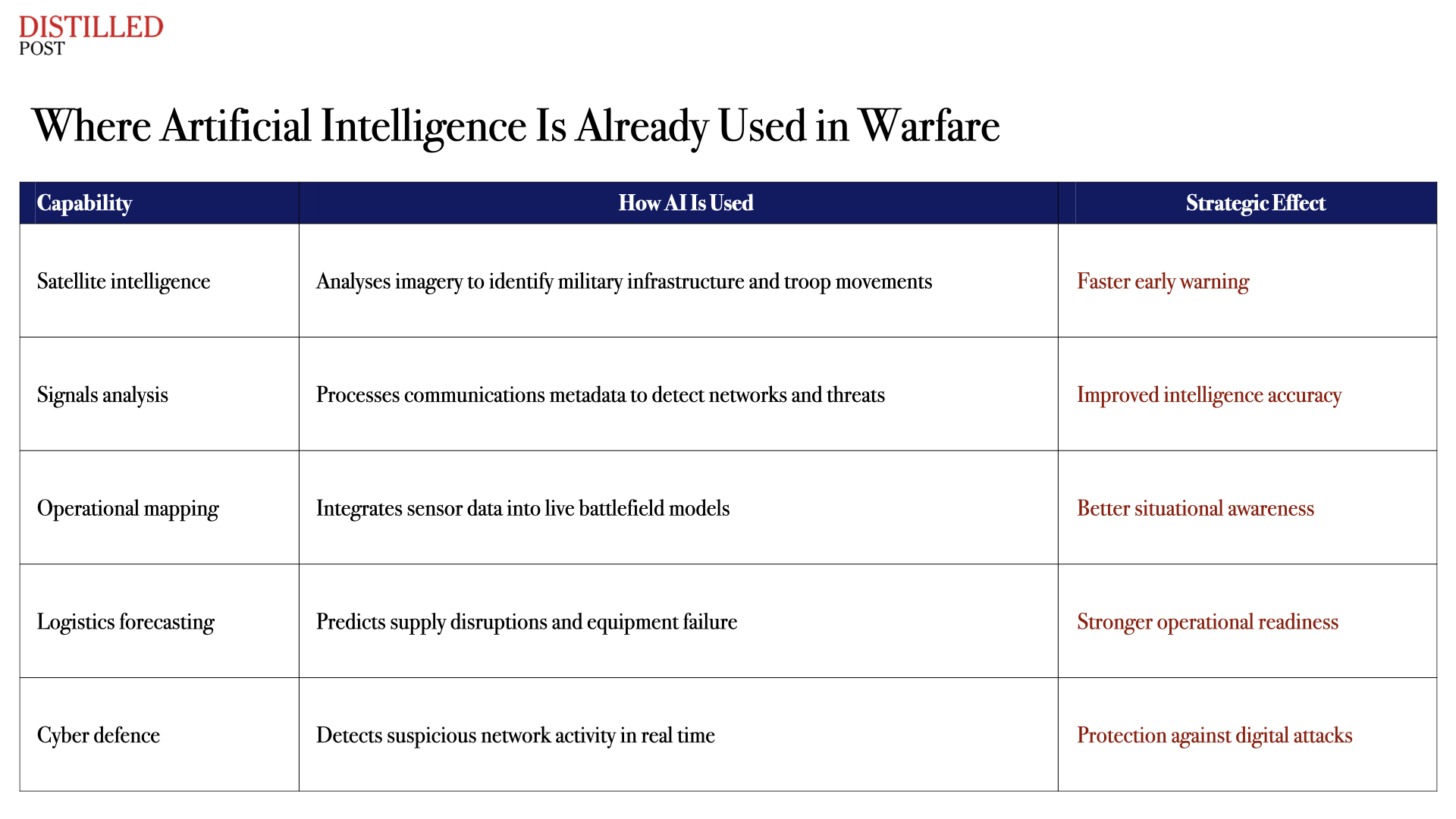
In modern warfare the challenge is no longer gathering information. The challenge is interpreting it quickly enough to act. Artificial intelligence allows intelligence agencies to scan millions of satellite images, detect anomalies and flag potential threats within seconds. Systems trained on historical data can identify patterns that might otherwise go unnoticed.
Recent conflicts have demonstrated how these capabilities are changing the dynamics of warfare. Machine learning systems are increasingly used to analyse drone footage, detect artillery positions and model potential troop movements. These tools do not replace military commanders but they increasingly shape the decisions those commanders make.
Artificial intelligence is also transforming the speed of warfare itself. Traditional command structures rely on layers of analysis and approval before decisions are made. Automated systems can process data and generate insights almost instantly. In a conflict where speed determines advantage, the ability to observe, analyse and respond faster than an opponent can be decisive.
This shift raises one of the most complex questions facing defence planners today. How much authority should machines have in military decision making?
Most governments maintain that humans must remain in control of any decision involving lethal force. Yet maintaining human oversight can slow the decision cycle. In high speed conflicts even seconds can determine the outcome of engagements. Military planners therefore face a difficult balance between preserving human judgement and pursuing technological speed.
Technology companies are confronting a different version of the same dilemma. Artificial intelligence systems are inherently flexible. A model designed to analyse satellite imagery could also potentially assist in planning cyber attacks or analysing personal data at massive scale. Once deployed these systems can be adapted in ways that were not originally anticipated.
This adaptability makes artificial intelligence far more difficult to regulate than traditional weapons. A fighter jet or missile system has clearly defined capabilities. Artificial intelligence platforms can perform a wide range of tasks depending on how they are configured and what data they are trained on.

The geopolitical dimension makes the issue even more complex. Artificial intelligence is now widely seen as a decisive factor in future military power. Countries that lead in AI development may gain advantages not only in warfare but also in cyber operations, intelligence gathering and economic security.
China has invested heavily in artificial intelligence as part of its long term strategic planning. Its regulatory framework allows the government to integrate commercial technology into defence programmes rapidly. In contrast Western democracies operate with a more fragmented relationship between technology companies and state institutions.
This difference may prove significant as the AI race accelerates. The ability to deploy advanced technologies quickly could influence global power balances over the coming decades.
What is clear is that artificial intelligence is no longer a future possibility in warfare. It is already embedded within the systems that monitor global security and support military operations. The real debate now concerns governance, oversight and the pace at which these technologies continue to expand.
Artificial intelligence is becoming the operating system of modern conflict. The countries and institutions that shape its development will ultimately shape the rules of warfare itself. The consequences of that race will extend far beyond the battlefield, influencing global security, political power and technological leadership for decades to come.



.jpg)