

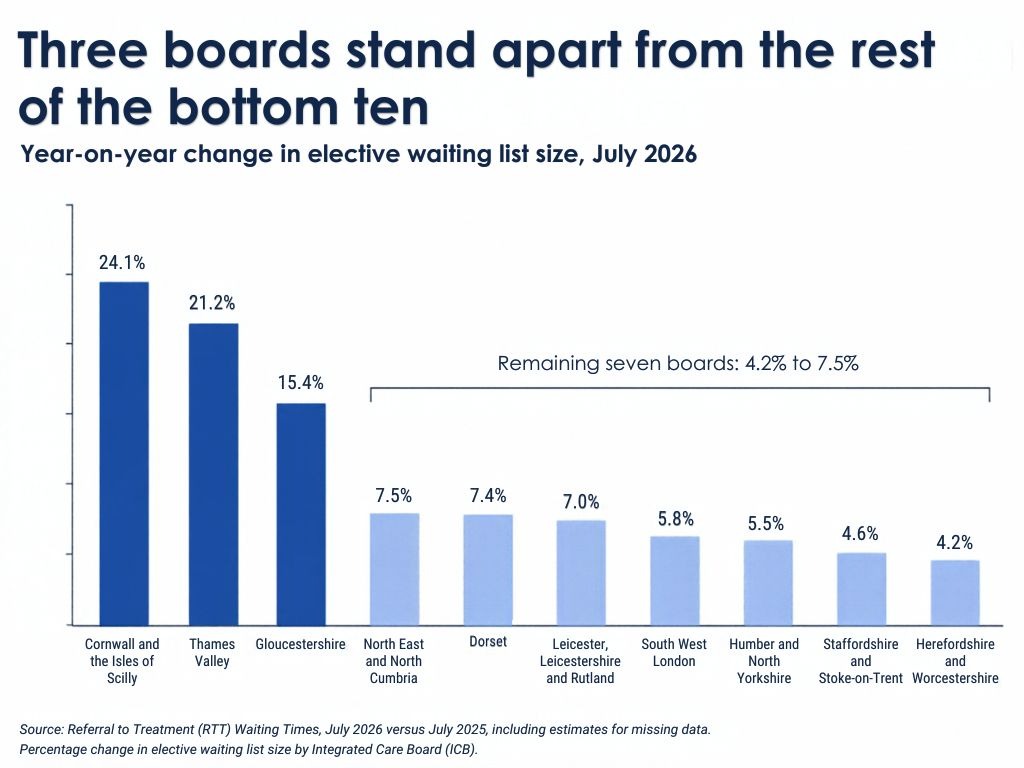
A rise of 24.1 per cent in a year is the kind of figure that silences a board meeting. That is how far the elective waiting list in Cornwall and the Isles of Scilly grew between July 2025 and July 2026, the steepest increase of any integrated care board in England. Thames Valley follows at 21.2 per cent and Gloucestershire at 15.4 per cent. The next board down, North East and North Cumbria, sits at 7.5 per cent, less than a third of the Cornish rate. That drop between third and fourth place is the most revealing feature of the data.
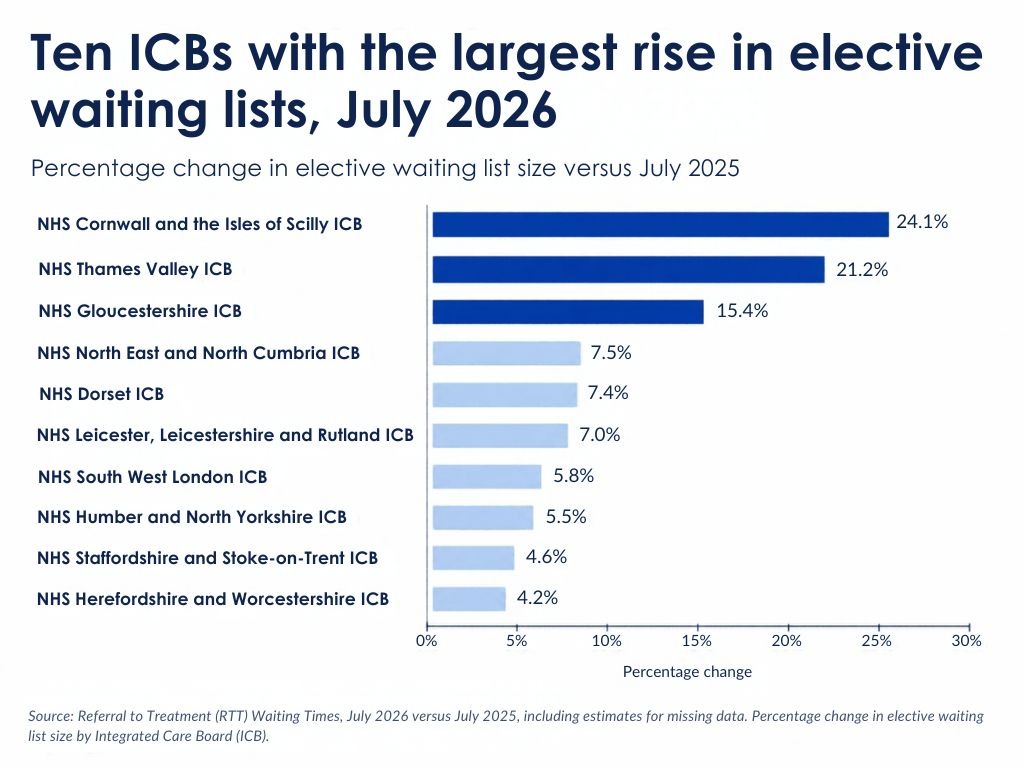
Three boards growing at double-digit rates while the rest of the worst ten cluster between 4.2 and 7.5 per cent suggests specific local events. A provider losing theatre capacity, a sudden rise in referrals, the collapse of a single service line or a change in how patients are recorded could each produce movement of this size. The figures include estimates for missing data, so some of the change may reflect reporting rather than clinical reality. Leaders in these three systems need to establish quickly which explanation applies, because the response to a data problem and the response to a capacity problem are very different.
The second tier is instructive for its mix. Dorset, Leicester, Leicestershire and Rutland, South West London, Humber and North Yorkshire, Staffordshire and Stoke-on-Trent, and Herefordshire and Worcestershire do not share an obvious profile. Some are coastal and rural, others are dense and urban, others are shire counties with a single large acute provider. No simple story about geography or funding formulas covers them all, which makes the usual political shorthand unreliable. Ministers who attribute rising lists to inherited neglect and opposition politicians who blame current mismanagement will both find the data awkward.
The wider context makes the numbers heavier. The government has committed to restoring the 18-week standard for most patients by the end of this parliament, a goal that depends on activity growing faster than demand year after year in every part of the country. A list that expands by a quarter in twelve months moves a local system further from that standard than it was at the start, and it also consumes the productivity gains achieved elsewhere in the same region. Years of industrial action, workforce gaps and constrained capital have left little slack for recovery, and the boards at the bottom of this table have the least.
There is also a structural question. Integrated care boards were created to join up commissioning, providers and local government, and they are now being asked to cut running costs and operate with leaner teams. The national oversight framework sorts organisations by performance and assigns support accordingly. The three outliers are a practical test of whether that machinery works. If a board's list grows by a fifth, it should trigger diagnostic help within weeks. If the response arrives only when the annual figures are published, the framework is measuring failure rather than preventing it.
Patients carry the consequences in forms the percentages cannot show. In Cornwall, geography limits mutual aid between providers, since a patient waiting for a joint replacement cannot easily be sent to a neighbouring hospital an hour or more away. Independent sector capacity can absorb some demand, but only where commissioners have contracts and clinical governance in place. For health-tech and life sciences firms, these boards represent both a market and a reputational risk. Tools for validating lists, managing referrals and supporting patient-initiated follow-up will find a receptive audience in systems under this strain, though only if procurement can move at the speed that the figures demand.
Policymakers should resist the temptation to treat the national average as the story. A system can report modest overall progress while three of its boards deteriorate sharply, and the political damage is local and immediate. The test of reform in the coming year is not whether the headline list falls. It is how quickly Cornwall, Thames Valley and Gloucestershire are identified, supported and turned around, and whether the new architecture of the NHS can act on a warning that its own data has already given.



.jpg)
.jpg)