.jpg)
A trust chief executive opens her inbox on a Monday morning to find eleven requests for returns, two of which ask for data submitted last quarter. Her board has a pathway redesign ready that could shorten orthopaedic waits, but it sits behind a compliance cycle and a funding pot that expires in March. Every senior NHS leader will recognise the scene. It is the ordinary working texture of a health service that has been asked to be more productive while being restructured, re-targeted and re-funded at short intervals.
A recent analysis of NHS productivity places the main brake on performance in these habits. Short-term funding, repeated reorganisation, an accumulation of targets and a thick layer of regulatory reporting consume the time and attention that improvement requires. Its remedy is organised around four conditions: stable direction, focused accountability, freedom to deliver and the capability to improve. The diagnosis is more hopeful than it first appears, because the causes sit largely within the gift of government. Demography and disease burden cannot be legislated away. Funding cycles and reporting duties can.
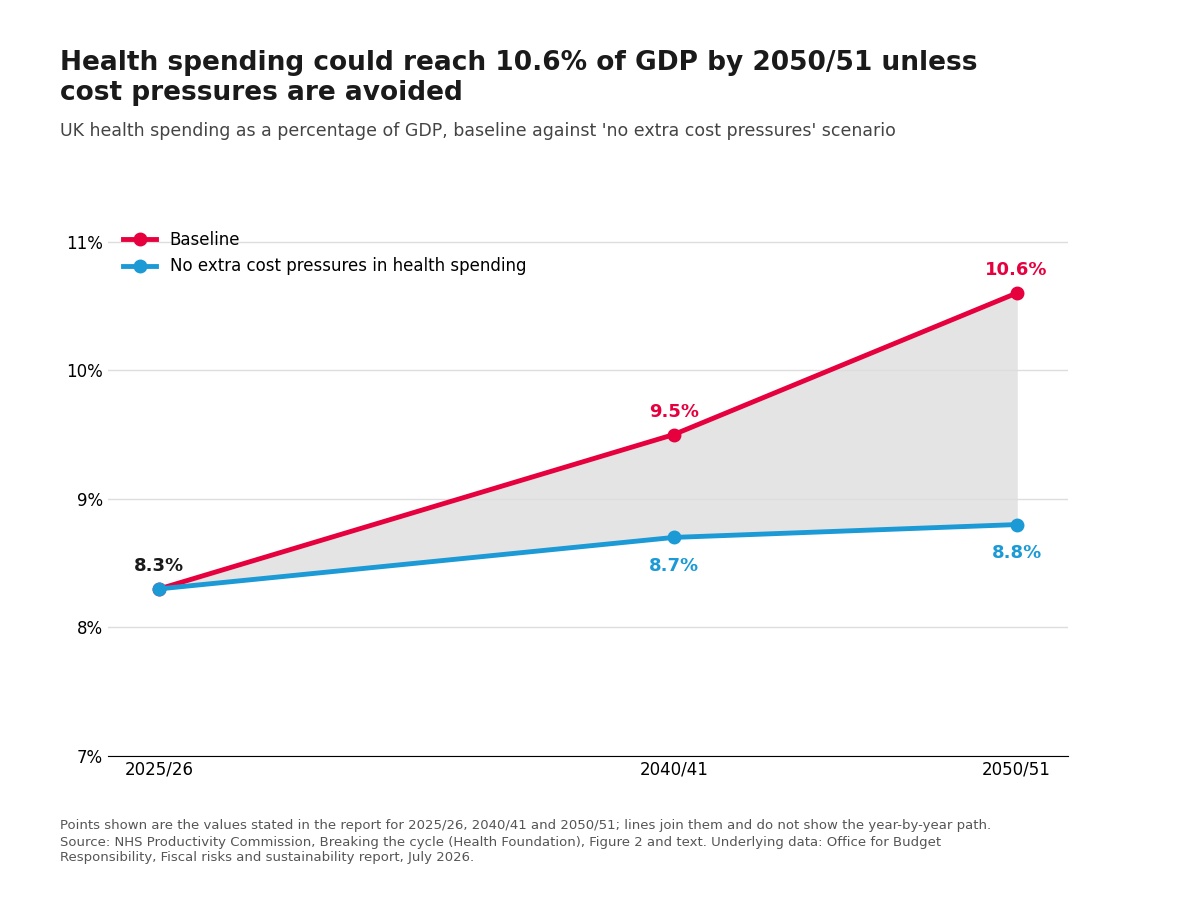
The estimated rewards are substantial. Closing the gap with international comparators within current budgets could prevent between 18,500 and 20,600 treatable deaths each year and add between 2.5 and 4.5 years of healthy life expectancy. On the fiscal side, health spending is projected to climb from 8.3 per cent of GDP to 10.6 per cent by the early 2050s on present trends. Better productivity could hold that to 8.8 per cent, worth some £33 billion a year by 2040/41 and £83 billion a year by 2050/51. For a Treasury wary of every new commitment, productivity is the only argument that pays for itself.
The timing favours action. The government has already moved to fold NHS England into the Department of Health and Social Care, cut integrated care board running costs, and promised a rebalancing of resources towards neighbourhood and community care, backed by a multi-year spending settlement. Each of these matches a recommendation in the analysis. Reorganisation is itself a source of churn, so the sensible reading is that this transition can serve as the last major upheaval, provided legislation and devolution arrangements are settled quickly and further restructuring is ruled out.
The practical implications differ by audience. NHS leaders should press for a rolling five-year framework that aligns capital, revenue, workforce and digital budgets, since a pathway redesign cannot be planned against a twelve-month pot. Regional bodies have a clear role in pooling scarce analytical, procurement and capital delivery expertise that individual providers cannot sustain. A national test-and-learn mechanism would spare trusts from piloting the same ambient voice technology or workforce model forty times over, which matters as AI tools move from promise to procurement. For life sciences and health-tech companies, binding interoperability standards would replace trust-by-trust negotiation with a single national specification and a larger, more predictable market. Patients stand to gain from a measurement regime that gives greater weight to reported outcomes and experience.
Caution is warranted. A simplification body will only matter if it removes burdens rather than adding a layer of review. Trimming national targets to a core set requires ministers to accept fewer visible levers, at a time when the public judges the service largely by waiting times. Capital will remain constrained, and community investment takes years to relieve hospital pressure. Workforce planning for managers, analysts and digital staff is unglamorous, and it is the area most easily deferred.
Even so, the case is stronger than most that have been put to the health service. For years NHS staff have been told to work harder and change faster. This analysis suggests the more productive instruction is to hold steady and let the system settle. A government that completes its reforms, commits to a durable funding framework and relinquishes some of its appetite for intervention would give the health service conditions it has rarely had. The productivity dividend would then follow from sustained management, which is within ministers' control.



.jpg)