On an August evening, a patient who arrived at an emergency department in the afternoon is still on a trolley, waiting for a bed that exists only on the board. The bed is occupied by someone medically fit to leave, for whom no care package or intermediate place is ready. Repeated across a summer in which attendances reached nearly 7.3 million, about 240,000 more than a year earlier, that scene explains much of what the latest integrated performance report records.
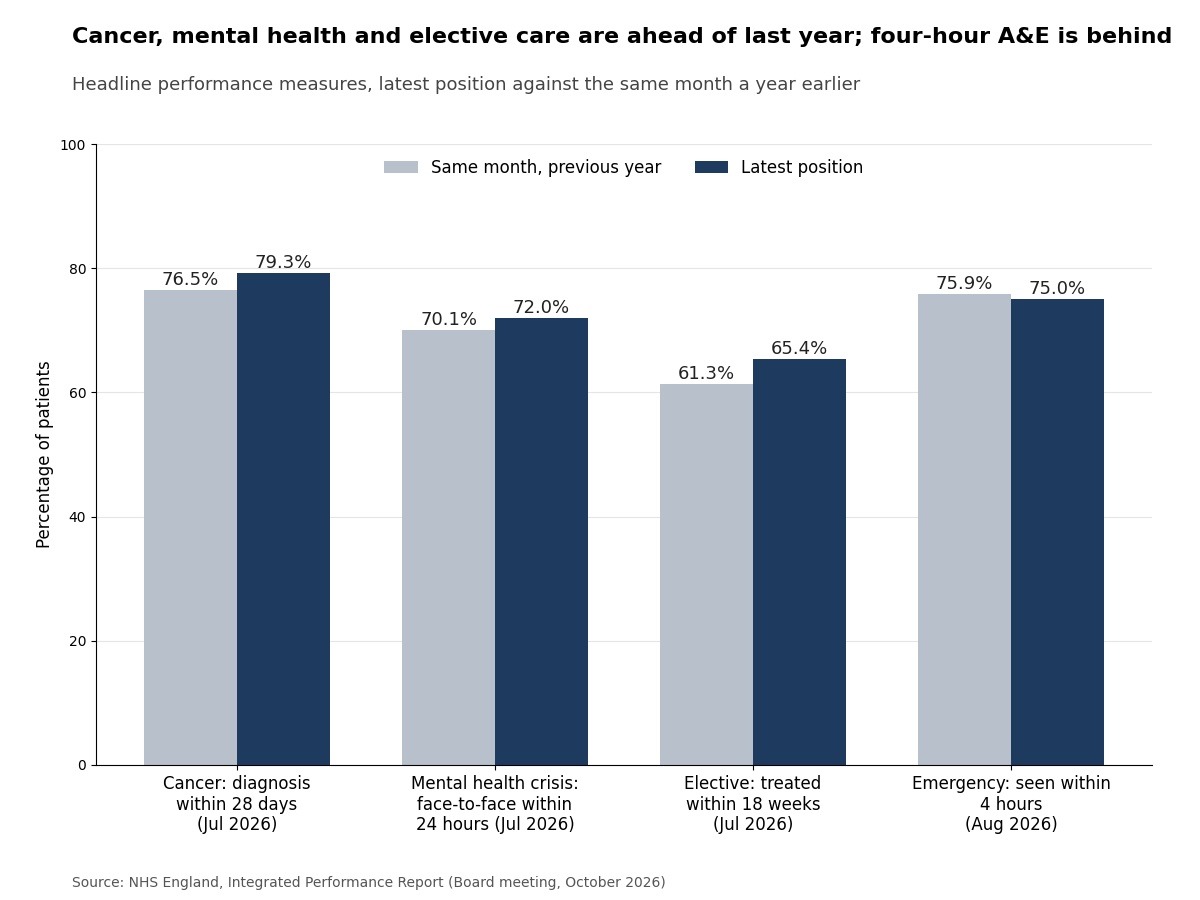
Emergency performance has slipped to 75.0% of patients admitted, transferred or discharged within four hours, and more than 9% wait over 12 hours. The elective waiting list stands at 7.33 million, with 65.4% of patients treated within 18 weeks, a slight month-on-month deterioration. Against this, 79.3% of cancer patients receive a diagnosis within 28 days, 72.0% of urgent mental health referrals receive face-to-face contact within 24 hours, and community services delivered 7.29 million contacts in a single month, up 8.7% on the previous year. The pattern is uneven in a way that deserves attention. Services with protected focus and clear national targets are improving. Services whose performance depends on movement through the whole system are not.
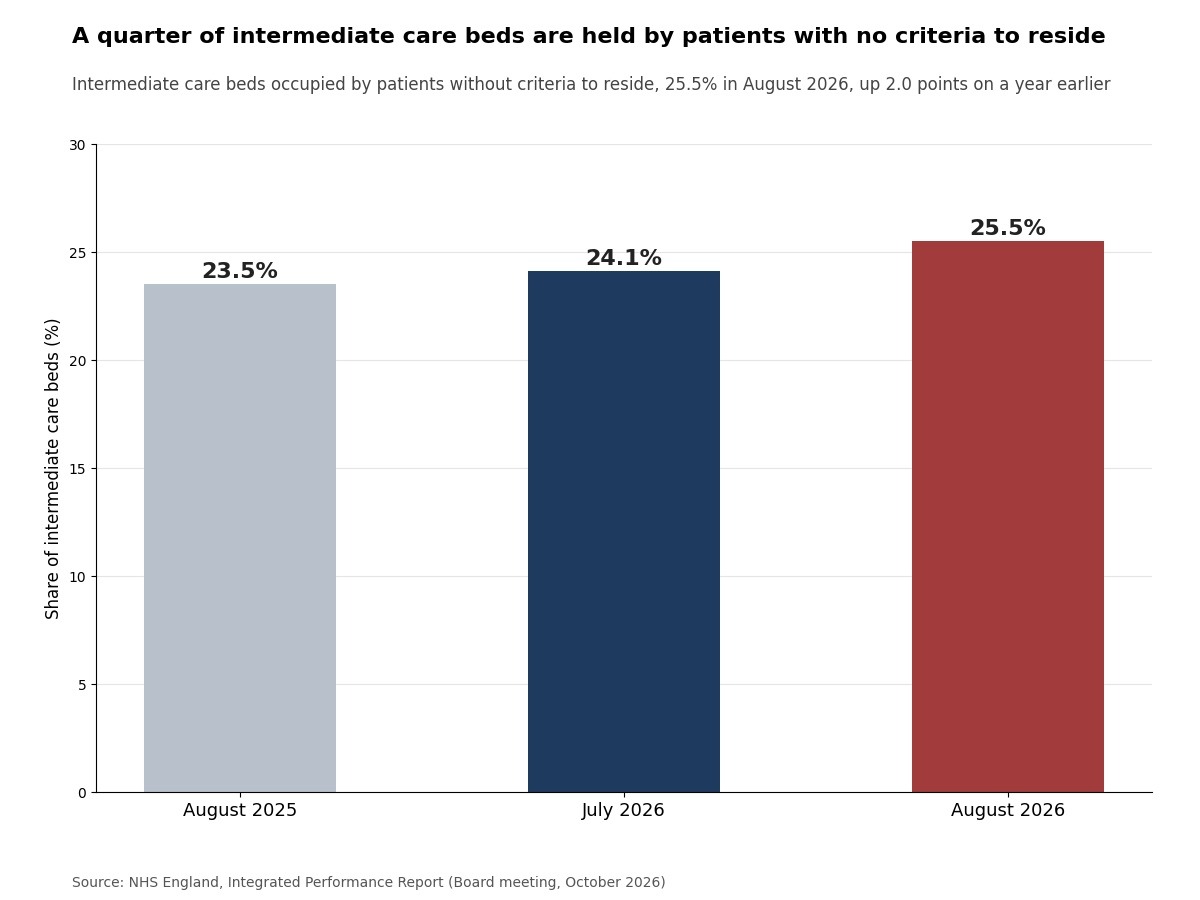
The figure that best explains the difference is the 25.5% of intermediate care bed occupancy taken up by patients with no criteria to reside. A quarter of the beds intended to speed recovery are held by people who cannot move on. That is a problem of social care, community capacity and local authority funding, and no hospital chief executive can resolve it from inside the hospital. Yet the four-hour standard remains the measure by which acute trusts are judged publicly. Leaders are held to account for outcomes they control only in part, while the bodies that control the rest work to different budgets and different timetables.
The financial position follows a similar logic. An overspend of £194 million is 0.3% of allocation, which is modest in proportion. Its composition is more informative. Providers and local care boards have overrun by £231 million, driven by the cost of industrial action, shortfalls against efficiency targets and elevated bank staffing spend. Thirteen organisations have had second-quarter deficit support withheld, totalling £19 million. Withholding funds is a legitimate instrument of financial control and the sums are small. The signal is larger than the money, because the organisations most likely to miss plans are often those facing the heaviest demand and the thinnest workforce. Pressure applied there risks raising agency and bank reliance rather than lowering it.
The workforce indicators suggest where the strain is landing. The staff survey advocacy score has slipped to 6.64 out of 10, confidence in raising safety concerns has fallen to 6.37, and sickness absence is 5.04%. General practice capacity is flat at 45.8 full-time equivalent GPs per 100,000 patients. Patient safety measures remain stable, with fewer inpatient hip fractures and lower rates of MRSA and E. coli infection, and that record is creditable. A service in which staff feel less able to speak up is drawing on that record, however, rather than adding to it. The rise in delayed planned inductions to 52.9 per 1,000 deliveries is a small number worth watching in a specialty where public trust is already fragile.
The practical implications differ by audience. NHS leaders should expect winter to test discharge capacity before it tests bed numbers, and should press integrated care boards for shared flow targets that reach into community and social care. Policymakers face a design question about whether national oversight can be rebuilt around system outcomes, so that responsibility sits with whoever holds the lever. Health-tech and life sciences businesses have a clearer case when they offer discharge coordination, community capacity planning or workforce deployment than when they add another entry point to an already overwhelmed front door. Patients will continue to see the divergence as variation by place and by pathway, with a fast cancer diagnosis and a long wait for a bed both possible within the same hospital.
The report describes a service that improves when a task is bounded and stalls when a task is shared. The next stage of reform will be judged on whether accountability is redrawn to match where control actually lies. Until it is, a winter of demand will fall on organisations already running hot, and the blame will land on the people least able to change the outcome.



.jpg)
.jpg)