
A woman leaves a maternity unit the day after a caesarean section with a leaflet and a number to ring. Nobody has had time to explain what the next fortnight might look like. Ten days later, a headache she has put down to exhaustion produces a blood pressure reading that sends her to an emergency department. Her baby is at home with her partner. In the statistics she becomes a readmission, one of roughly one in nine women now returning to hospital within six weeks of giving birth in England.
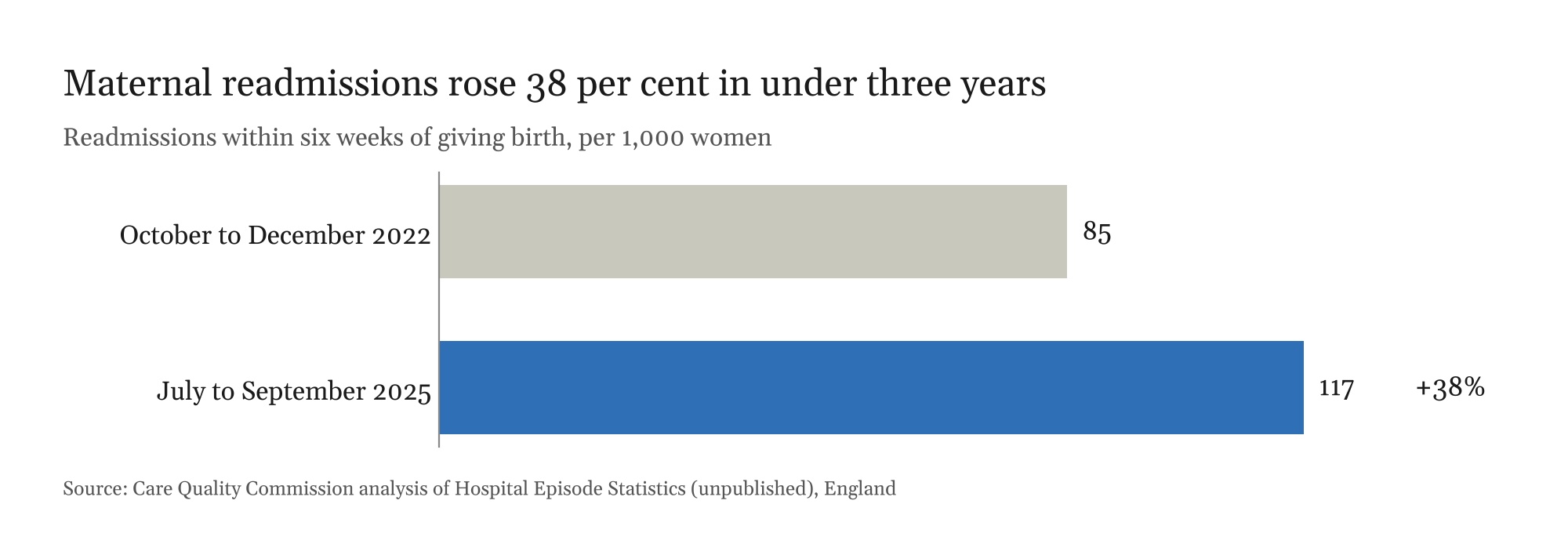
The scale of that shift is easy to understate. Regulator data show the readmission rate rising from 85 per 1,000 women in the last quarter of 2022 to 117 per 1,000 in the third quarter of 2025, an increase of 38 per cent. It rose in ten of the eleven quarters between, and stands at the highest level since the series began. The Royal College of Midwives and the Royal College of Obstetricians and Gynaecologists point to more caesarean sections, which carry a higher risk of postnatal complications, together with staffing gaps in postnatal services and pressure on community and primary care. Those explanations are plausible. They leave a harder question largely untouched, which is who is bearing the cost.
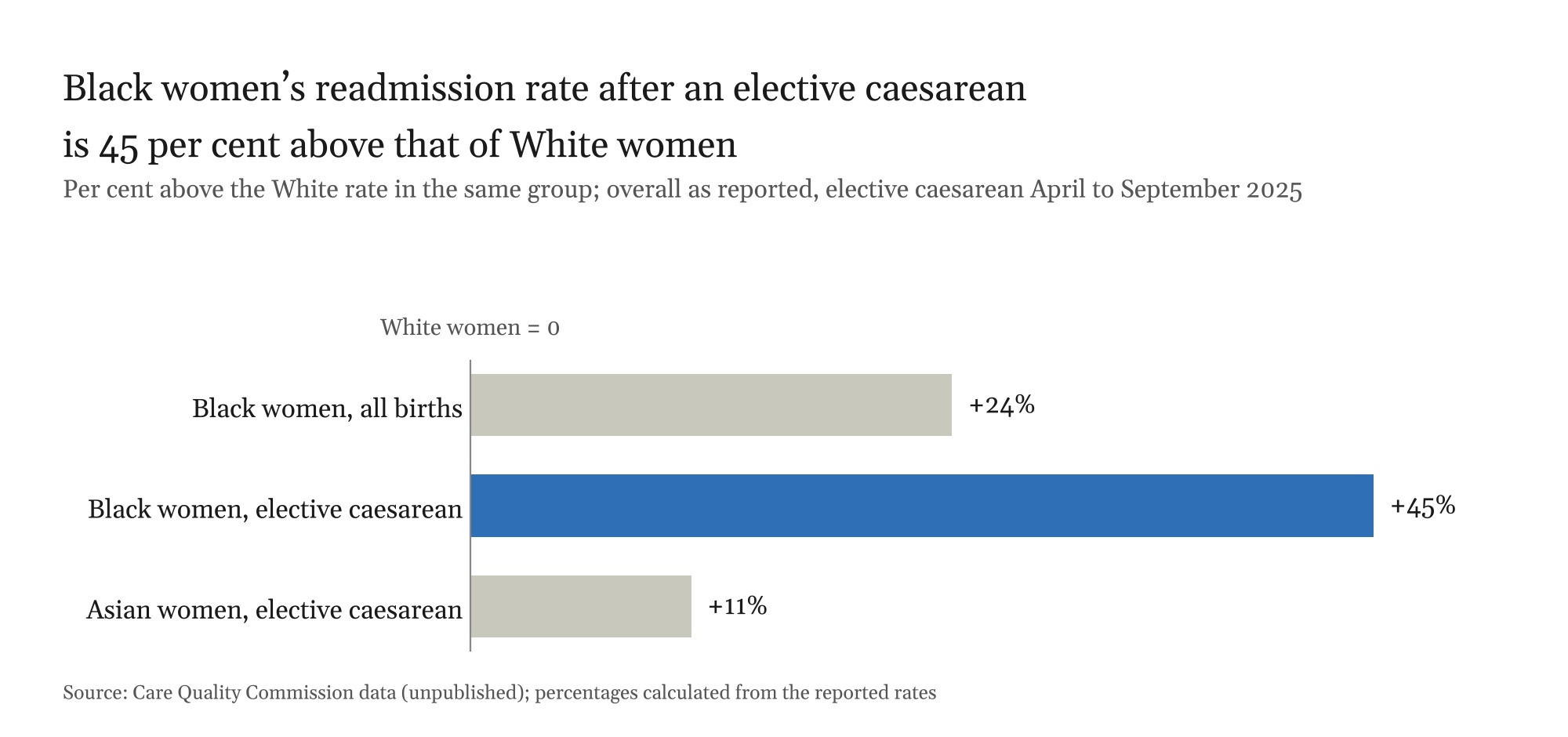
The answer is uneven. Black women had the highest overall rate at 138 per 1,000, against 111 for White women. Over the period, rates rose by 45 per cent among Asian women and 51 per cent among women in other ethnic groups, widening the gap with White women. After an elective caesarean the contrast sharpens: 183 per 1,000 Black women were readmitted, nearly one in five, compared with 140 for Asian women and 126 for White women. Set that beside the White rate after an emergency caesarean, 147 per 1,000, and an awkward fact emerges. A Black woman who had a planned operation was more likely to be readmitted than a White woman who had an unplanned one.
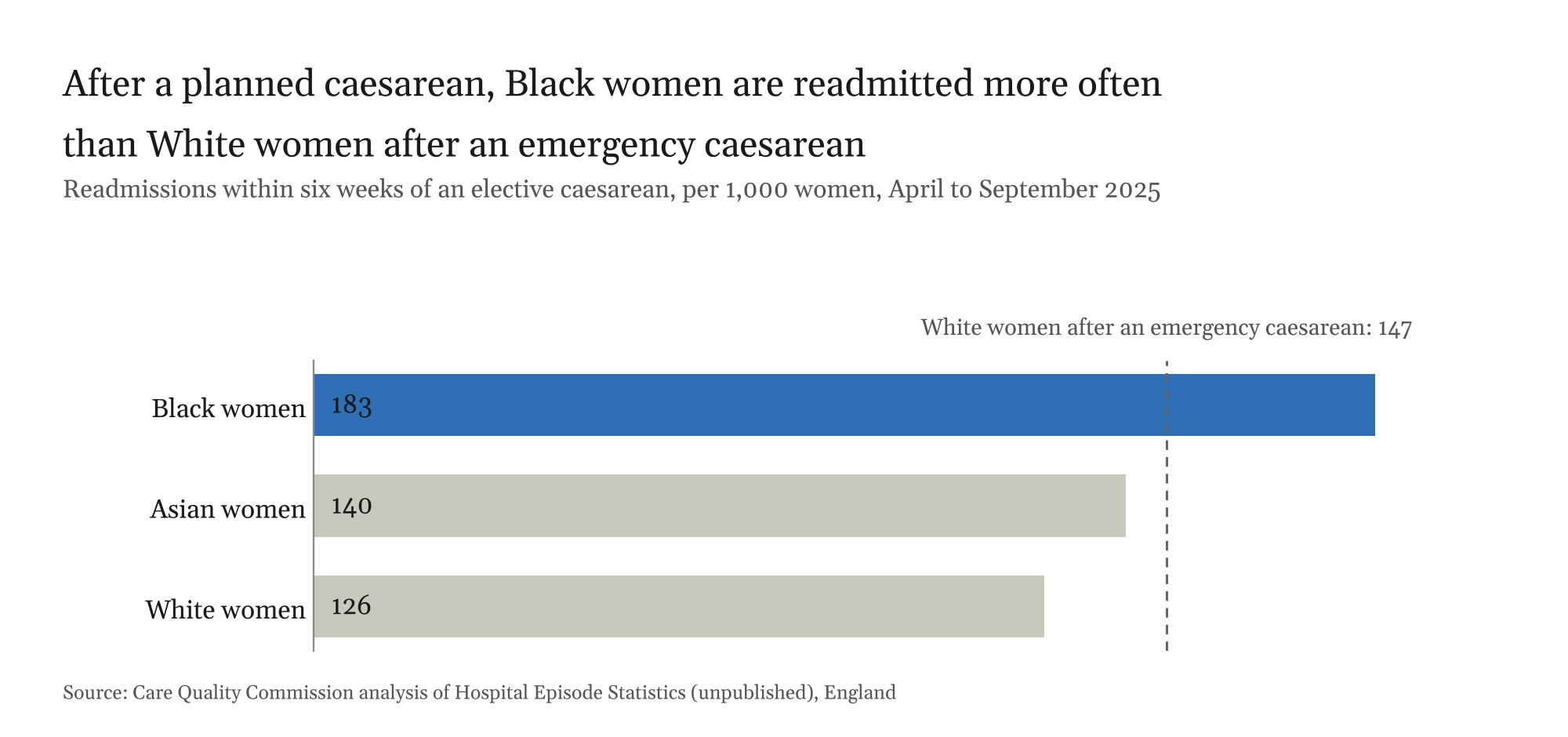
That comparison matters because it weakens the most convenient explanation. If delivery method accounted for the gap, comparing women who had the same type of birth would make it disappear. Among elective caesareans it does not. The published figures appear to be unadjusted, so age, deprivation, pre-existing conditions such as hypertension and diabetes, and the timing of first booking will explain some of the difference, and honest analysis should say so. Yet those factors are themselves markers of preventable risk, and none obviously accounts for a gap that peaks after the most predictable and best prepared episode in maternity care.
The NHS Race and Health Observatory reads the pattern as consistent with symptoms being dismissed. The data cannot prove that, but a plausible mechanism is available. A woman whose concerns are minimised in the days after discharge is likelier to present later and sicker, and a readmission is what late presentation looks like on a spreadsheet. Postpartum hypertension, infection, haemorrhage and mental health crises can emerge only once a woman is home, and the outcome depends on whether anyone is positioned to hear about them and act.
This is where the national picture matters. Postnatal wards draw on the same midwifery workforce as labour wards, and when the system is stretched, staff move towards the births and away from the women who have already delivered. Early discharge, meanwhile, is a throughput decision made under bed pressure. The Royal College of Midwives describes postnatal care as the Cinderella of maternity services and wants postnatal wards staffed safely in their own right. The financial logic supports it, though it is seldom stated. A readmission is an emergency episode that consumes the bed days early discharge was meant to release, so the saving looks smaller once the return journey is counted.
The regulator adds context that leaders will recognise. Of 51 maternity services rated under its current framework, 67 per cent were rated requires improvement or inadequate for safety, though it prioritised services where its data suggested greater risk, so the figure should not be read as a national average. Maternity remains among the most politically exposed parts of the NHS after repeated inquiries into avoidable harm, and a national maternity and neonatal action plan is due. The colleges want it underpinned by ring-fenced funding and safe staffing commitments. Trust leaders have seen what happens to ring-fences under deficit pressure, and a commitment that does not reach the postnatal ward will not move this number.
Several practical steps follow. Trusts can examine discharge after caesarean section, with a named contact in the first days and blood pressure checks for women at higher risk, and they can review that pathway by ethnicity before anyone asks them to. The national bodies should publish readmission rates by ethnicity and delivery method at trust level, adjusted for case mix, because this finding arrived as unpublished analysis rather than as routine information that boards see. Health-tech and life sciences firms have an opening in remote monitoring of postpartum blood pressure, provided their products are validated across skin tones and communities. Pulse oximeters that read less accurately on darker skin are a warning of how a device can entrench the disparity it was bought to reduce.
Readmission is a crude measure, but it records what the NHS has chosen to resource in the weeks after birth, and the gap records who pays for that choice. A service that cannot yet say why a planned operation returns Black women to hospital more often than an emergency one returns White women has a data problem and a trust problem, and the second will not wait for the first to be solved. Closing the gap begins with counting it properly and ends with someone on the ward having time to listen.