
A GP in a market town sends an urgent referral on a Monday morning and can estimate, with uncomfortable accuracy, how long the patient will wait. The estimate surprises nobody in the building. Less often discussed is how that wait looks beside other health systems, and what it will cost the Exchequer over the next quarter of a century.
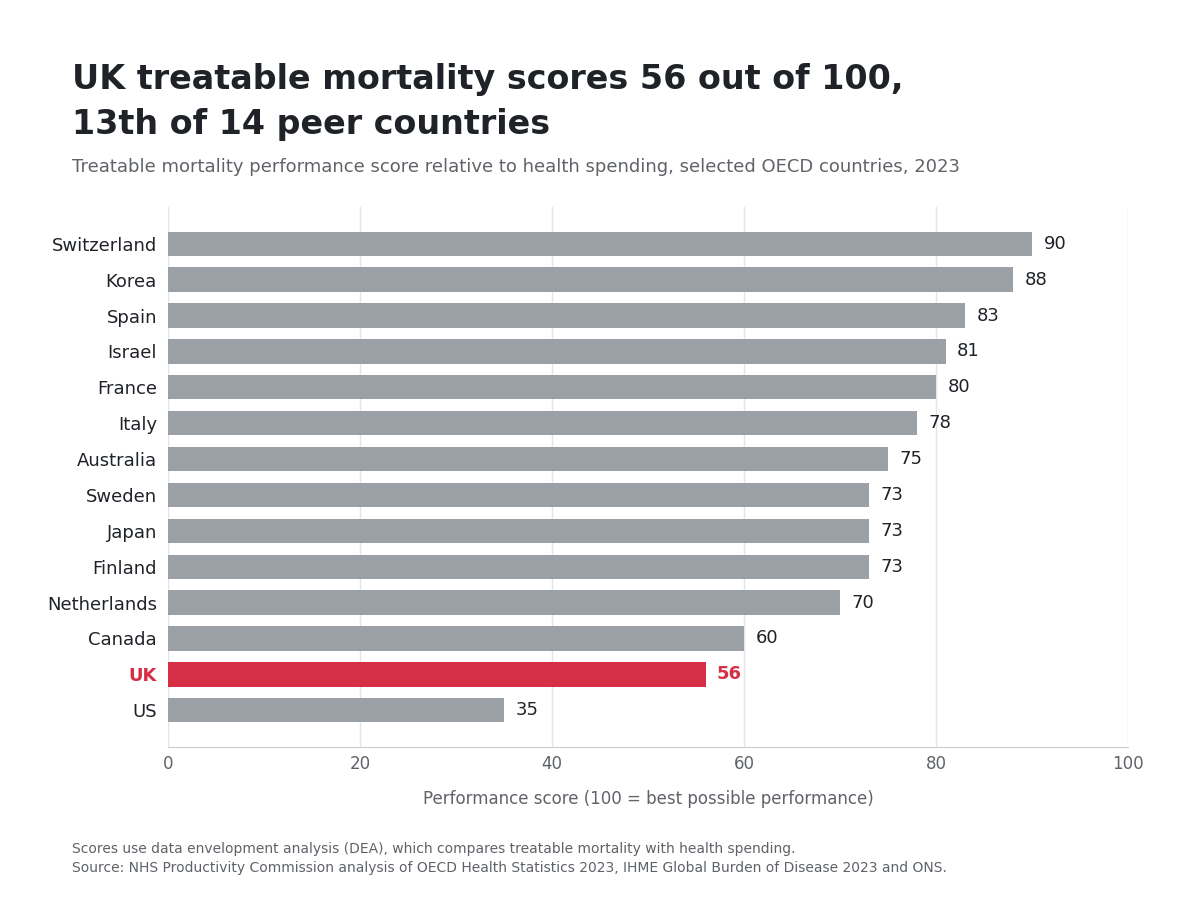
Recent comparative analysis of OECD countries scores health systems on outcomes relative to spending. On health-adjusted life expectancy the UK scores 97 out of 100, level with France and Australia and slightly behind Switzerland, Japan, Spain and Korea. That is a respectable result. On treatable mortality, which counts deaths that timely and effective care should prevent, the UK scores 56. Canada reaches 60, the Netherlands 70 and Switzerland 90. Only the United States, on 35, sits lower.
The gap between the two measures matters. Life expectancy reflects housing, income, smoking rates and much else that lies outside hospital walls. Treatable mortality sits far closer to what a health service actually does. Britain can look sound on the first and weak on the second, and the figures show it doing both. This sits awkwardly with the familiar defence that the NHS delivers fair value and simply needs more money. Adjusted for spending, it converts resources into saved lives less efficiently than most comparable systems. Data envelopment analysis is a relative technique and is sensitive to the choice of peers and inputs, so the result should prompt scrutiny and does not amount to a verdict. Even so, a ranking this low is hard to attribute to method alone.
The fiscal projections give the abstraction a price. The Office for Budget Responsibility's July 2026 analysis has health spending rising from 8.3 per cent of GDP in 2025/26 to 10.6 per cent by 2050/51 if current cost pressures persist. Without those additional pressures, the figure reaches 8.8 per cent. The difference of 1.8 per cent of GDP is a sum that would reshape any spending review. Higher productivity growth is estimated to save around £460 per person each year by 2040/41. Under fiscal rules that leave little headroom, health absorbs a growing share of whatever room exists, and schools, local government and defence compete for the remainder.
What follows for NHS leaders is uncomfortable. Productivity has been discussed for years through efficiency programmes that trusts experience as annual cuts, and clinicians rightly distrust the language. The comparison points elsewhere. The largest gains lie in pathways where timeliness determines survival, such as cancer diagnosis and cardiovascular care. Faster diagnostics, better data flow between primary and secondary care and fewer avoidable handoffs all raise output without asking staff to work harder, and staff who are already stretched have little more to give.
That requires capital, and capital is the budget most easily raided in a difficult year. Output per clinician is held down by ageing buildings, unreliable systems and scanners that cannot be staffed or serviced quickly enough. Policymakers who protect day-to-day spending while trimming investment will find the productivity gap widening while the accounts look orderly.
For life sciences and health-tech suppliers, the message is equally direct. A buyer under this kind of pressure has less appetite for pilots and more interest in evidence of throughput, measured in time saved per pathway and in waits shortened. Procurement that rewards demonstrable gains, and data standards that allow products to work across trusts, would do more for the sector than another strategy document.
Patients will notice the change in a plain way. A shorter wait for a scan or a first appointment carries none of the visibility of a headline funding announcement, yet it is where the benefit of any reform becomes real.
The temptation in Westminster is to treat the 2050 figures as distant and the 2023 score as history. The treatable mortality result describes the present, and the cost of the gap is already being paid in avoidable deaths and in a spending path the public finances cannot comfortably sustain. A health service that cannot show it turns money into outcomes at the rate of its peers will find the case for each additional pound harder to make, and public patience shorter.



.jpg)
.jpg)