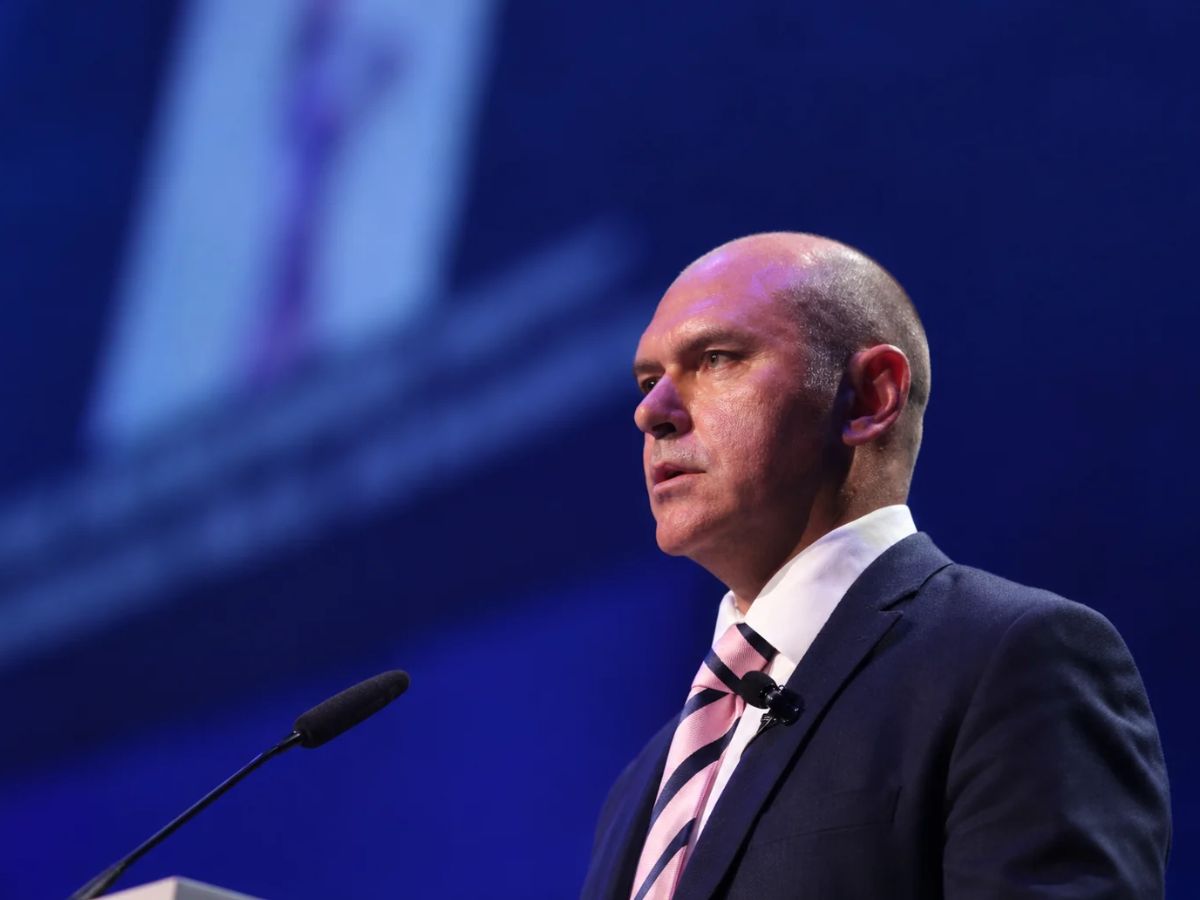
On Tuesday, the chair of NHS England, Dr Penny Dash, told her board that Sir Jim Mackey will leave as chief executive no later than the end of March 2027.
The announcement was delivered in the flat register of a board meeting. Its consequences are less flat.
Mackey goes weeks before the organisation he runs is due to cease to exist, and the vacancy has not yet been advertised.
He took the post in April 2025 on a transitional secondment. Before that he had spent from September 2021 to March 2025 as national director of elective recovery, the role in which he led the effort to bring down waiting lists. He intended to step aside at the end of October 2026 and agreed instead to remain through the winter.
Winter is when the health service is least forgiving of any gap at the top, and the extension says something about how few people the system could trust to hold the job while the ground shifts beneath it.
The succession is already tangled. Recruitment cannot begin because NHS England is waiting for sign-off from the Department of Health and Social Care to advertise.
Dr Dash has called the time left to recruit and complete a handover "very, very tight", and has described the position as one of the largest leadership roles anywhere in the world. A body that is being abolished must ask permission from the department absorbing it before it can look for its own leader. That arrangement tells you where power now sits.
The Health Bill, designed to dissolve NHS England by April 2027 and fold its functions into the department and other bodies, explains the awkwardness. Yvette Cooper, the Health and Social Care Secretary, confirmed earlier this month that the chief executive post will survive abolition. It will head an internal NHS Group within the department. The title endures, but the job it describes changes character. Since the Health and Social Care Act 2012, the chief executive of NHS England has run the service at arm's length from ministers, with a statutory identity and a board of his or her own. The successor will be a senior official inside a government department, answerable to a secretary of state who will be held directly to account for what the service does.
That has consequences for who will want the role. The pool of people with the operational record to run a system of this size is small, and most of them are currently running something else with a measure of autonomy. A candidate will want to know how much authority the post carries over trusts and integrated care boards, who controls the budget, and whether the NHS Group has its own leadership or is managed by the departmental permanent secretary. These are questions the government can answer, but it needs to answer them before it advertises, not after the first candidate asks. Delay in resolving them is probably part of why the advertisement has not gone out.
The Department of Health and Social Care has said that Mackey's tenure was always conceived as a bridge towards a permanent appointment inside the merged structure, and that he is committed to an orderly handover. That is a reasonable account of the intention. A bridge, however, needs a far bank, and at present nobody can say who will be standing on it in April. If the appointment is made in the new year, the successor will arrive with weeks rather than months to shadow an outgoing chief executive, in the same period that a large national organisation is being taken apart and rebuilt inside Whitehall. Handovers of that kind depend on overlap, and the calendar allows very little.
Mackey's particular asset has been credibility with the people who run hospitals. He came from trust leadership, he spoke bluntly about money and performance, and trust chief executives listened because he had done their jobs. That kind of authority is personal. It does not transfer by statute to whoever inherits the title. A successor will have to earn it while managing a merger, a financial settlement that leaves little slack and a workforce that has watched several years of reorganisation announcements with understandable fatigue. Staff at NHS England, many of whom face uncertainty about their own roles, will take their cue from how steadily the top of the organisation behaves in the next four months.
The implications reach beyond the boardroom. Trust leaders need to know who sets national priorities and who signs off planning guidance once the new structure takes hold. Companies in life sciences and health technology hold contracts and frameworks with NHS England, and they will want clarity on which entity is the counterparty from April and who in the department has the authority to decide. Patients and the public will not follow the machinery. They will notice whether waiting times continue to fall, whether winter pressure is managed and whether somebody visible is answerable when it is not.
That last point is the heart of the matter. The case for abolishing NHS England rested on duplication and on a belief that ministers should hold the levers they are blamed for. The case is coherent. It also removes a buffer that has absorbed political heat for more than a decade. When a chief executive stood between the secretary of state and a failing hospital or a missed target, ministers could point to an independent body with its own board. Once the post sits inside the department, that distance disappears, and the person occupying it will be a civil servant whose performance is the government's performance.
Mackey's exit is therefore the first test of whether the new settlement works as designed. The government has fixed the date, and it has said the post will continue. What remains is to make it a job that an exceptional candidate would accept, with defined powers and a clear line to the secretary of state, and to fill it early enough for a handover that means something. If that does not happen, ministers who abolished the buffer will find themselves at the despatch box with the waiting list and nobody beside them who can explain it.