Sixteen years of argument about the NHS have returned again and again to the same image, the swollen bureaucracy that absorbs money meant for patients. New analysis from The King's Fund tests that image against the workforce data, and the data point elsewhere. The NHS in England now employs 36 full-time equivalent staff for every manager. In 2010 the ratio was 28 to one. That is a rise of 26 per cent, and it describes a management tier that has become thinner at the moment the service is asking more of it.
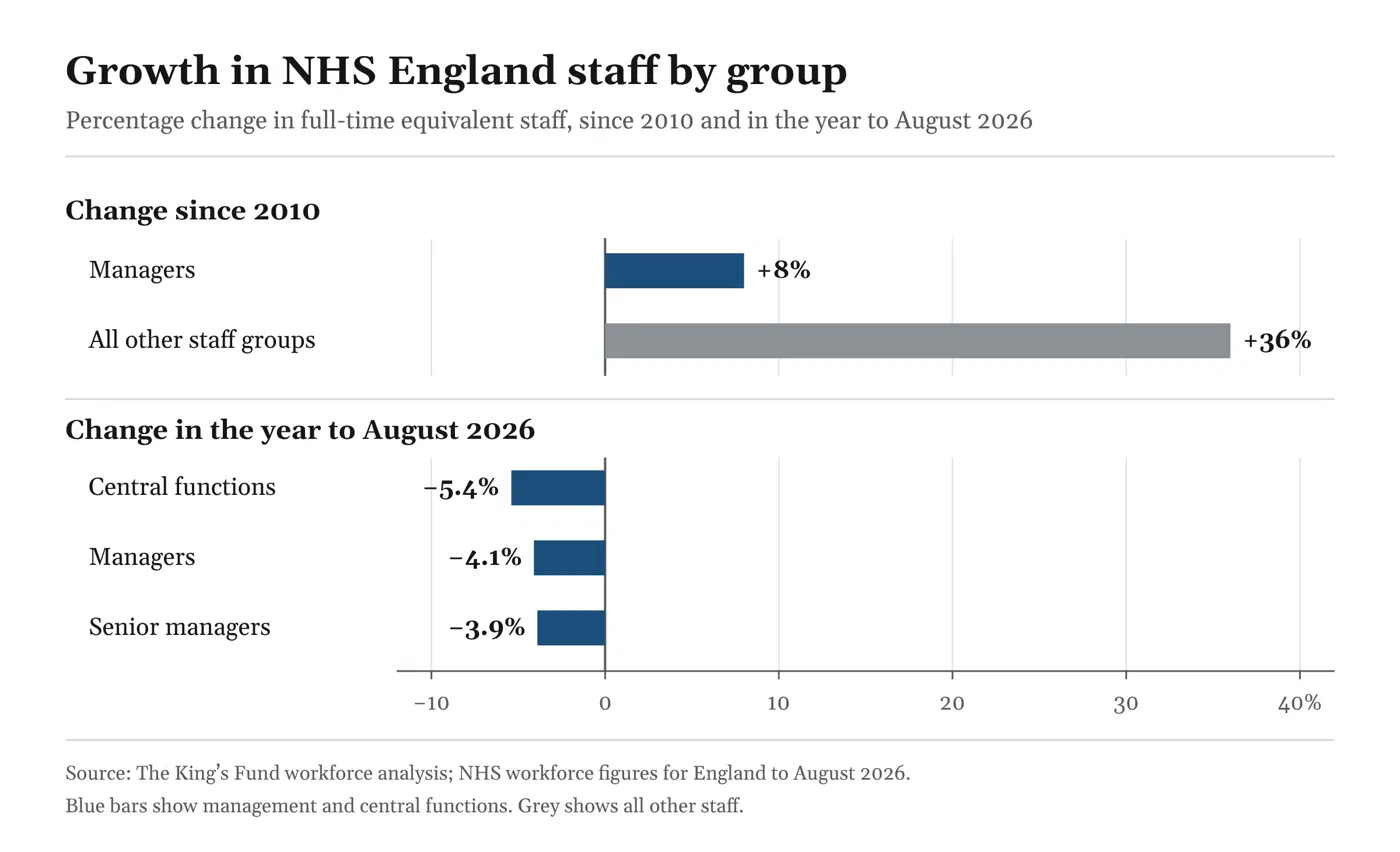
The divergence is easy to state. Since 2010 the number of managers in the English NHS has risen by 8 per cent, while all other staff groups combined have grown by 36 per cent. Official figures put formal managers at roughly 3 per cent of the total workforce. A tier that has grown at less than a quarter of the pace of everyone around it, and that accounts for roughly one post in thirty, is hard to describe as the source of the service's difficulties. Management remains a fair subject for scrutiny, and that scrutiny should begin from the right numbers.
The timing gives the finding its weight. Over the past year trusts and integrated care boards have trimmed administrative and leadership posts to hold their finances together, a response with obvious appeal, since removing a manager looks less like a cut to care than closing a ward. Annual workforce figures to August 2026 show the effect. Central functions have shrunk by 5.4 per cent, managers by 4.1 per cent and senior managers by 3.9 per cent. Those are substantial reductions for a group that was already small, and they arrive with the ratio already standing at 36 to one.
The King's Fund concludes that claims of the NHS being overmanaged are unfounded. Its warning runs the other way. When management capacity lags behind the growth of the clinical workforce, the work of running the system does not disappear. It becomes harder, slower and more dependent on goodwill, and administrative bottlenecks multiply. The NHS Productivity Commission took a similar position in September 2026, describing the service as undermanaged and cautioning that trimming administrative support risks weakening clinical teams and the delivery of patient care. Two separate assessments now point the same way.
A wider ratio carries a human cost that rarely appears in workforce tables. Each remaining manager is responsible for more staff, more targets and more reporting, in organisations where leadership turnover is already a recognised concern. Spans of control that look efficient on a spreadsheet can leave little time for the unglamorous work that keeps a hospital functioning, such as settling a rota dispute before it becomes a grievance or noticing that a ward's discharge process has stalled. Those tasks seldom feature in national targets, and they are the first to slip when capacity tightens.
The practical consequences sit where patients and ministers are most likely to feel them. Elective recovery depends on theatre scheduling, outpatient booking, waiting list validation and discharge coordination, work done largely by people who do not appear in clinical headcounts. Digital programmes, procurement and data sharing agreements need commissioning skill and careful contract management, and a trust with a thin corporate centre will struggle to run them well. The government's reform agenda, with its reorganisation of national and regional structures and its demand that integrated care boards reduce running costs, assumes that a smaller administrative layer can carry more responsibility. That assumption deserves testing before it is built into further plans, because the data suggest the layer is already stretched.
Public expectation compounds the difficulty. Voters and many politicians carry a settled belief that the NHS has too many managers, which makes administrative cuts easy to announce and slow to reverse once the consequences show. Accountability is affected as well. Ministers expect trusts and boards to report on waiting times, finances and quality, and that reporting is produced by the same corporate teams now being reduced. The reforms on the table, from neighbourhood health models to wider use of data and technology, need people to design, contract and monitor them. A health service short of that capacity can still announce reform. Delivering it is another matter.
For life sciences and health technology companies the point is commercial as much as political. Adoption in the NHS depends heavily on the capacity of buyers to evaluate and procure products, whatever their quality. Fewer managers in trusts and boards mean longer sales cycles and more pilots that never reach scale. NHS leaders face a related problem from the other direction. Cuts to corporate functions deliver a saving on paper, and the cost reappears as clinical time spent on rotas, forms and coordination, which is far more expensive per hour.
The headline ratio also has limits. Official headcounts record formal management posts and miss the leadership carried out by clinicians. Medical directors, clinical leads and senior doctors take on hybrid or informal responsibilities for rotas and service redesign, and none of it registers in the manager count. Reaction among frontline doctors reflects that ambiguity. Some contend that clinicians already absorb substantial administrative work that no headcount captures. Others see the data as proof of an under-resourced management tier. The two readings are compatible, and they describe the same gap from opposite sides.
The sensible reading of the evidence is that management capacity has become a constraint on delivery, and a constraint should be measured before it is cut. Ministers who want waiting lists to fall and budgets to balance should ask what the administrative base beneath that ambition can bear. NHS leaders should be able to show what each post does before it goes. A service cannot be asked to recover access and live within its means while the people who organise the work are the first to leave it.