Ambient voice technology has moved remarkably quickly from AI experiment to serious NHS technology category. Across acute hospitals, mental health services, community providers, specialist centres and ambulance trusts, clinicians are beginning to use AI to capture consultations and generate clinical documentation.
But the more interesting story is what happens when you look across the NHS rather than at individual pilots. There is already a sizeable competitive market, and although several companies are pulling ahead, there is still no single dominant platform.
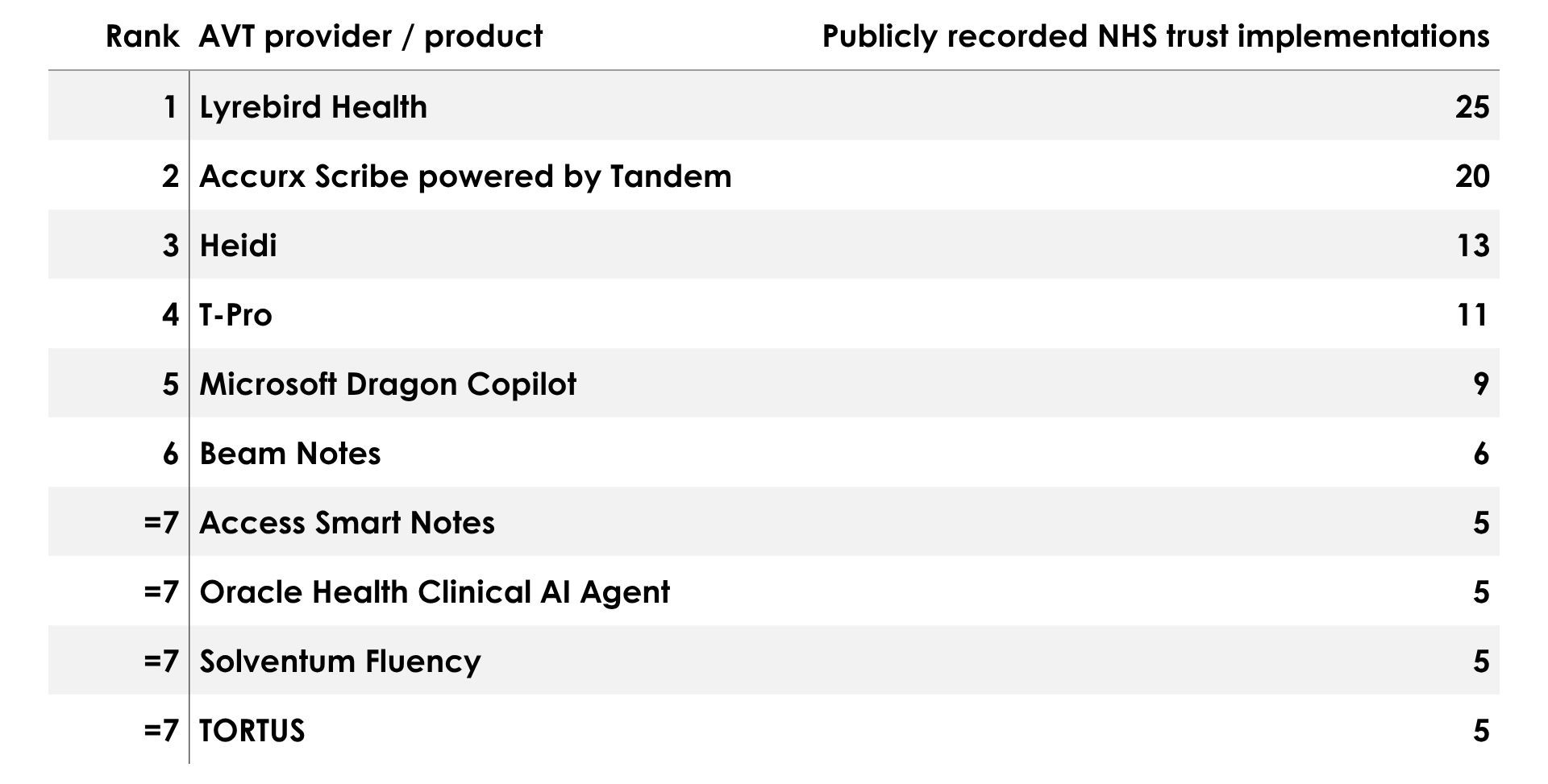
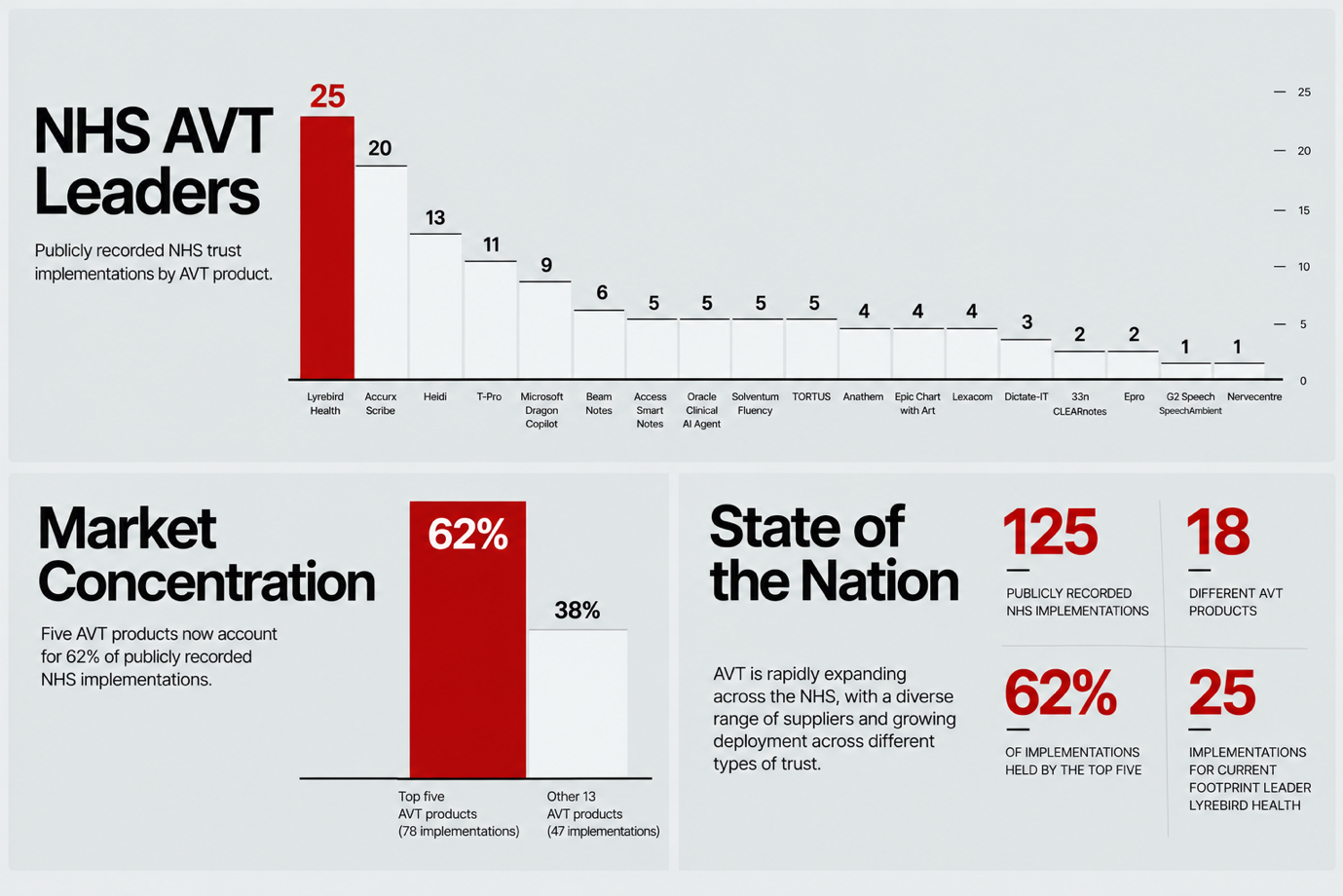
NHS Tech Register data records 18 different AVT products and 125 implementations. Lyrebird Health currently has the largest publicly recorded NHS trust footprint with 25, followed by Accurx Scribe with 20, Heidi with 13, T-Pro with 11 and Microsoft Dragon Copilot with nine.
A Leading Pack Is Emerging
The first thing the numbers reveal is that AVT is no longer an evenly distributed field of experiments. Lyrebird and Accurx alone account for 45 recorded implementations, while the five largest products collectively account for 78; around 62% of the entire dataset.
There is then a sharp drop. Lyrebird leads with 25 implementations, Accurx has 20, Heidi 13, T-Pro 11 and Microsoft nine. After Microsoft, no individual product has more than six recorded implementations.
That creates the beginnings of a three-tier market: two footprint leaders, a group of serious challengers and a highly fragmented long tail. The top five have meaningful scale, but the remaining 38% of recorded implementations are distributed across another 13 products.
The NHS Isn’t Picking One Winner
The supplier leaderboard only tells half the story, because NHS trusts are not necessarily selecting one AVT platform and standardising around it. The underlying trust data shows multiple products operating inside the same organisations.
East London NHS Foundation Trust is associated with T-Pro, Microsoft Dragon Copilot and Anathem. Lancashire and South Cumbria is associated with Accurx, Heidi and Access Smart Notes, while Mersey Care has Lyrebird, T-Pro and Access Smart Notes recorded.
This suggests that the NHS is still in a period of comparison and experimentation. Different specialties can have different requirements, individual departments can trial different platforms, and organisations can evaluate competing products before making broader decisions.
For suppliers, getting through the door therefore isn't necessarily the same thing as winning the account. The bigger prize will be converting initial adoption into repeatable, organisation-wide deployment.
AVT Has Escaped the Acute Hospital
This is also becoming a much broader technology category than simply “AI notes for doctors”. The dataset shows AVT appearing across acute, mental health, community, specialist, children's and ambulance organisations. Examples range from Great Ormond Street and The Christie to London Ambulance Service, North East Ambulance Service, Oxford Health and numerous community and mental health providers.
That matters for the potential size of the market. If ambient AI proves valuable across mental health assessments, community care, ambulance documentation, specialist consultations and multidisciplinary services, the opportunity becomes considerably larger than conventional outpatient transcription.
The Next AVT War Won’t Just Be About the Best AI
The competitive landscape contains two very different types of company. Specialist and AI-native businesses such as Lyrebird, Heidi and TORTUS are competing alongside much larger clinical technology ecosystems including Microsoft, Oracle, Epic and Access. The current numbers demonstrate that specialists can build significant NHS footprints. Lyrebird currently has almost three times Microsoft's recorded implementations, while Heidi has also established a substantial position in the market.
The larger technology companies, however, have another weapon: distribution and integration. If ambient functionality becomes embedded directly inside the systems clinicians already use, AVT could eventually stop being a separate technology purchase altogether.
That is where the competitive battle starts to become more interesting. The question shifts from who has the best AI scribe to who can make ambient intelligence part of everyday clinical workflow.
From Scribe to Infrastructure
The first phase of AVT has largely been about whether AI can listen accurately, understand clinical language and generate a useful note. As those capabilities become increasingly common, differentiation is likely to move elsewhere.
Integration with clinical records, structured data capture, downstream automation, specialty-specific workflows, governance and demonstrable productivity gains will become increasingly important. Trusts will also need to determine whether maintaining several overlapping AVT products makes sense once experimentation gives way to scaled deployment.
The NHS market therefore appears to have reached an important transition point. There is enough adoption to identify meaningful leaders, but still enough fragmentation that the eventual structure of the market remains wide open. Lyrebird currently leads on publicly recorded NHS footprint, with Accurx close behind and Heidi, T-Pro and Microsoft forming the next group. But the bigger finding is what sits underneath the ranking: 125 recorded implementations, 18 competing products and NHS organisations still experimenting with multiple approaches.
The first AVT battle was proving that the technology works. The next will be about who can turn it into infrastructure.


.jpg)