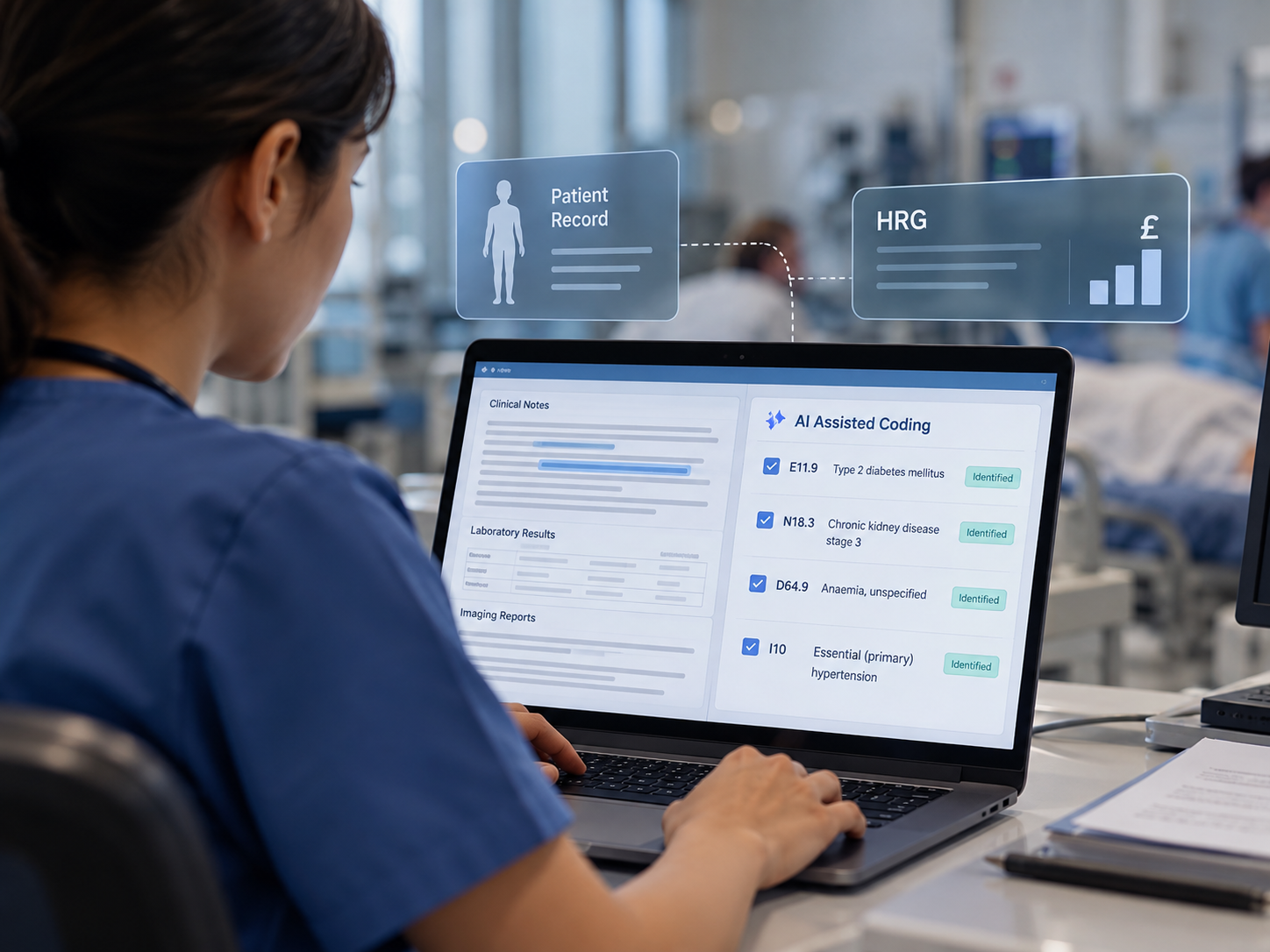
Artificial intelligence is beginning to change one of the least visible but most important parts of healthcare: the moment when a clinical story becomes data, and data becomes money. In the United States, that relationship has suddenly become very real. Blue Cross Blue Shield says increasing coding complexity was associated with an estimated $942 million in additional expenditure between 2023 and 2025. More patients were recorded with secondary conditions and moved into more expensive billing categories, while the treatment recorded did not appear to change in the same way. That does not automatically mean hospitals are coding incorrectly. AI may simply be finding clinical detail that used to be missed. But it raises a very NHS question: could AI become a new form of PbR?
What is happening in America is relatively simple. Hospitals are increasingly deploying AI to examine clinical records, laboratory results, physician notes and other data. The technology can identify diagnoses or comorbidities that humans may previously have missed. A secondary diagnosis can matter financially. Anaemia, renal impairment, electrolyte abnormalities or the severity of another condition may all change the coded picture of a patient when properly documented.
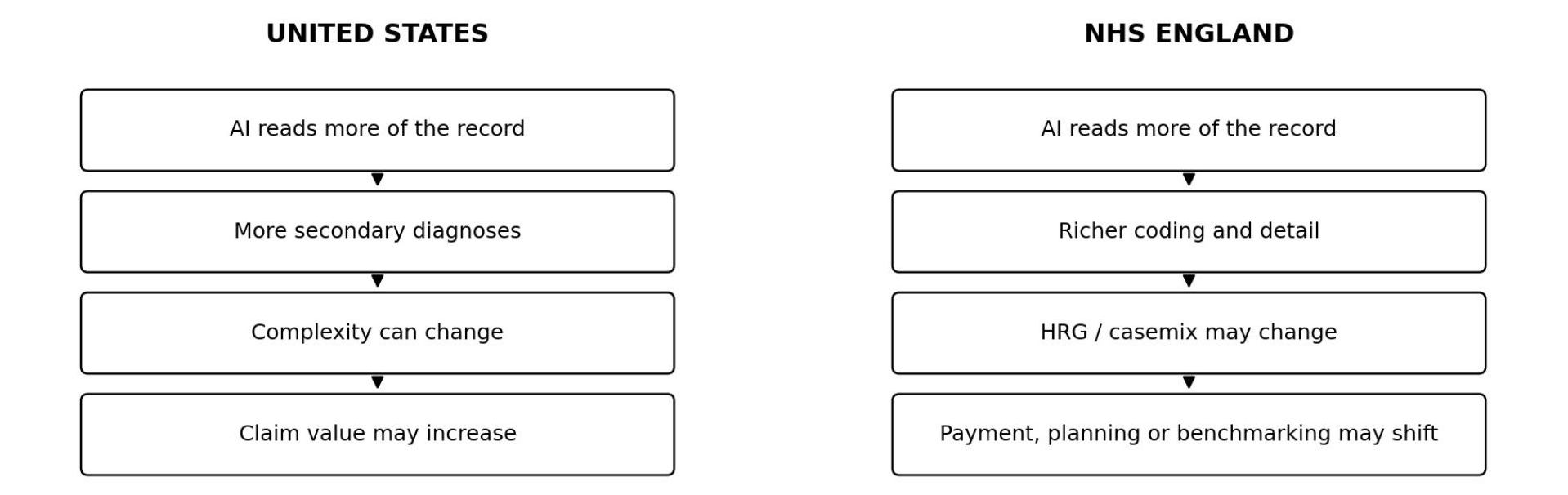
The important point is that AI does not need to invent a diagnosis for expenditure to rise. It simply needs to find more of what is already there, and find it consistently. In a reimbursement system in which coded complexity influences payment, a richer clinical record can become a richer claim. At scale, that turns documentation quality into an economic issue as well as a clinical one.
The patient may be identical. The treatment may be identical. What changes is the data describing the patient.
The United States reimbursement system is very different from the NHS, but the underlying mechanism should sound familiar to anyone who lived through the rise of Payment by Results. PbR changed the relationship between activity, coding and hospital income in England. Rather than relying only on block funding, payment increasingly followed what hospitals actually did. A clinical episode generated diagnosis and procedure codes. Those codes were grouped into a Healthcare Resource Group, or HRG, which represented clinically similar treatments expected to consume similar levels of resource. A nationally determined tariff could then be attached to that activity.
That made the clinical record economically important. Better documentation could change coding. Coding could change the HRG. The HRG could change the value attached to the episode. PbR itself is no longer the formal national payment architecture. The National Tariff replaced it, and the NHS Payment Scheme followed from 2023. But the basic relationship between clinical information, currencies, HRGs and activity value has not disappeared. Elective activity in particular still has a strong variable payment component linked to NHS Payment Scheme unit prices.

Imagine two clinically similar NHS trusts. Trust A documents care largely through traditional workflows. Trust B introduces ambient AI across thousands of consultations and combines it with intelligent coding support. The AI hears more, reads more and connects more. It may identify the severity of chronic kidney disease from previous notes, surface a relevant secondary diagnosis buried in the record, or prompt a clinician where additional specificity is appropriate.
Suddenly Trust B has richer data. Its patients may start appearing more complex. Its HRG distribution could move. Its casemix may shift. Where activity is linked to unit prices, there may also be a financial consequence. That does not imply gaming. It may simply mean that one organisation has become materially better at describing the work it was already doing.
There is a strongly positive interpretation. Healthcare may have been under-documenting patient complexity for years. Clinicians are busy, notes vary and comorbidities can be missed. Coding teams can only code what is supported by the record. AI could close that gap and give the NHS a more accurate picture of the patients it is actually treating.
That could improve far more than reimbursement. Better clinical data could strengthen research, population health management, workforce planning, service design and comparisons between organisations. A hospital treating older, frailer patients with several long term conditions may finally have the true complexity of that work represented more accurately. The opportunity is significant. The challenge is understanding when a change in recorded complexity reflects a change in patients, and when it reflects a change in documentation.
Every trust deploying ambient documentation or AI assisted coding should be able to answer that question. A small set of measures could be tracked before and after implementation:
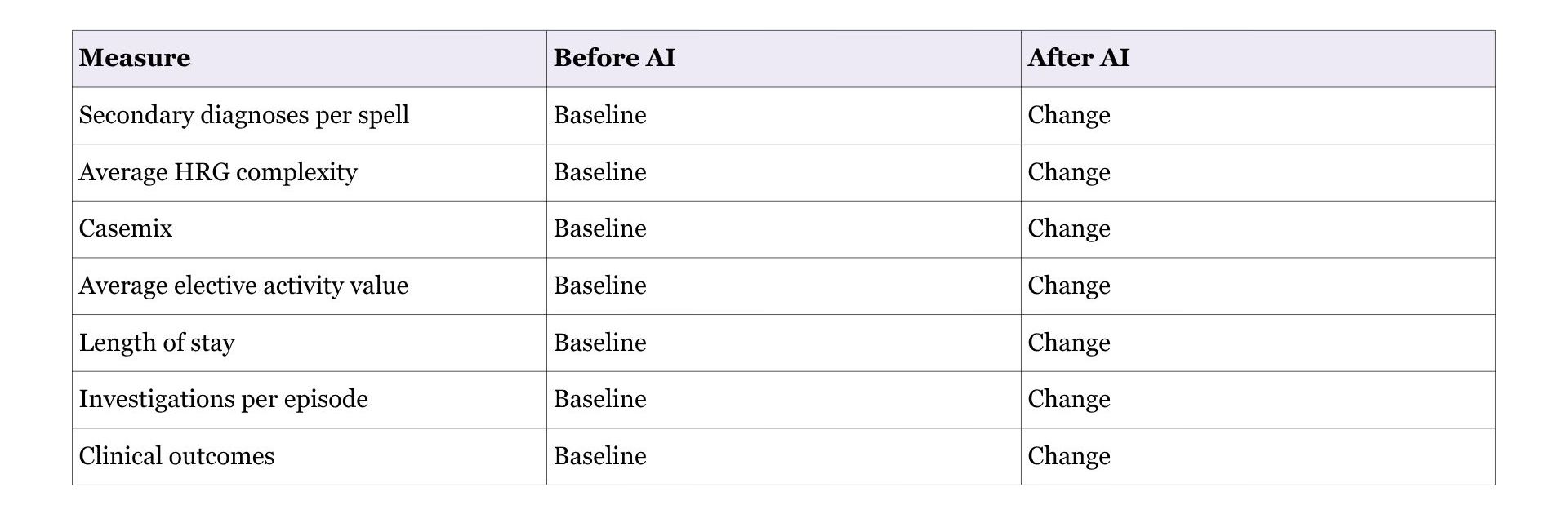
If diagnoses rise but treatment intensity does not, that tells us something. If HRGs change while patient characteristics remain stable, that tells us something else. Neither automatically indicates a problem, but both deserve to be understood. The NHS has the advantage of being able to learn from the American experience before a new documentation pattern becomes embedded at scale.
Perhaps that is the most interesting parallel. Twenty years ago, PbR made NHS leaders pay much greater attention to coding because coding became connected to revenue. AI could create another such moment, except this time the change may not arrive through a new payment policy. It may arrive through technology becoming dramatically better at reading what is already inside the patient record.
That could make NHS data more complete, more representative and considerably more useful. It could also alter the reported complexity and financial value of millions of episodes. For chief executives, finance directors and digital leaders, that makes this bigger than an ambient scribe debate. AI is not simply going to analyse NHS data. It is increasingly going to influence how NHS data is created.
America has given us an early glimpse of what happens when that richer data meets a reimbursement system. The NHS now has an opportunity to use that learning positively: measure the effect, understand the coding changes, protect clinical integrity and ensure that better documentation genuinely produces better intelligence. Because the next evolution of PbR may not arrive in another national payment reform. It could arrive quietly through the clinical record.
Blue Cross Blue Shield Association, analysis of AI coding tools and healthcare costs, September 2026.
NHS England, 2026/27 NHS Payment Scheme and associated payment mechanism guidance.