

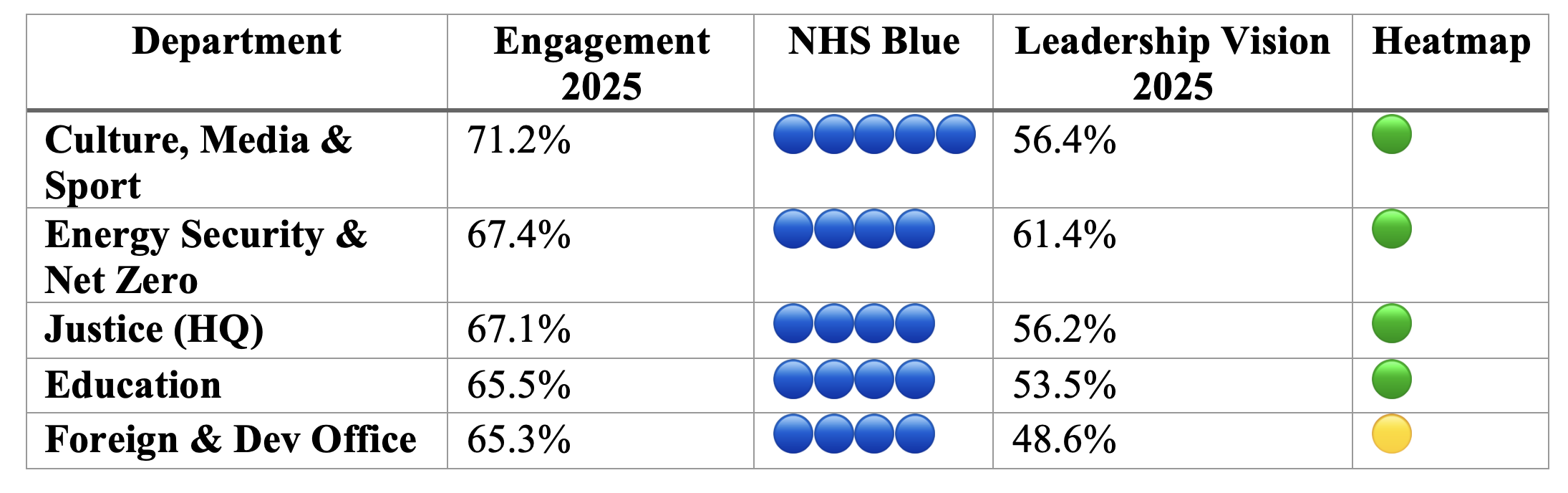
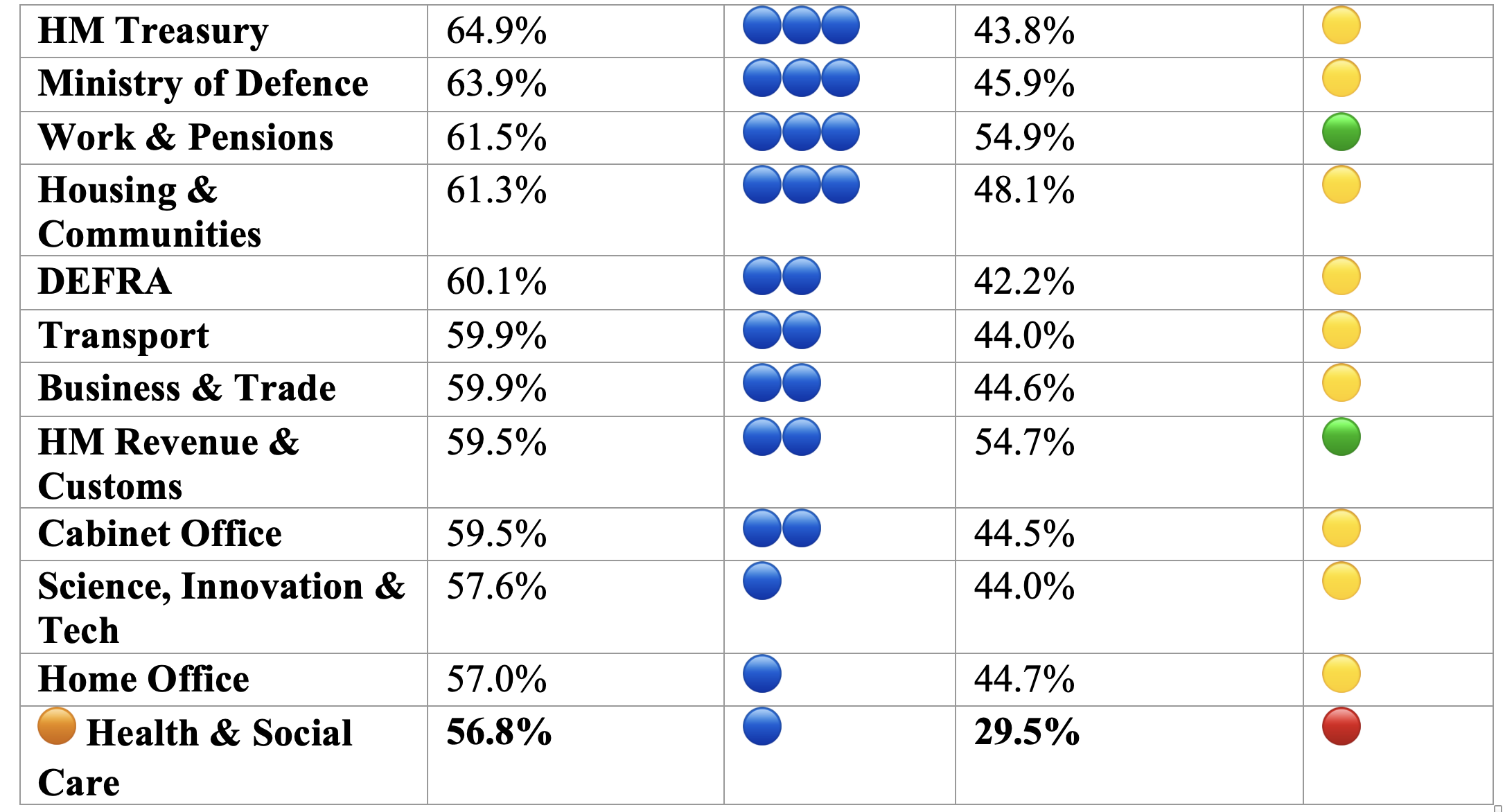
The numbers land with a thud. In the latest Civil Service People Survey, the Department of Health and Social Care has recorded the sharpest collapse in leadership confidence across Whitehall. Just 29.5 per cent of staff now agree that senior leaders have a clear vision for the future of the organisation, an 18.8 point plunge in a single year. Overall engagement has fallen 5.7 points to 56.8 per cent, placing the department at the bottom of the league table.
The deterioration is not marginal. It is structural. Across government, the median engagement score sits at 64.9 per cent. On the leadership vision question, the civil service median stands at 52.1 per cent. DHSC is not just below average, it is dramatically detached from the pack. Energy Security and Net Zero leads on leadership vision at 61.4 per cent. Culture, Media and Sport posts engagement above 71 per cent. Health, the department responsible for the system that employs more than a million NHS staff and consumes one of the largest shares of public expenditure, now ranks last on belief in leadership direction. At a moment when ministers are pushing a 10 year health plan, restructuring the centre and absorbing NHS England functions, the message from inside the building is stark: many officials do not see where this is going.
To understand the scale of the shift, the survey data must be placed side by side. Engagement is a composite measure built from pride, advocacy, personal attachment and motivation. It is the emotional contract between workforce and institution. Leadership vision measures something more pointed: whether senior figures are seen to have a coherent destination. In 2024, roughly 48.3 per cent of DHSC staff believed leaders had a clear vision. A year later that figure has collapsed to 29.5 per cent. In the same period, overall engagement slid from approximately 62.5 per cent to 56.8 per cent. The civil service median barely moved. This is not a whole of government malaise. It is concentrated. It coincides with voluntary redundancy programmes, headcount pressure, leadership churn and the politically sensitive transfer of responsibilities from NHS England back into the department. A new permanent secretary has arrived. Senior posts are being merged or filled on an interim basis. Strategy documents are being drafted even as organisational charts are redrawn. For staff, that can feel less like transformation and more like turbulence.
Below is a consolidated view of the core metrics.

The accompanying line chart illustrates the divergence visually. DHSC’s trajectory on leadership vision falls sharply while the civil service median remains comparatively stable. Engagement also drifts downward, widening the credibility gap between the health department and the rest of Whitehall.
What makes this episode more than an internal HR story is timing. The government has set out an ambitious long term reform agenda for the NHS. Productivity, digital transformation, prevention and financial discipline are central pillars. Yet the department charged with steering that programme is signalling internal fragility. In complex public systems, morale at the centre matters. Policy execution depends on clarity of intent. If officials do not feel inspired or aligned, delivery slows, risk appetite narrows and innovation retreats into caution. The survey shows DHSC performing relatively well on immediate team cohesion and line management. That suggests pockets of resilience. It also suggests the problem is not interpersonal. It is strategic. Staff trust their teams. They question the direction from the top.
Restructures rarely occur in calm waters. The integration of NHS England functions into the department represents one of the most consequential governance shifts in a decade. For years, operational control sat at arm’s length. Bringing it closer to ministers reshapes accountability, information flow and political exposure. Officials must adapt to new reporting lines while maintaining continuity of service oversight. Add fiscal constraint and the pressure intensifies. Voluntary redundancy programmes send signals, sometimes unintended ones, about future stability. Even if departures are limited, the perception of contraction can dampen confidence. In private sector terms, it is akin to merging two large divisions while announcing cost discipline and unveiling a new corporate strategy simultaneously. Execution risk multiplies.
The leadership vision question is particularly revealing. It does not ask whether staff agree with the strategy. It asks whether they perceive one. A fall of nearly 19 points implies not disagreement but opacity. Clarity is currency in periods of change. Without it, rumours fill the vacuum. In a department as politically exposed as health, where policy missteps translate quickly into headlines and parliamentary scrutiny, the appetite for risk is already constrained. A workforce uncertain of direction may default to defensive administration rather than proactive reform. That tension sits uncomfortably with the government’s promise of transformation.
Comparisons with other departments sharpen the contrast. Energy Security and Net Zero, itself operating in a volatile policy space, tops the leadership vision ranking. Justice, Work and Pensions and HM Revenue and Customs cluster around or above the median. Even departments facing spending constraint maintain stronger internal belief in strategic coherence. DHSC alone drops below 30 per cent on vision. In corporate governance, boards would treat such a figure as an amber warning at best, red at worst. In government, the consequences are more diffuse but no less real.
None of this implies inevitability. Survey data capture sentiment at a point in time, in this case September to October of the preceding year. Leadership teams change. Narratives evolve. Communication can be sharpened. The department’s relative strength on team level indicators suggests that if strategic clarity improves, engagement could stabilise. Yet the margin for error is narrow. As NHS England functions migrate, the centre will hold more direct operational levers. That heightens both responsibility and scrutiny. Investors study management credibility before backing a turnaround. Civil servants, though not investors, make a similar calculation about whether to invest discretionary effort.
The deeper question is cultural. Health policy is uniquely emotive. It sits at the intersection of fiscal prudence and human vulnerability. Officials often join the department driven by purpose. When purpose feels blurred, disengagement can follow quickly. The survey’s findings on organisational objectives and sense of purpose, where DHSC ranks near the bottom, reinforce this risk. In the private sector, leaders facing such data would convene town halls, clarify strategy, simplify messaging and demonstrate early wins. In government, communication must also navigate ministerial priorities and political cycles. That can complicate candour.
There is also the matter of external expectation. The NHS remains one of the most trusted public institutions in Britain. Public patience with delays or perceived drift is limited. If internal confidence at the centre remains fragile while reform accelerates, friction is likely. Conversely, a credible articulation of how the 10 year plan translates into tangible milestones could reverse sentiment. Leadership credibility is cumulative. It is built through consistent signals, not isolated speeches.
Whitehall has weathered difficult moments before. Departments rise and fall in engagement rankings as policy tides shift. What distinguishes this episode is magnitude. A near 19 point fall in perceived vision within a year is not noise. It is a signal. For ministers and senior officials, the task is less about defending the data and more about responding to it. The alternative is a slow erosion of internal confidence at precisely the moment when the health system demands steady hands and clear direction.
The survey does not write the future. It offers a mirror. At present, that mirror reflects a department grappling with identity amid reform. Whether the next iteration shows recovery or further decline will depend on how convincingly leaders translate ambition into clarity. In public administration as in markets, confidence once lost is harder to regain.



.png)

.jpg)