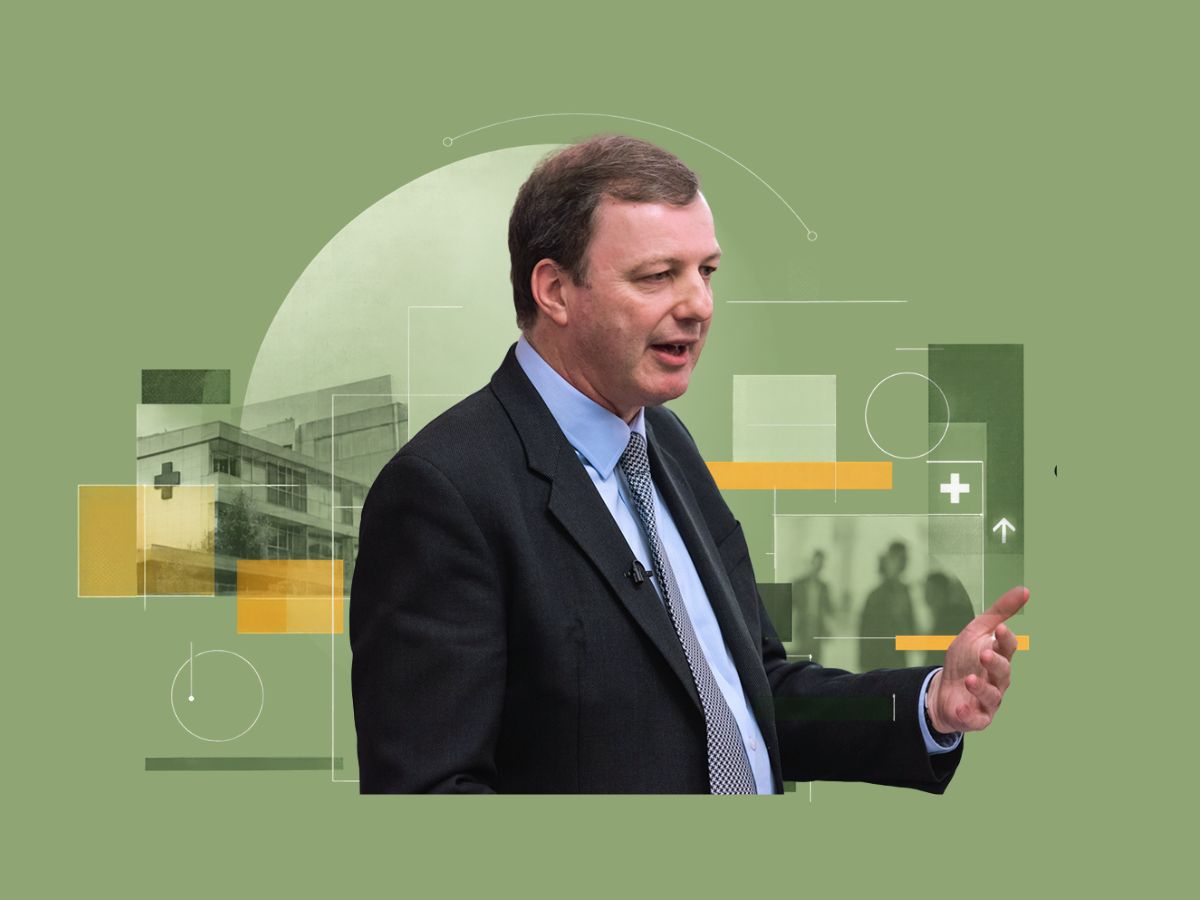
Gareth Davies, Comptroller & Auditor General, UK National Audit Office
The leaving card is doing its fourth lap of an integrated care board’s open-plan office this autumn. This one is for the manager who knew why the community equipment contract was priced as it was, and who kept a handshake arrangement with the county council over discharge funding that existed chiefly in her head. Her last day is Friday. A colleague has asked, with rising hope, whether anyone has seen the spreadsheet. Nobody has. Similar cards are circulating across England, and the arithmetic behind them has now reached Parliament.
The National Audit Office has put figures on the exodus. Integrated care boards are trying to reduce running costs from about £2.1 billion to £1.4 billion by 2026/27, a little short of the original £1.2 billion ambition. Some 8,000 posts are going, and 42 boards are being folded into 25 boards or clusters. NHS England is due to be absorbed into the Department of Health and Social Care by April 2027. The auditors' verdict is that the cuts are galloping ahead of the design. Nobody has said plainly how smaller commissioning teams are meant to work alongside regional NHS bodies and local authorities once the reshuffle is over.
The case for the axe deserves a fair hearing. Successive reorganisations left England with overlapping layers of national, regional and local bureaucracy, and critics of every political colour have complained about the duplication. A health service under acute financial strain cannot easily defend paying several organisations to do much the same corporate work. Ministers are entitled to ask why, and the Treasury is entitled to expect that money saved in the back office reaches the ward and the surgery.
The difficulty is what leaves with the departing staff. Strategic commissioning is unglamorous work. It means analysing the needs of a population, designing care pathways, drafting contracts that can actually be enforced and coaxing hospitals into changing what they do. The people who can do it have usually spent years learning how, and they are the ones most readily hired elsewhere when a redundancy scheme opens. The NAO reports sagging morale and an erosion of exactly these skills. When planning capacity thins, the work does not evaporate. It slides towards general practices and provider organisations that are already overstretched, and it arrives without a penny attached.
Town halls feel this first. Councils told the auditors that churn and lost institutional memory in the boards have unsettled joint work on community and social care. The consequences are visible in the places where the system already creaks: patients stuck in hospital beds because a care package is not ready, ambulances queuing outside emergency departments, months-long waits for community services. Each of these sits on the seam between health and social care, and that seam is held together by named individuals who trust one another. Replace those individuals every few months and the trust must be rebuilt from scratch each time. Councils have their own balance sheets to mend and little room to nurse a partner in flux. The government's enthusiasm for devolution to mayors adds a further voice to the table before the existing ones have agreed their parts.
There is also an awkward mismatch with ministers' own ambitions. The government wants more care delivered closer to home and less reliance on the hospital as the default setting. It speaks warmly of prevention. Someone must redesign the pathways, shift money between settings and hold providers to account for results, and that someone is a commissioner. Waiting list recovery, the measure on which the public is most likely to judge this government, leans heavily on community and primary care capacity that local planners exist to build. Dismantling the planning function while demanding transformation is a curious way to go about it.
Accountability is the quieter casualty. Bringing NHS England inside the department puts ministers nearer to operational decisions just as the local machinery is being rebuilt. The public already holds the Health Secretary responsible for waiting times and A&E performance. If a local service falters and the body that once owned the problem is a skeleton team in a sprawling cluster, finding the responsible party will be a game of hide and seek. The chair of the Public Accounts Committee, Sir Geoffrey Clifton-Brown, was right to demand precise operational guidance. Without it, nobody can show that the savings will last.
The practical lessons differ by audience. Trust chief executives should assume they will be asked to shoulder more of the system planning themselves, and should press early for clarity on decision rights and funding. Ministers face a question of sequencing. Publishing the post-reform operating model before the next round of reductions would cost some time and some political comfort, but it would allow boards to cut to a pattern instead of guessing at one. Health-tech and life sciences companies selling into the NHS should expect thinner procurement teams and slower, warier contracting, especially for anything that needs several organisations to agree. Patients are unlikely to notice the headline. They will notice a community service that takes longer to arrive, a pathway that no longer quite fits their circumstances, a discharge that drags.
The sums are easy to read. Savings show up in the budget within a single financial year. The costs turn up later, dispersed across practices, councils and waiting lists, where they are hard to pin on anyone. Governments under fiscal pressure tend to bank the first and discount the second. A reorganisation that strips out capacity before settling its purpose hands the design problem to whoever is left, and the bill is paid in a currency the Treasury does not count.