When we first published our NHS succession watchlist, the argument was largely about what kind of leader might eventually follow Sir Jim Mackey. Two months later, the more revealing question is what kind of job that person would actually inherit.
There is still no announced departure date and this remains an editorial tracker, not a prediction of a vacancy. But October has changed the context around the race. The NHS is entering winter with an uncomfortable combination: the financial reset is still unfinished, elective recovery has lost some momentum, and the service is carrying record or near-record pressure across urgent and emergency care.
That makes the succession question less theoretical. The next NHS leader, whether that is Mackey for longer or somebody new, will be judged on three things before almost anything else: can the money be made to work, can elective performance recover at scale, and can the wider service improve without simply moving pressure from one part of the system to another?
The NHS is not short of policy. It is short of room for error. The 2026/27 financial directions allow NHS England and providers up to £215.4 billion of revenue resource use, yet the operating model still demands far tighter control. The medium-term framework requires organisations to plan for financial balance and at least 2% annual productivity improvement. That sounds technical. In practice it means the next national leader will inherit a service where every operational promise has to be translated into cash, workforce and capacity.
The scale of the challenge is visible in the previous year. NHS systems ended 2025/26 with a £563 million deficit despite a national reset that had started from a £4.4 billion planning gap and required around £11 billion of planned efficiencies. Nearly half of those efficiencies were originally judged high risk. The lesson is not that the NHS has failed to control money. It is that the margin between control and instability is extremely thin.
This is why the leadership profile matters. The next phase cannot be run as a choice between finance and operations. It needs somebody who can do both at once: reduce variation, force difficult trade-offs, hold providers to account and still create enough clinical and political confidence for the system to keep moving.
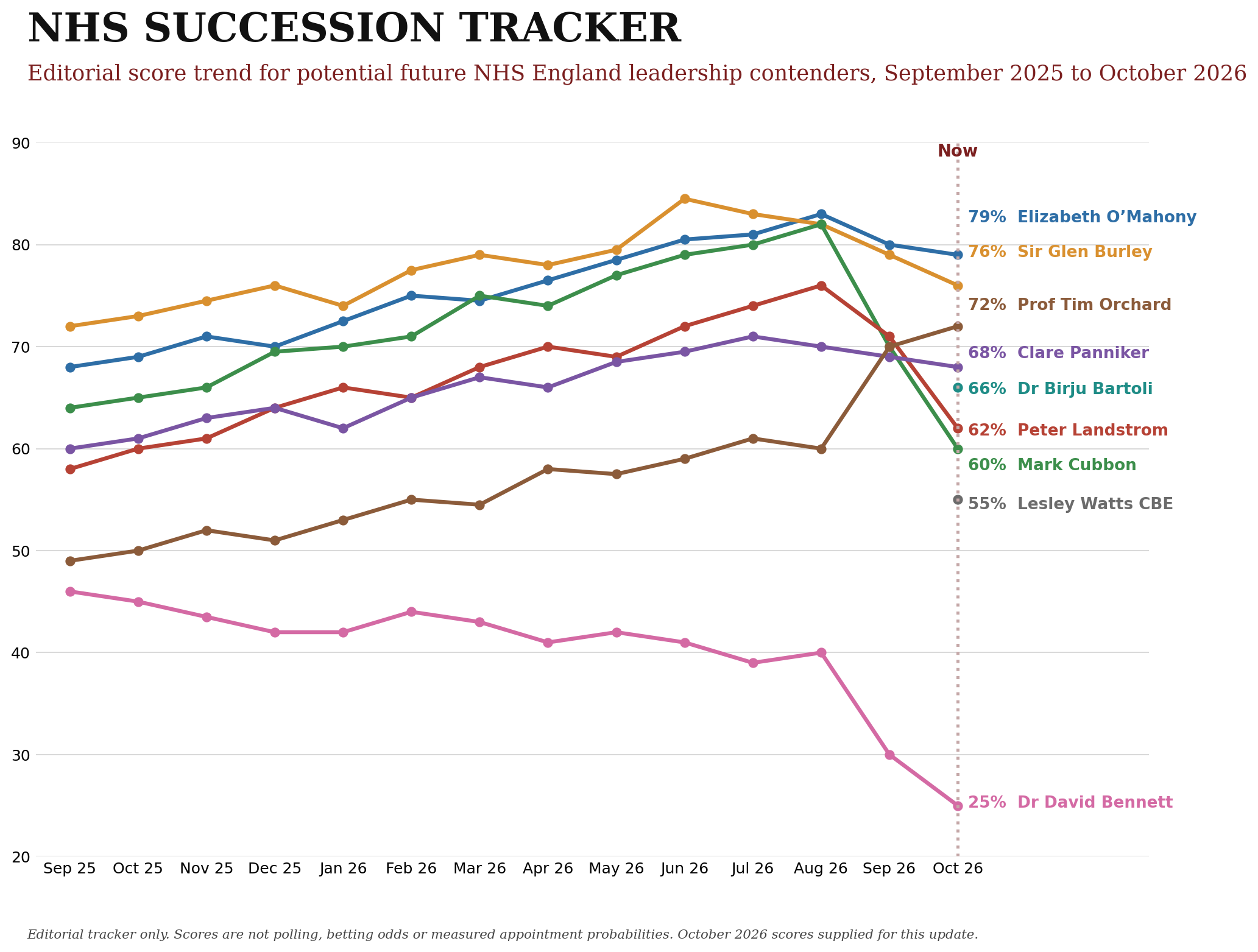
Elizabeth O’Mahony remains at the top of our tracker at 79%. Her score has eased from 83% in August, but the logic behind her position has become stronger rather than weaker: finance is now the defining constraint on almost every major NHS ambition. The question around O’Mahony is not whether the brief matters. It is whether a finance-led profile would be judged broad enough for a role that increasingly resembles chief executive, chief operating officer and political negotiator combined.
Sir Glen Burley sits second at 76%. His financial reset and accountability brief still maps closely onto the national problem. His score has fallen from the summer because the succession conversation now looks less like a pure reset exercise and more like the next stage of rebuilding performance across a complicated service.
The biggest movement is Professor Tim Orchard, up to 72% from 60% in August. His new role as group chief executive and single accountable officer across the four-trust North West London Acute Provider Group gives him something increasingly valuable in this race: a live test of whether scale, collaboration and stronger accountability can improve both performance and economics. His CBE this summer adds a profile, but the more important issue is delivery. If the group model works, Orchard becomes harder to ignore.
Clare Panniker remains firmly in the conversation at 68%. Her mix of provider and regional leadership continues to make her relevant if the centre of gravity moves towards stronger regional management, devolution and closer performance control between the national team and trusts.
There is also a significant new entrant. Dr Birju Bartoli enters our October tracker at 66%. Northumbria Healthcare named her chief executive in 2024, and this year the trust highlighted both her number-one ranking in HSJ’s chief executive list and its Advanced Foundation Trust status. That combination matters because it puts Bartoli into the discussion as a leader associated with performance, culture and financial sustainability rather than national machinery.
Peter Landstrom is at 62%. He remains one of the strongest pure provider operators on the list and Royal Free London has reported material improvements in cancer and urgent care performance. But the October score reflects a more crowded provider field and a succession debate that is now rewarding leaders who can demonstrate system-wide financial and operational reach.
Mark Cubbon falls to 60% in our editorial tracker. That should not be read as a judgment on his capability. He still runs one of the country’s largest trusts, has previously been NHS England Chief Delivery Officer and retains national planned-care experience. The movement reflects the way the editorial question has changed: the field is being judged less on who has held the biggest jobs and more on who appears closest to solving the current mix of finance, elective recovery and system performance.
Lesley Watts CBE enters at 55% after being asked this month to take on the additional role of Interim Regional Director for London while continuing as chief executive across Chelsea and Westminster and Hillingdon. That immediately broadens her relevance. London is the NHS at maximum difficulty: teaching hospitals, major capital demands, workforce pressure, health inequalities and some of the most complex provider relationships in the country.
Dr David Bennett falls to 25%. The outsider case remains intellectually possible, but October makes it harder to argue that the immediate priority is structural disruption for its own sake. The service looks as if it needs operational grip before it needs another institutional experiment.
The latest data is a useful warning against reading too much into a few good months. At the end of August, England’s elective waiting list stood at about 7.37 million treatment pathways, up from 7.33 million in July and the highest level since October 2025. Around 6.24 million individual patients were represented on the list. The proportion waiting within 18 weeks slipped to 65.2%, while more than 113,000 pathways had been waiting for over a year.
That is still materially better than some of the worst post-pandemic performance, and the NHS has been delivering record volumes of activity. But it exposes the central problem: activity can rise while the queue still grows. Demand is moving quickly enough that simply asking hospitals to do more is not a strategy. The next stage has to be about productivity, referral management, diagnostics, theatre utilisation, clinical validation, pathway redesign and using capacity across organisational boundaries.
This is also why elective performance will shape the succession race. A candidate who can talk convincingly about national reform but cannot show how to move 65% towards the 92% standard will struggle to define the next chapter. The job is moving closer to industrial-scale operational management.
Elective care is only one part of the pressure. The NHS came through the busiest summer on record for A&E, and September brought further pressure before winter had properly begun. That is the uncomfortable backdrop to the leadership question: a service can improve planned care and still lose ground if emergency demand absorbs beds, staff and management attention.
The next NHS chief executive therefore cannot be appointed as the leader of a waiting-list programme. They will need to run a national operating system. Elective recovery, urgent and emergency care, cancer, diagnostics, workforce, productivity and finance increasingly interact with each other. A hospital that cannot discharge patients cannot protect elective beds. A system that overspends cannot keep buying temporary capacity. A workforce plan that fails will show up in both money and performance.
That points towards a tougher definition of leadership than the NHS has sometimes used. The next leader needs enough authority to say no, enough operational credibility to know what is genuinely deliverable, and enough political skill to explain when a target requires a trade-off somewhere else.
The original article asked whether succession was even necessary if Mackey’s reset continued to deliver. That question remains valid, but the answer is now more conditional. The summer demonstrated genuine improvement in activity and productivity. The August waiting-list numbers and early autumn pressure show how quickly those gains can be tested.
If the NHS reaches the end of winter with financial control intact, elective performance improving again and urgent care stable, continuity becomes a powerful argument. If those measures deteriorate together, the succession discussion changes from “who can continue the reset?” to “who can restore control?”. Those are very different recruitment briefs.
That is why the next few months matter more than another round of speculation about names. Winter performance and the money will decide what problem the eventual successor is being hired to solve.
October has made the field more interesting. O’Mahony and Burley remain strongest where the pressure is greatest: finance and accountability. Orchard has moved sharply because he is now running a model that looks increasingly like the NHS’s future. Bartoli brings a new high-performing provider voice into the contest. Watts gains national relevance through London. The established operational names remain credible, but the test around them is becoming more demanding.
The most important conclusion, however, is not who sits first or third on an editorial tracker. It is what the tracker is now measuring.
The next leader of the NHS will inherit more than a reform programme. They will inherit a £200 billion-plus operating challenge in which the public expects waiting times to fall, the Treasury expects productivity to rise, hospitals expect workable funding, clinicians expect credible decisions and the government expects visible delivery.
The winning profile will be the person who can make those demands coexist.
That is a much harder job than succeeding Jim Mackey. It is the job of making the NHS work.
Data note: The succession tracker is an editorial scoring tool, not polling or an estimate of appointment probability. Historic scores are retained from the original article; September and October 2026 scores are the updated editorial inputs supplied for this edition.