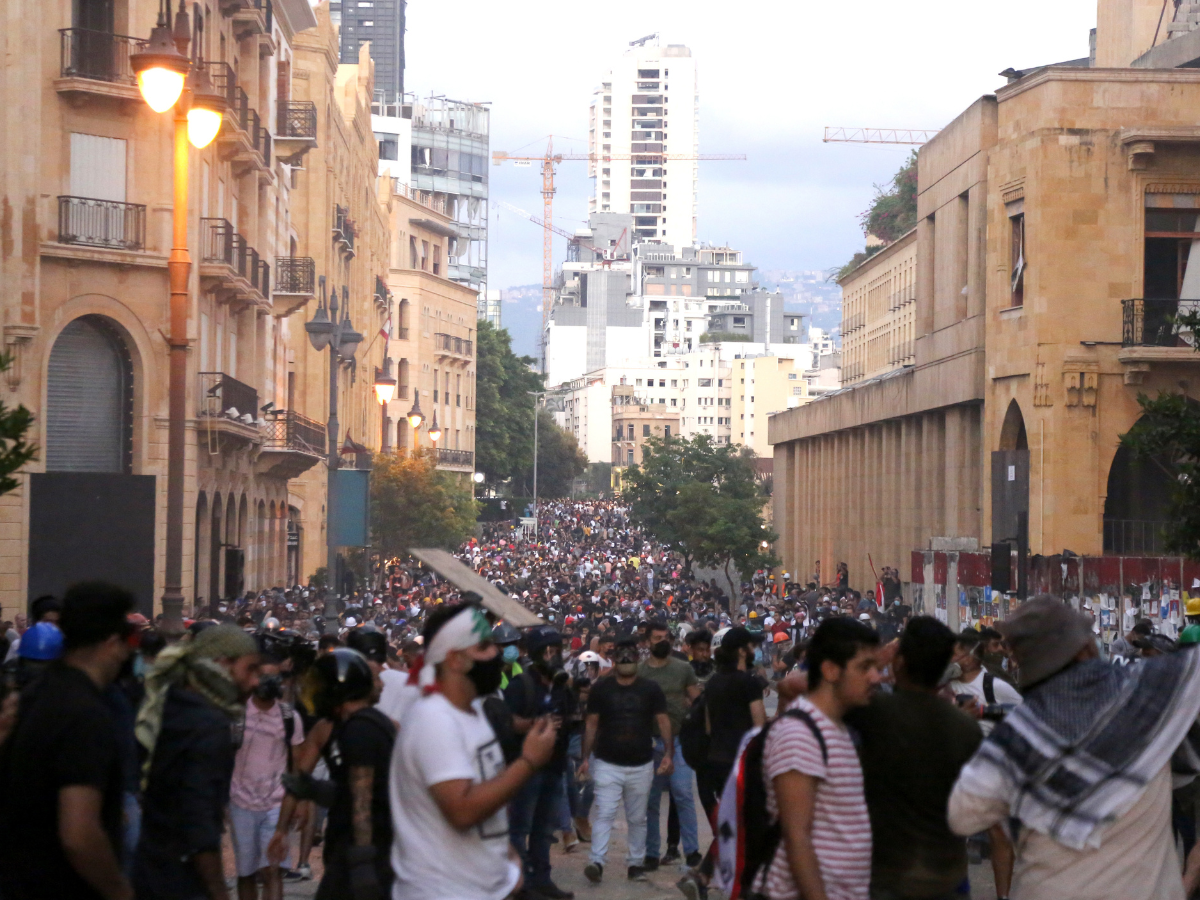
Europe's cost-of-living story changed this weekend. More than half a million people took to the streets in France, while separate demonstrations hit Belgium, Italy and Portugal. The protests were not centrally coordinated and they were not identical. Students, workers, trade unions, renters and families were responding to different national grievances. But the common thread was unmistakable: people do not experience the economy through GDP releases or central-bank forecasts. They experience it through rent, fuel, food, pay, public services and whether there is anything left at the end of the month.
That distinction matters because headline inflation has already fallen a long way from the peaks of the last crisis. Yet social pressure is clearly not falling at the same speed. Prices may be rising more slowly, but they are rising from a much higher base. Housing has become structurally unaffordable in several countries, energy has accelerated again, wages remain politically sensitive and public services are under visible strain. The next phase of the cost-of-living crisis may therefore be less about inflation itself and more about accumulated affordability.
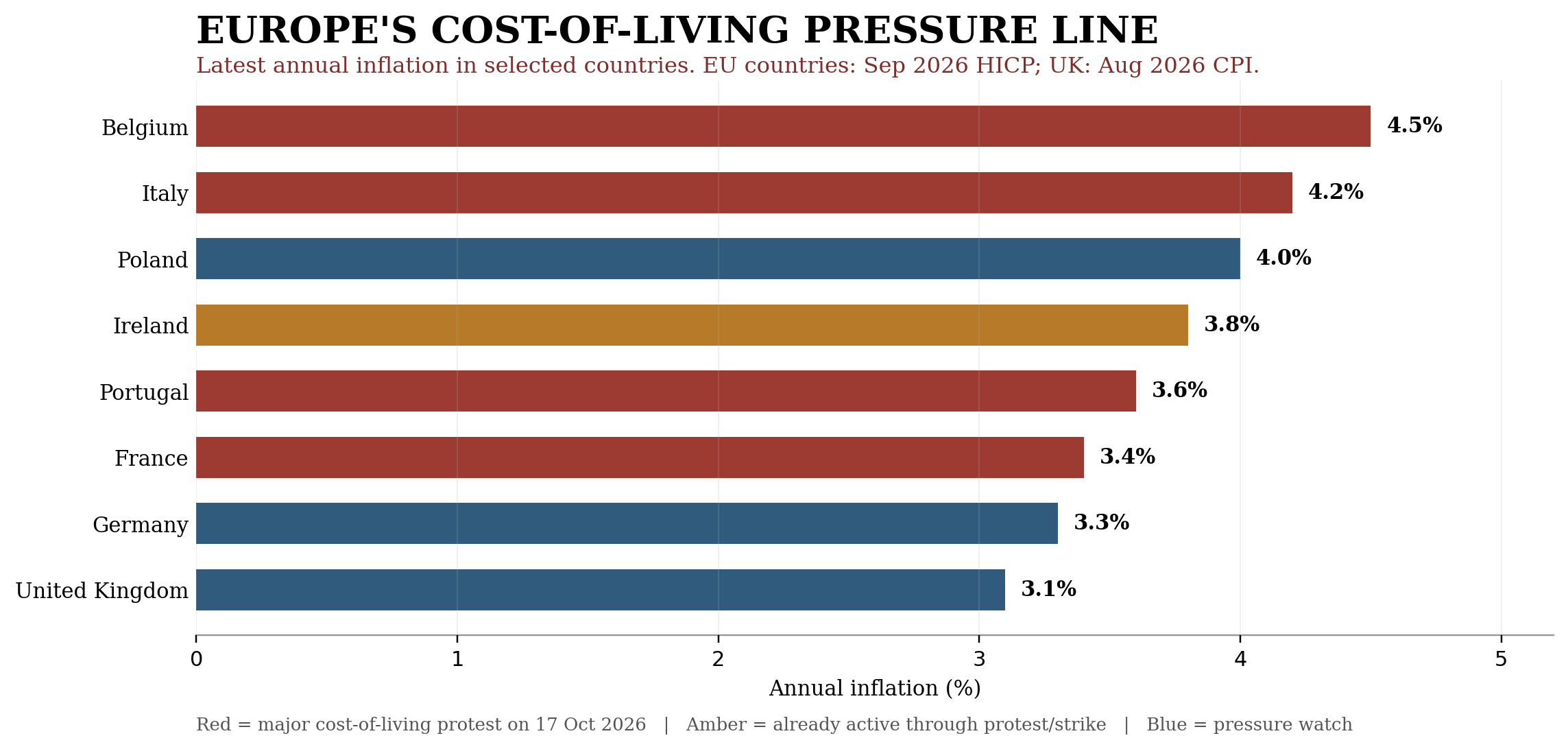
France was the most dramatic flashpoint on 17 October, with more than 550,000 people reported on the streets. Belgium saw clashes in Brussels after weeks of student protests over university registration fees. Tens of thousands marched in Lisbon over living costs, low wages and access to housing. Italy saw rallies and clashes in Milan and Bologna. These are separate national stories, but they share a political warning: governments are struggling to keep the metrics that citizens feel every day moving in the right direction at the same time.
Ireland should already be added to that map rather than treated as a future risk. A cost-of-living and housing protest took place in Dublin in September, and on 14 October roughly 300,000 public-sector workers, including health staff and teachers, took part in a nationwide strike over pay and living costs. Medical appointments were cancelled and schools closed. Ireland is therefore an important case study for Britain: cost pressure does not have to become a riot to create major disruption. It can arrive through organised labour, public-sector pay and the erosion of confidence that wages are keeping pace with essential costs.
The UK is not currently experiencing the same national mobilisation as France, Belgium, Italy or Portugal, and it would be wrong to pretend that a 3.1% inflation rate automatically produces protest. But that is not the useful comparison. The useful comparison is whether the pressures that turn dissatisfaction into mobilisation are becoming concentrated in the same places at the same time.
The latest ONS data show why this deserves attention. UK CPI inflation was 3.1% in August, but housing and household services were rising by 4.9% and transport by 4.6%. Average private rent reached £1,400 a month, up 3.8% in a year. In England, the North East and North West had the fastest regional rent growth at 5.8%. London remained in another category entirely, with average monthly rent at £2,332. Parts of the Midlands also show much sharper local pressure than the national number suggests: in North West Leicestershire, average rent was up 9.9% year on year in August.
This is why any UK pressure map would not be evenly distributed. The North and parts of the Midlands combine lower household financial buffers with faster increases in some essential costs. London combines the country's highest housing costs with extreme inequality and a very large population of renters. Scotland is different again: official modelling estimated that 31% of Scottish households could be in fuel poverty from July to September 2026, with 16% in extreme fuel poverty. Glasgow therefore belongs in any serious resilience discussion, not because unrest is inevitable, but because energy costs, poverty, public services and urban concentration can interact quickly when household confidence deteriorates.
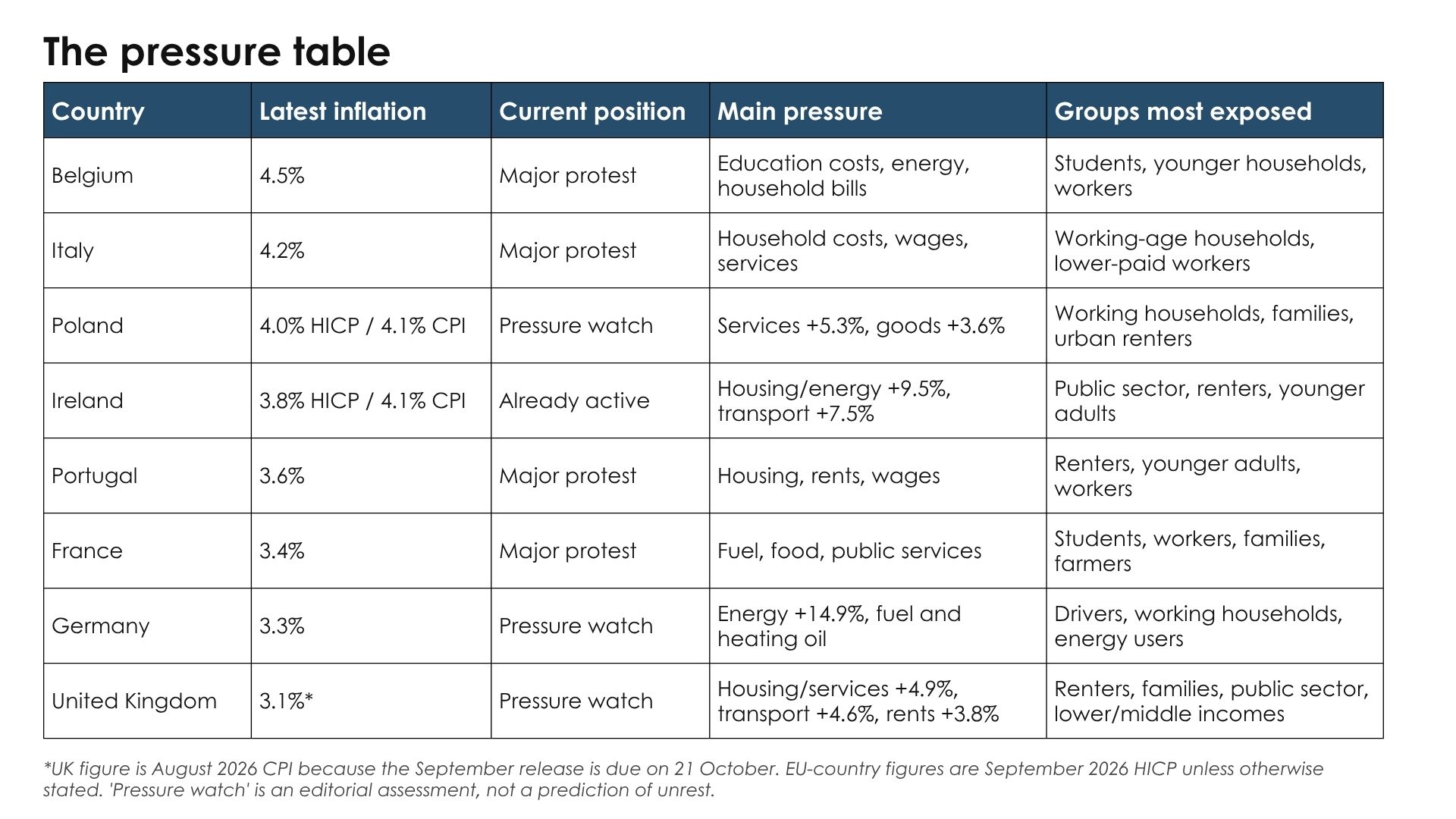
Germany is another country where the headline number can understate the political pressure. Inflation reached 3.3% in September, the highest rate of 2026, but energy prices were up 14.9% year on year. Motor fuel prices rose 37.1% and heating oil 74.9%. The German economy ministry has acknowledged that elevated energy prices, financing costs and uncertainty are weighing on purchasing power and domestic demand. Germany has not seen the same cost-of-living mobilisation as France this weekend, but the ingredients are visible: expensive energy, weak growth, political fragmentation and households being asked to absorb another round of costs.
Poland is perhaps the most interesting omission from this weekend's protest map. Its September HICP rate was 4.0%, while the national CPI measure was 4.1%. Services were 5.3% more expensive than a year earlier and goods 3.6%. Those numbers sit very close to countries where public frustration has already spilled into the streets. Yet the sources reviewed for this article do not show an equivalent national cost-of-living mobilisation on the scale seen in France, Portugal, Belgium or Italy.
That should not be interpreted as evidence that Poland is somehow immune. It is a reminder that inflation is only one part of the ignition mechanism. Wage growth, home ownership, household debt, trust in government, trade-union organisation, political culture and the availability of a single grievance around which different groups can coalesce all matter. The absence of protest today can be genuine resilience. It can also simply mean the pressure has not yet found a common trigger.
The central lesson is that governments cannot manage cost-of-living politics one metric at a time. Inflation can fall while rents rise. Wages can grow while mortgage resets absorb the gain. Energy support can improve while public transport becomes more expensive. GDP can expand while families feel poorer. The public sees the combined result, not the individual line items.
A serious government response therefore needs a citizen dashboard built around five things: disposable income after housing costs, housing affordability, energy and transport costs, real wage growth and access to functioning public services. If several deteriorate together, the political risk rises even when headline CPI looks respectable. The next mistake would be to assume that 3% or 4% inflation is too low to generate anger. The events of this week suggest the opposite: once the price level has ratcheted up, small additional increases can become politically explosive because households are already carrying the cumulative burden of the previous four years.
If Britain did experience a broader period of cost-of-living mobilisation, industrial action or civic disruption, the NHS would feel the effects quickly. The direct route is obvious: strikes and transport disruption affect staff availability, appointments, supply chains and elective activity. Ireland has already demonstrated this in real time, with health appointments cancelled during its public-sector strike.
The indirect route is more important. Financial stress worsens mental health, pushes some people to delay routine care and medication, and increases the health consequences of cold homes, poor nutrition and insecure housing. These pressures do not arrive neatly labelled as 'cost of living'. They arrive at GP practices, mental-health services, ambulance control rooms and emergency departments.
The NHS has very little spare operational room for another demand shock. This summer was already the busiest on record, with more than 7.2 million A&E attendances between June and August and a record 2.46 million ambulance call-outs. NHS England is entering winter with an explicit requirement to eliminate corridor care while protecting elective capacity. Those two ambitions are already difficult to reconcile. A surge in emergency demand, staff disruption or delayed discharge would make the trade-off harder, not easier.
The consequence would be predictable. Elective lists would lose capacity as beds and staff are redirected into urgent care. Corridor care would become harder to eradicate. Agency and escalation costs would rise. Productivity assumptions would come under pressure. The financial position would deteriorate. A system already trying to recover waiting times while living within a constrained envelope could find itself paying twice: once for the social consequences of the cost-of-living crisis and again for the operational disruption it creates.
The sensible conclusion is not that Britain is about to copy France. It is that the warning signs are close enough that government should act before frustration becomes harder to manage. The North, parts of the Midlands, London and major Scottish cities such as Glasgow all have different combinations of housing, energy, income and public-service pressures. They should be watched through household data and service demand, not political stereotypes.
The same is true internationally. Ireland is already active. Germany is absorbing a renewed energy shock. Poland has inflation that would look entirely familiar in the countries protesting this weekend, yet has not seen an equivalent national mobilisation in the sources reviewed. These differences matter because they show that social stability is not determined by one number. It depends on whether citizens believe the system is still capable of improving their daily lives.
Governments now need to get ahead of that question. Cost-of-living policy can no longer be a sequence of emergency rebates announced after public anger appears. It needs to become part of core economic and public-service management. For Britain, that means housing, energy, wages, transport and NHS resilience need to be read together.
If they are not, the next European cost-of-living story may not begin in Paris, Lisbon or Milan. It may begin much closer to home.
Data note
This article uses official inflation data from Eurostat, the UK Office for National Statistics, Germany's Destatis, Ireland's CSO and Statistics Poland; protest reporting from Al Jazeera, Reuters and RTE; and NHS operational material from NHS England. The country 'pressure watch' and UK regional discussion are editorial analysis, not forecasts of protest, disorder or violence.