
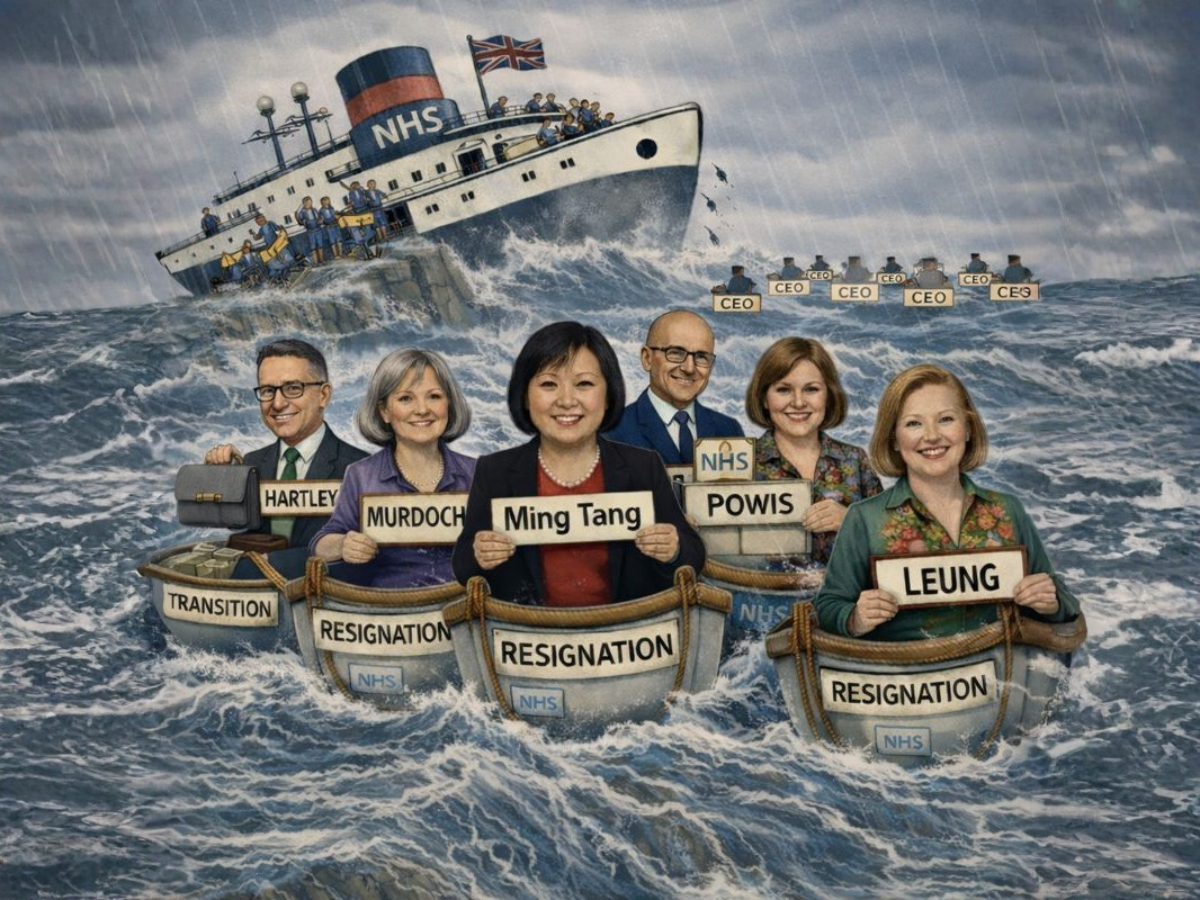
On a grey Monday morning an email landed in the inboxes of thousands of staff across NHS England. Calm. Polite. Almost apologetic. After sixteen years in the service, Ming Tang wrote that she would be stepping down and taking a short pause before her next chapter. There was no drama, no protest, just the careful language of continuity and handover. In another organisation it might have passed unnoticed. In the NHS it should have set off sirens. Tang was not simply another director moving desks. She had become one of the architects of the system’s digital backbone, the person who knew how the wires connected. When someone like that walks away, it is not a routine resignation. It is a structural loss.
Her departure also did not occur in isolation. Over the past six months a string of senior figures have quietly exited, among them Claire Murdoch, one of the most recognisable national voices in mental health. Trust chiefs, system leaders and seasoned operators have followed similar paths, often with the same measured phrasing about “new challenges”. Taken one by one, each move is explainable. Taken together, they look less like coincidence and more like attrition. The NHS is not losing junior staff or temporary managers. It is losing the grown-ups, the people who know how to keep the show on the road when everything else goes wrong.

What makes this moment particularly fraught is the nature of the task facing the service. The UK is already under pressure economically, stretched on defence, and increasingly exposed in artificial intelligence and advanced technology. The NHS is not merely attempting to balance budgets or chip away at waiting lists. It is trying to rebuild itself as a modern, data-led organisation. The ambition is vast. Interoperable records. Predictive analytics. AI-assisted triage. Operational command centres that can see patient flow in real time. The NHS Federated Data Platform is intended to knit together information that has sat in silos for decades, while the NHS App promises to shift whole swathes of care into patients’ pockets. These are not incremental upgrades. They are generational changes that require steady leadership over years, not months.
And that is precisely the problem. Digital transformation at this scale is not primarily about technology. It is about judgement. It requires people who understand procurement rules, clinical politics, data governance, suppliers, privacy law and the sheer gravitational pull of the NHS itself. Lose those people and the software still arrives, the dashboards still light up, but nothing quite works as intended. Programmes slow. Deadlines slide. Pilots multiply. Billions are spent with little to show for it. The rhetoric of AI continues, but the lived reality remains stubbornly analogue. Without experienced leaders forcing the system forward, transformation becomes theatre. It looks impressive on paper and disappoints in practice.

Behind the scenes, the reasons for departure are rarely ideological. They are practical and, to many insiders, entirely rational. Senior NHS leadership has become an endurance test. Endless governance meetings. Permanent winter pressures. Responsibility without control. Public accountability for problems that originate in funding settlements or national policy. Executives are asked to deliver Silicon Valley levels of agility inside some of the most restrictive frameworks in the country. Pay, while respectable, rarely competes with what equivalent talent can earn elsewhere. For years, purpose bridged that gap. People stayed because the mission mattered. Increasingly, purpose alone is not enough to compensate for the personal cost.
Burnout is commonplace. Diaries are saturated. Every delay is treated as a failure of leadership rather than a symptom of structural strain. A consultancy role looks calmer. A portfolio career looks humane. Even early retirement begins to make sense. None of this requires bitterness or protest. It is simply arithmetic. If the job consistently takes more than it gives back, people will leave. The tragedy for the NHS is that it has always relied on a kind of civic stubbornness, a willingness to absorb that imbalance for the greater good. If that cultural glue weakens, the service cannot compete on pure market terms. It cannot outbid the private sector. It can only hope to out-inspire it, and inspiration is harder to sustain when leaders feel permanently on the rack.

Politically, this should worry Westminster far more than it appears to. Governments talk constantly about AI, productivity and modernisation, about turning the NHS into a digitally enabled, globally competitive system. Yet reform is not delivered by speeches or strategy documents. It is delivered by individuals with credibility, stamina and institutional memory, people who can translate policy into practice and persuade thousands of staff to change how they work. Lose them and the system does not collapse dramatically. It simply becomes slower, clumsier and more fragile.
The metaphor is unavoidable. The NHS is a vast ship heading into rough water, demand rising and resources tight. The hull is still strong. The crew is still committed. But the navigators, one by one, are stepping into lifeboats. Momentum will carry the vessel for a while. Habit and goodwill will help. Eventually, though, someone has to steer. If the NHS cannot persuade leaders like Tang and Murdoch that staying is worth the strain, no amount of funding announcements or digital slogans will compensate. Because the future of healthcare will be built on data, analytics and intelligent systems. And right now, the people who know how to build that future are quietly leaving the bridge.



.jpg)
.jpg)
.jpg)