
There is a statistic buried in a new piece of American healthcare research that every NHS executive team should probably read twice.
Seventy-one per cent of senior executives working in health systems that use Epic say their organisations are now "Epic-first". In other words, when they need new clinical or administrative technology, their starting position is to see whether Epic can provide it.
Only 29 per cent say Epic competes on an equal footing with outside suppliers.
Not one respondent said their organisation actively preferred an external vendor to Epic.
That is not normal procurement behaviour. It is the emergence of an ecosystem.
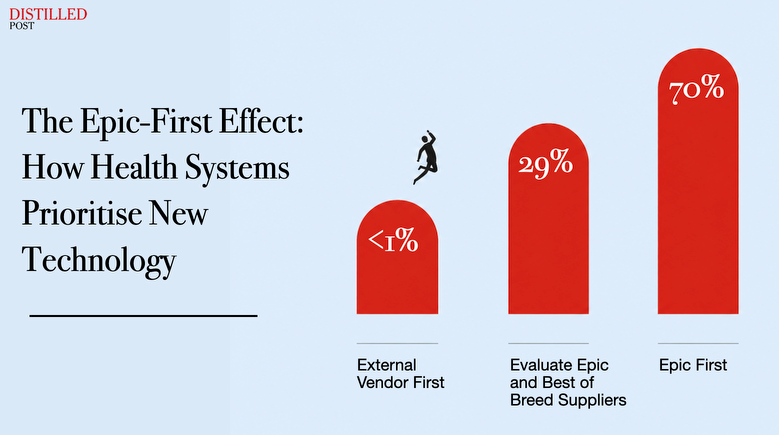
The research surveyed 112 senior executives at American health systems using Epic. These were not peripheral technology managers. They included chief executives, CIOs, CMIOs and other senior decision-makers, with a large proportion holding final purchasing authority.
Its findings should matter enormously in Britain because Epic's footprint inside the NHS is expanding at precisely the moment the health service is finishing one digital revolution and beginning another.
Epic already sits inside some of Britain's most important hospitals, and more shared EPR models are appearing across systems and regions.
The obvious story is therefore that Epic is winning more NHS business.
The more important story is what happens after it wins.
Because American experience indicates that the business regulations around the hospital begin to shift once Epic becomes the primary clinical system.
The £4 question
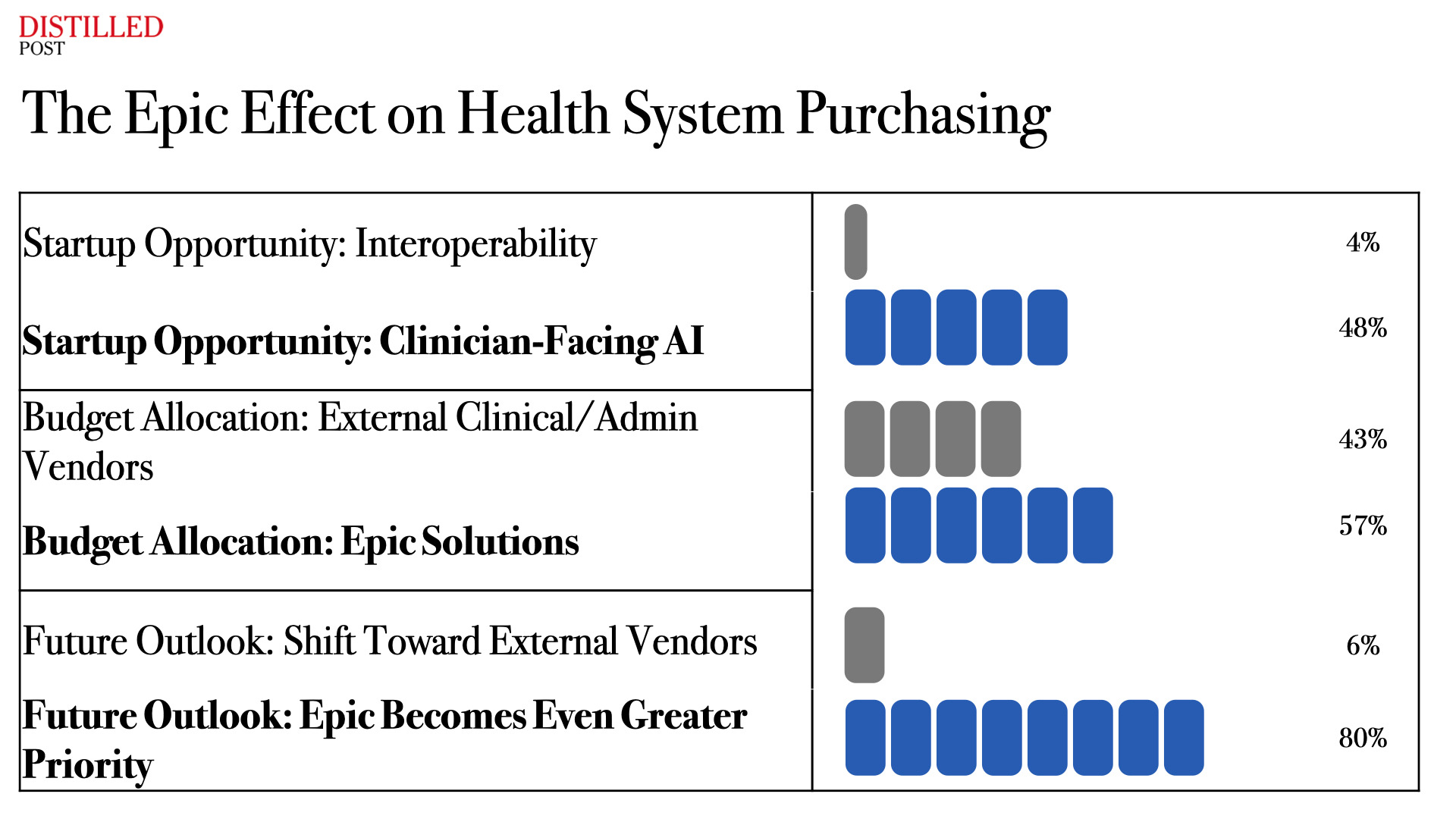
The survey found that Epic customers allocate roughly six dollars in every ten of their clinical and administrative information-system spending to Epic, leaving only around four dollars for everybody else.
And the direction of travel is striking.
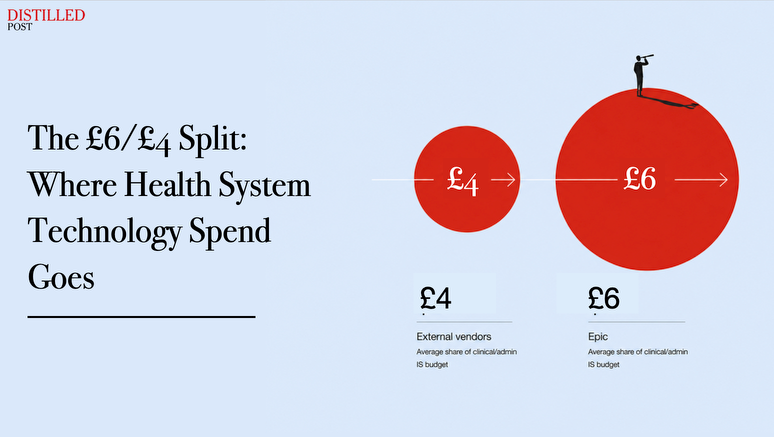
Seventy per cent of executives said their organisations had placed greater emphasis on buying Epic modules during the previous three to five years. Eighty per cent expect Epic to become even more important during the next three to five. Only a small minority expect to move towards more external best-of-breed products.
For NHS suppliers, this changes the question.
For years, technology companies have walked into trusts saying: ours is the better product.
In an Epic environment, better may no longer be enough.
Epic has something that most startups cannot easily reproduce: it is already there.
It already knows the patient. It already knows the clinician. It already sits inside workflows, permissions, governance, scheduling, messaging, orders and records.
As a result, every new vendor comes with a hidden cost: an extra integration, an information-governance assessment, a security evaluation, a contract, a clinical safety procedure, an interface to maintain, and a system that physicians might need to open.
"Slightly better software" becomes a very unappealing offer to a management team that is already working to increase productivity, regain lost performance, remove duplication, and limit expenses.
Almost half of executives said an outside vendor must demonstrate significantly greater return on investment or outcomes than Epic. Another large group demands somewhat higher returns. Only a minority judge Epic and external vendors on equivalent criteria.
This is perhaps the most important lesson for the NHS vendor market.
The competition is no longer:
Are you better than Epic?
It is:
Are you sufficiently better than Epic to justify everything required to bring you into an Epic hospital?
Those are very different tests.
Then comes AI
The stakes become even larger when artificial intelligence arrives.
Ninety-one per cent of the executives polled are confident that Epic will ultimately provide AI solutions that are on par with the finest specialised goods made elsewhere.
Think about what that means for a healthtech founder.
You may have a product that is better today.
Epic does not necessarily have to beat you today.
A hospital executive merely has to believe that Epic will eventually become good enough.
That belief itself can delay a procurement.
Why spend £1 million integrating a specialist AI product, train hundreds of people, complete governance and redesign pathways if the incumbent EPR supplier may introduce 80 per cent of the functionality within two years?
That is the power of platform economics.
Platforms win because they reduce the cost of saying yes to themselves and increase the cost of saying yes to everybody else.
Epic appears to be achieving something similar in healthcare.
But this is not the death of the startup
There is, however, an important twist.
A majority of respondents said they would still be likely to buy from a startup with only a handful of existing customers. That appetite rose further for established external suppliers.
The doors are not closed.
They have simply become narrower.
And we now have a reasonably clear picture of what gets through them.
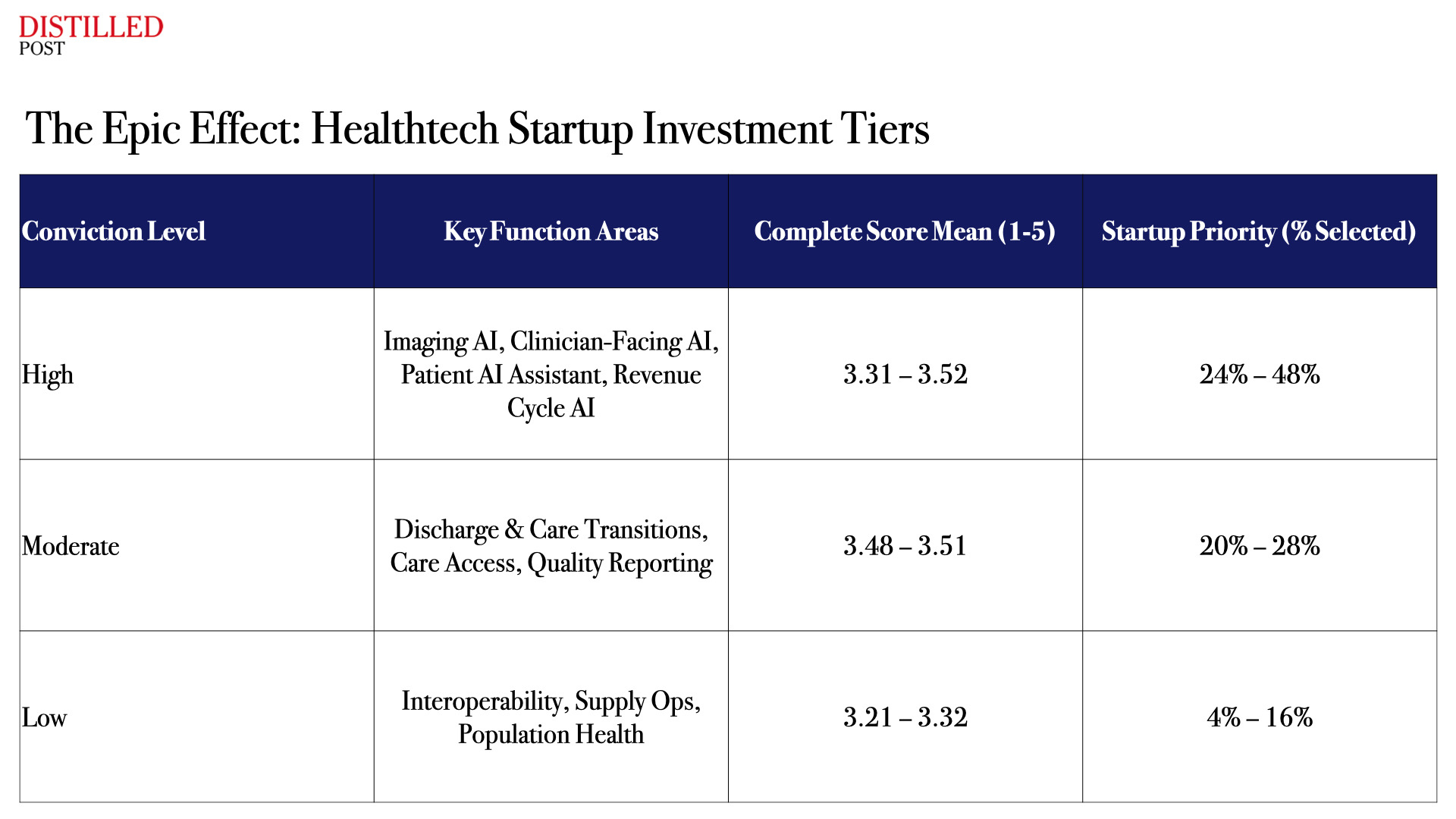
Clinician-facing AI was identified as an area where startups could compete. Imaging AI also scored highly. Patient AI assistants, care access, discharge and care transitions, revenue-cycle AI and quality reporting all showed meaningful opportunity.
At the other end of the spectrum sits interoperability.
Very few respondents saw it as a strong startup opportunity.
There is a brutal logic behind this.
The closer a product gets to Epic's core data and workflow territory, the harder the battle becomes.
The further it moves towards deep specialist capability, patients, external organisations, complex diagnostic technology or problems Epic is unlikely to prioritise, the more oxygen remains.
That should cause many NHS technology companies to reconsider their strategies.
Trying to become another hospital operating system may be a dead end.
Becoming extraordinarily good at something the operating system needs may be an enormous business.
Integration has become a product
For vendors wanting to play inside this world, one finding matters almost as much as the 71 per cent Epic-first figure.
When external suppliers do beat Epic, ease of integration is one of the most important factors. Faster time to value also scores highly.
This should be written across the wall of every NHS digital-health company.
Integration is no longer the tedious technical work performed after somebody has bought the product.
Integration is part of the product.
A brilliant AI application requiring nine months of implementation may lose to a good AI application that can operate safely in six weeks.
A vendor demanding that clinicians log into another portal may lose to one that appears almost invisibly inside existing workflows.
A company pitching innovation but creating another operational burden will eventually discover that NHS executive teams already have enough complexity to manage.
The winners will arrive saying: we work with your EPR, not against it. We can prove the benefit. We can deploy quickly. Your clinicians will barely notice the plumbing.
What NHS executive teams should do now
This is where the story becomes strategic.
Epic-first cannot be allowed to mean Epic-only.
There is obvious economic value in standardisation.
Shared EPR environments can allow information to follow patients across major institutions and can reduce the fragmentation that has plagued the NHS for years.
But consolidation brings its own danger.
If every digital problem begins with the question "what does Epic have?", hospitals risk exchanging the chaos of dozens of disconnected systems for dependence on a single enormous supplier.
That is not simply a CIO issue.
It is a board issue.
For chief executives, it is about strategic dependency.
For CFOs, it is about total cost of ownership and whether long-term concentration creates value or lock-in.
For COOs, it is about whether technology genuinely removes operational friction.
For CMIOs and clinical leaders, it is about whether innovation improves pathways or simply adds another layer of workflow.
For strategy teams, it is about where the hospital wants to build distinctive capability and where it is comfortable buying standard infrastructure.
The right executive question is therefore not whether to choose Epic or innovation.
It is where standardisation creates value and where competition creates value.
Core records, orders, scheduling and hospital workflow may benefit enormously from one integrated architecture.
Specialised AI, patient engagement, diagnostics, remote monitoring, pathway-specific technology and emerging forms of care may need a much more competitive market.
That boundary will become one of the most important strategic decisions NHS boards make during the next decade.
The new rule
For years, selling technology into the NHS meant surviving procurement.
The next era may be different.
It will mean surviving the platform.
For suppliers, that means building products that are dramatically rather than marginally better, integrating quickly, producing measurable ROI and concentrating on areas where an incumbent EPR cannot easily replicate their advantage.
For NHS executive teams, it means guarding against two opposite mistakes.
The first is buying endless shiny applications that create fragmentation.
The second is assuming that the safest answer to every digital problem is whatever happens to be available from the incumbent.
Epic's extraordinary American success demonstrates the attraction of consolidation.
It also demonstrates its power.
Seventy-one per cent Epic-first today. Eighty per cent expect greater dependence tomorrow. Ninety-one per cent confident it can catch the best AI companies.
Those numbers describe something considerably bigger than an electronic patient record.
They describe a company becoming part of the decision-making architecture of healthcare itself.
That should get the attention of every NHS executive team.
Because once a hospital has chosen its platform, the platform increasingly helps decide who gets chosen next.



.jpg)