

The numbers look reassuring at first glance. National cleanliness scores sit above 98 per cent. Food has edged up. Privacy has nudged forward. However, beneath those averages lies a sharper story. In 2025, patient-led inspections published by NHS England reveal a widening performance gap between standout hospitals and those struggling with ageing estates, catering contracts and operational strain. Some trusts achieved perfection. Others dropped sharply, exposing vulnerabilities that go far beyond surface hygiene.
This year’s assessment, carried out by teams made up at least half of patients alongside staff, offers one of the clearest windows into the non-clinical reality of NHS care. Clean wards, edible food and dignified spaces are not luxuries. They shape recovery, morale and public trust. The national cleanliness average remained steady at 98.6 per cent. Food improved from 91 to 92 per cent. Privacy and dignity rose from 88 to 89 per cent. Marginal gains, yes. But averages conceal volatility. Several acute trusts fell three percentage points or more on cleanliness alone. In food, some saw double-digit declines that would make any board uneasy. At the same time, a small cadre of hospitals delivered near flawless scores across multiple domains, proving that excellence is possible even under fiscal constraint.
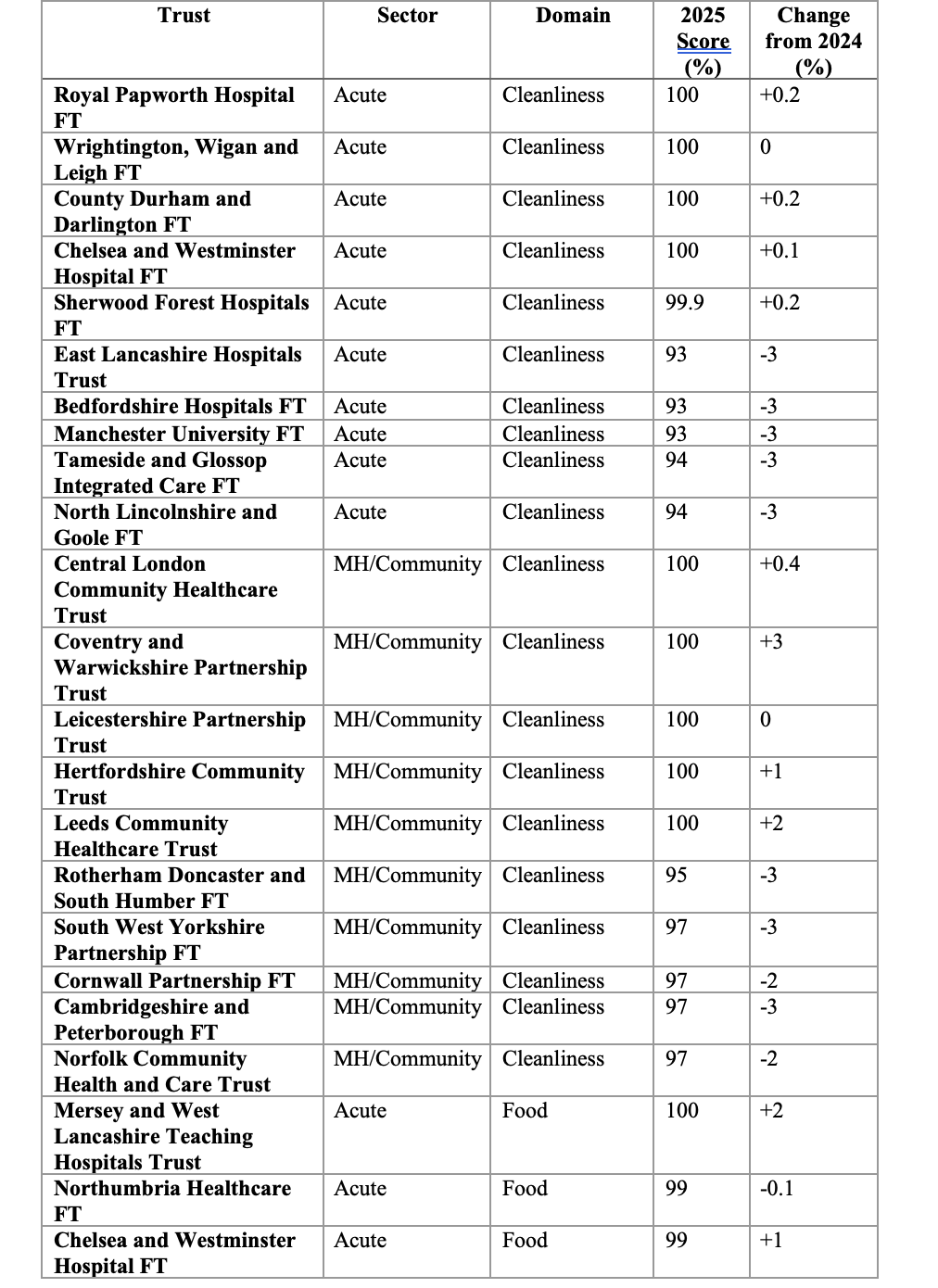
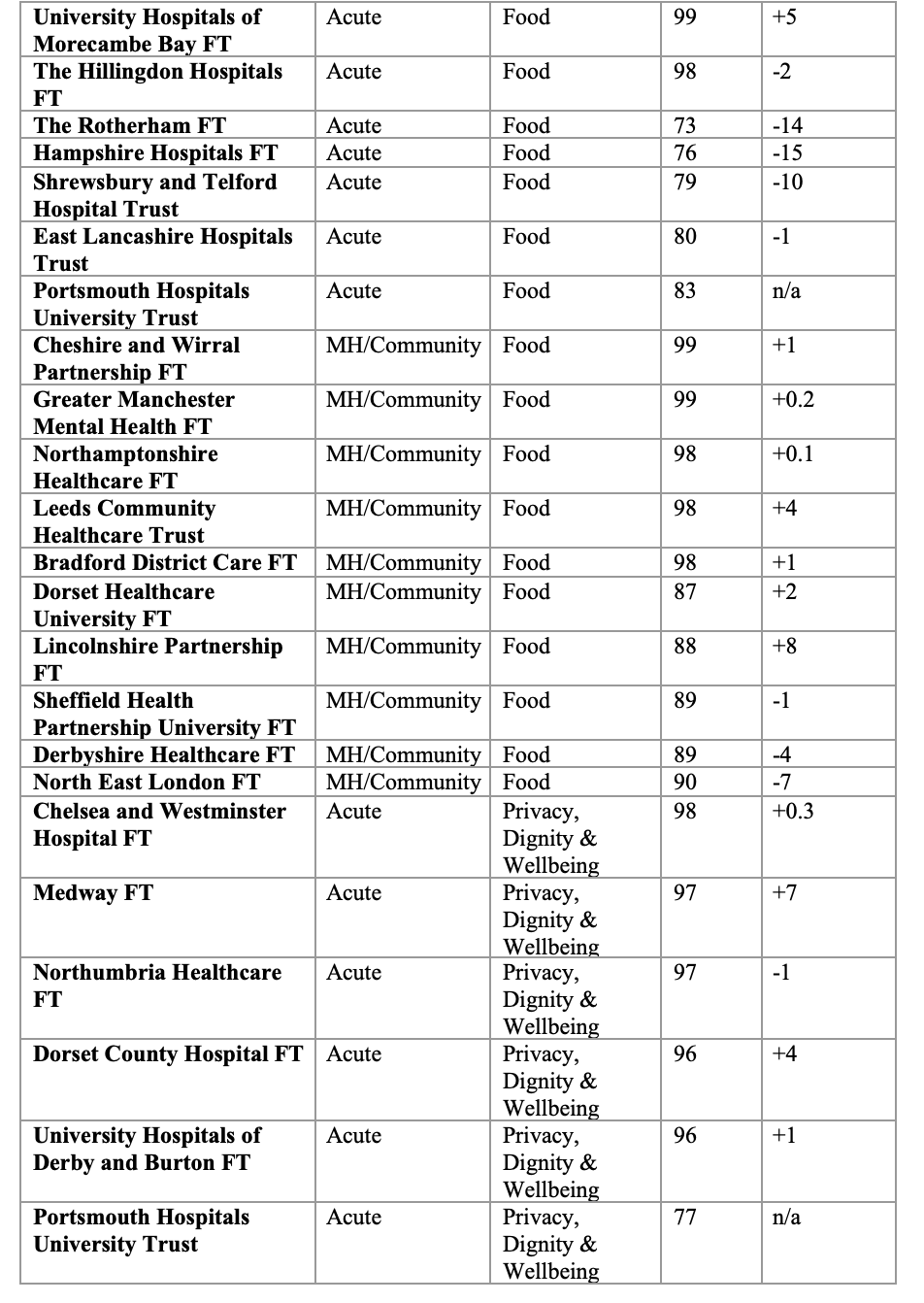

The divide is perhaps most visible in the contrast between consistent top performers and repeat strugglers. Chelsea and Westminster Hospital FT once again featured among the highest scorers across cleanliness, food and privacy, an unusual triple distinction in a system where strengths often vary by domain. Several northern and London providers also dominated food rankings, with perfect or near perfect catering scores. Meanwhile, East Lancashire Hospitals Trustremained among the lowest scorers for both cleanliness and food, despite local leaders stressing that inspections capture only a snapshot in time. In privacy and dignity, West Hertfordshire and others improved significantly year on year yet still remained in the bottom tier, illustrating how deep structural issues such as outdated wards and shared facilities can blunt short term operational fixes. Among mental health and community providers, volatility was equally striking. Some achieved 100 per cent cleanliness. Others recorded declines of up to seven percentage points in food or privacy, often attributing setbacks to estate age or supplier transitions. The pattern is clear. Performance is not uniformly drifting. It is fragmenting.
Below is a consolidated snapshot of the national averages and the spread between the strongest and weakest acute performers in 2025.
The table displayed above shows a system with high ceilings and uncomfortable floors. Cleanliness at the national level remains strong, yet the weakest acute performers sit five to seven percentage points below the best. Food presents the most dramatic spread, from perfect scores to the low seventies. Privacy and dignity reveal a similar gap, with top acute trusts reaching 98 per cent while the lowest remain in the high seventies. In a publicly funded system built on equity, those margins matter.
The line chart illustrates the broader national trajectory. Cleanliness has plateaued at a high level. Food and privacy show modest improvement. Stability, however, should not be confused with resilience. When individual trusts experience ten or fifteen point swings in food ratings within a single year, it signals operational fragility beneath the headline averages. Catering contracts, staffing churn, estate upgrades and local leadership focus all leave fingerprints on these scores.
What is driving the divergence? Ageing infrastructure is a recurring theme. Trusts serving older estates often cite limited single room capacity and outdated ward design as barriers to improving privacy and dignity. Capital constraints slow refurbishment. In food services, outsourced catering models can create variability during procurement cycles or supplier changes. Cleanliness, though generally strong, is highly sensitive to workforce stability. A thin domestic services rota can quickly translate into lower inspection day performance.
There is also a governance dimension. Trusts that consistently score highly tend to integrate patient feedback into operational dashboards rather than treating assessments as episodic audits. They align estates, infection control, facilities and catering under unified accountability, with board visibility of trends rather than isolated data points. In those organisations, non-clinical quality is framed as strategic, not cosmetic.
For boards sitting near the bottom of any domain, the reputational stakes are rising. Public transparency has sharpened comparisons. Patients choosing elective providers increasingly scan quality indicators beyond clinical outcomes. A spotless theatre means little if the ward meal is inedible or privacy compromised. In an era of social media amplification, small lapses can travel fast.
Yet the story is not one of systemic decay. The fact that multiple trusts achieved 100 per cent cleanliness and near perfect food scores under current financial pressure demonstrates that operational excellence is replicable. The challenge for NHS leadership is not discovering what good looks like. It is scaling it. That requires disciplined contract management, ring-fenced estates investment and relentless measurement. It also requires cultural clarity that dignity and environment are clinical multipliers, not soft add-ons.
The 2025 data ultimately reframes a familiar debate. The NHS does not suffer from an absence of standards. It suffers from uneven execution. Where leadership, infrastructure and accountability align, patients experience clean wards, decent meals and dignified care. Where they do not, performance slips quickly. The gap between 100 per cent and 73 per cent on food is not statistical noise. It is lived experience.
For policymakers, the message is equally direct. National averages can reassure ministers. Patients experience local reality. As the service enters another financially constrained year, the trusts that treat environment as core quality will protect both outcomes and reputation. Those that do not may find that the next set of figures tells a harsher story.



.png)

.jpg)