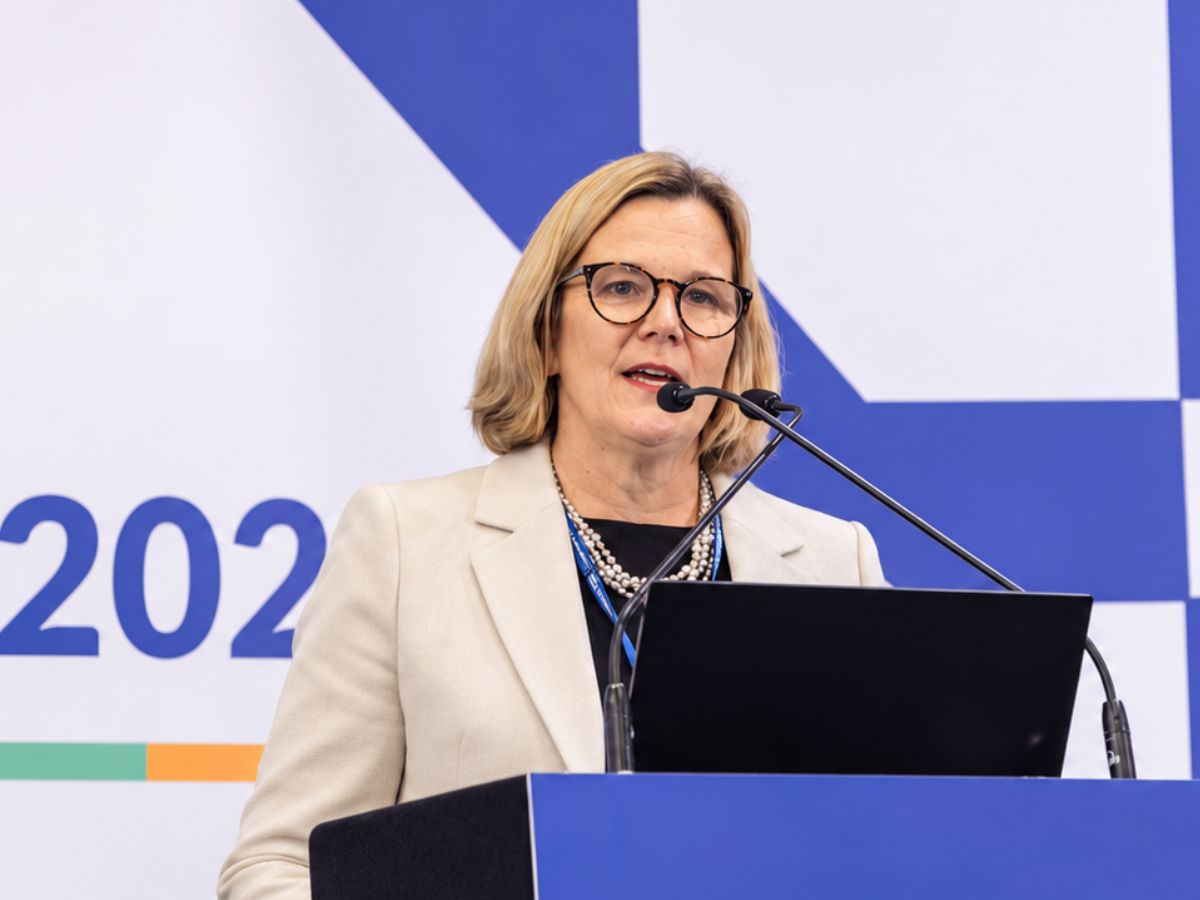
Sir Jim Mackey, Chief Executive of NHS England
The session was an extension of his patient workshop at HPCC, and there was something unusually personal about the conversation. Sir Jim was not discussing the NHS as an institution he merely runs. He uses it. His family uses it. He has long-term conditions himself and receives regular NHS care. He also described becoming a personal navigator for relatives and friends when communication breaks down or nobody is quite sure what happens next.
That matters because it gives his leadership a perspective that is both strategic and deeply human. He has seen the NHS at its brilliant best, with skilled and compassionate teams delivering world-class care. He has also seen first-hand how the experience of that care can be strengthened further through clearer communication, smoother transitions and greater certainty for patients and families at vulnerable moments.
He spoke candidly about a recent experience involving one of his daughters. The clinical care was good, and the experience reinforced for him how important clear communication is alongside clinical excellence. It was a revealing moment: the chief executive of NHS England understands that quality is not only about the treatment delivered, but also about ensuring patients and families feel informed, supported and confident about what happens next.
What followed was not a procession of individual complaints. It was a picture of the system seen through the people who use it most. Patients spoke about variation between trusts, difficulty reaching specialist expertise, information that does not travel with them and the burden of navigating several parts of the NHS at once.
Sarah*, who has lived with rare diseases for decades, provided one of the clearest examples. She described spending 40 years trying to reach the right specialist care, then experiencing something very different when she developed breast cancer: a recognised pathway, clear support and a system that seemed to know what should happen next. Her question was simple. Why should that clarity depend on the condition you happen to have?
Sir Jim listened carefully and responded in practical terms. Patients with a diagnosis should be able to reach the appropriate specialist expertise, even when that expertise is not local. Where there were specific failures, he asked for the details. Where standards were not being followed, he wanted to know where. Where access had broken down, he offered to have it examined.
That was perhaps the most important feature of the session. Patient voice was not treated as testimony to be politely acknowledged and then set aside. It was used as intelligence: a way of identifying where national ambition is not yet translating into a consistent experience on the ground.
Sir Jim's answers revealed a coherent reform agenda. The first priority is continuity. For people whose care spans primary care, local hospitals and specialist centres, fragmented records are not a technical inconvenience. They are a safety and confidence issue. When information does not move, the patient becomes the person responsible for joining the system together.
The proposed single patient record and wider access through the NHS App are intended to change that. But Sir Jim's most significant point was about ownership: the record should increasingly feel as though it belongs to the patient, with clinicians being given access to it rather than patients having to recover fragments of their own history from different organisations.
The second priority is access to expertise. Sir Jim was realistic that every rare disease cannot have a specialist service in every town. His ambition is more practical: routine care should happen closer to home, while specialist expertise should be reachable wherever the patient lives through clearer referral routes, remote consultation and local delivery supported by specialist teams.
The third priority is care that does not begin and end with an appointment. Remote monitoring, digital tools and new models of contact can allow the NHS to respond earlier, but only if the clinical service around the technology is able to interpret the information and act on it. His test was simple: technology matters when it changes the patient's pathway, not when it merely creates more data.
And the fourth is consistency. Patients described standards that can feel different from one trust to another. Sir Jim pointed to audit, Getting It Right First Time, commissioner oversight, peer review and greater transparency as mechanisms for reducing that variation. He also made clear that patient involvement should be part of how organisations judge whether improvement is actually being delivered.
The discussion also pointed to an opportunity to deepen how the NHS hears the patient voice. National surveys and existing feedback mechanisms remain important, but they can be complemented by more regular, condition-specific and direct engagement with people using services. The message from the session was not to replace what exists, but to make patient insight a more continuous part of how priorities are shaped, services are improved and progress is understood.
The strategic lesson from the discussion was that patients should not be invited in at the end of reform to comment on a finished design. Their experience should help determine what is designed in the first place. People living with complex conditions see the points where systems fail to connect because they experience every handover, every missing result and every unclear next step.
Their priorities were remarkably consistent: information that travels with them, specialist expertise they can reach, standards that do not depend on postcode, support between appointments and clinicians with enough time to listen to the whole person. These are not peripheral measures of satisfaction. They are indicators of whether the NHS is working as one service from the patient's point of view.
That is also why Sir Jim's interest in technologies such as ambient voice matters. If technology can reduce administrative burden and return clinicians' attention to the conversation in front of them, it supports the same objective: making the service feel more connected, more responsive and more human.
His approach to artificial intelligence follows the same logic. Patients are already using AI to interpret letters, understand results and navigate care. Sir Jim's response was not to resist it. New technology, he argued, should not be compared with an imaginary perfect health service. "We have errors already. We have people missing care already."
It is a pragmatic position. Strong governance, good data and close monitoring are essential, but inaction carries risk as well. The strategic question is whether technology can help the NHS reduce missed care, improve access and give clinicians more time to focus on patients while remaining safe and accountable.
Sir Jim's vision ultimately brings these strands together: universally strong standards, equitable access to specialist and routine care, a service that remains free at the point of use, much stronger patient involvement and greater personalisation in how people receive care.
What made the discussion significant was not simply that he articulated that vision. It was that he spent time testing it against the lived experience of patients, listening to where the system still falls short and asking for concrete examples he could act on. The patients were not an audience for reform. They were helping define it.
There is a strong case that Sir Jim Mackey could become one of the defining NHS chief executives of the modern era because his reform agenda begins with a deceptively simple question: what does the NHS feel like to the person trying to use it? He is not asking patients to fit themselves around the service. He is asking how the service can be redesigned around them.
*Patient names have been changed to protect privacy.