
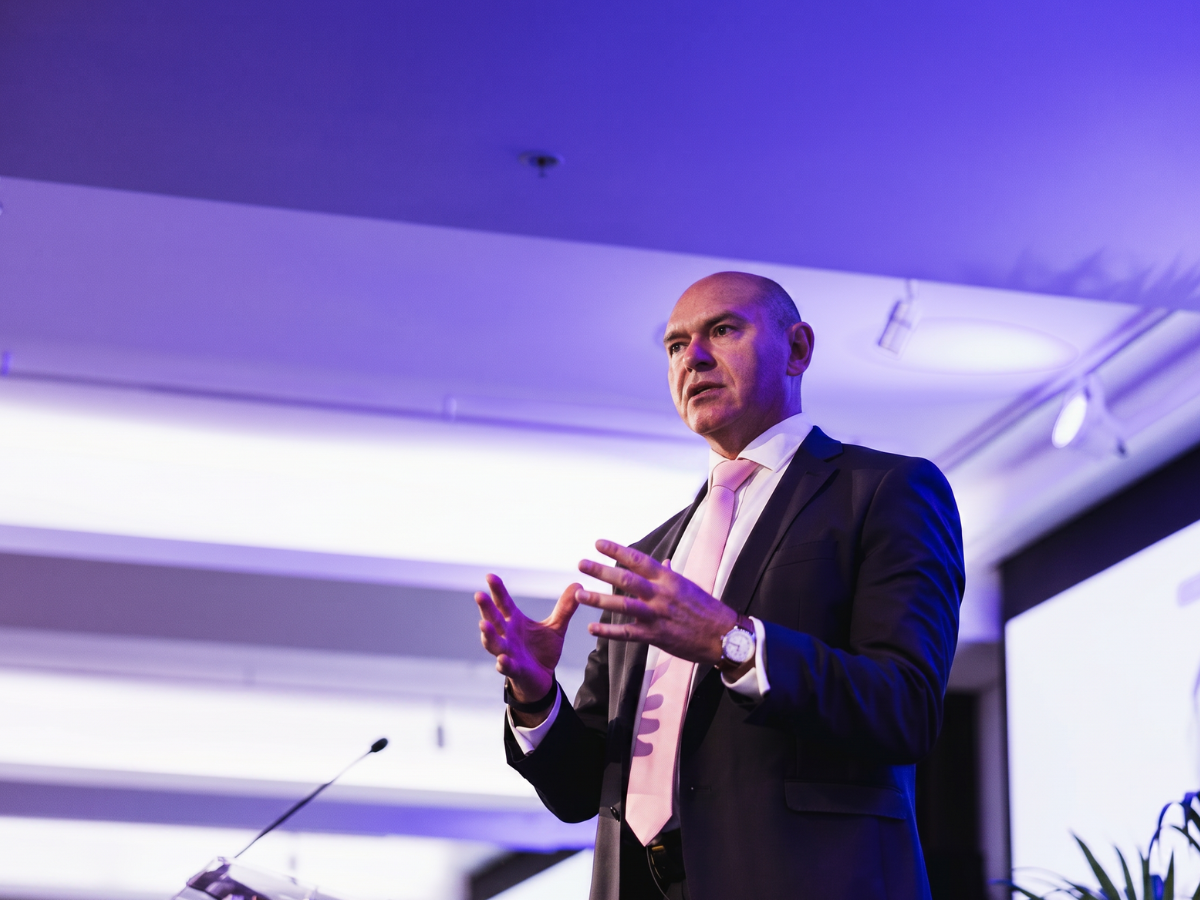
The NHS Strategy Summit 2026 was not designed for public consumption. A closed-door gathering of senior NHS leaders, it offered something rarely available in the formal machinery of national health policy: a forum in which the most senior figure in NHS England could speak candidly, without the managed language of a published strategy document or a parliamentary select committee appearance. What Sir Jim Mackey said there, and perhaps more revealingly, how he said it, tells us a great deal about where NHS England believes the system stands and what it expects from those running it.
The context matters. NHS England entered this period carrying the accumulated weight of years of underperformance against constitutional standards, a financial position that has required significant in-year course correction, and a public confidence deficit that has made political headroom scarce. Mackey took up his role against that backdrop, and his speech at the Summit was in large part an account of where that first year of renewed effort has landed. The tone was that of a leader who has been out in the field, who knows what has been achieved, and who is now setting expectations for what comes next.
A Year of Recovery, Framed as a Starting Point
The opening of his remarks was deliberately celebratory, but not sentimental. Mackey acknowledged that twelve months ago, the financial position looked severe and public confidence, as measured by the British Social Attitudes survey and other indicators, was deeply damaged. He said plainly that "nobody believed it was possible" to turn things around at the pace that followed. The NHS, in his framing, had "really stepped up." For a system often accused of institutional inertia, this is significant language. It positions the workforce and leadership cadre not as passive recipients of national direction but as active agents of recovery.
The substance behind the acknowledgement is worth examining. Mackey cited measurable progress on elective standards, ambulance Category Two performance, and primary care satisfaction indicators, all of which represent areas where the gap between aspiration and delivery has historically been most visible to patients and most damaging politically. The reference to "1% a week on RTT through the last quarter" is a striking operational claim. Whether or not that trajectory holds, the willingness to anchor the narrative in specific performance metrics rather than process activity signals an intent to be held to account in straightforward terms.
What Mackey is doing here is also making an implicit argument to his audience. By demonstrating that the system can move faster than conventional wisdom assumes, he is removing one of the most durable excuses for managed decline. The phrase "big leaps, not incremental improvement" runs throughout the speech as both a description of what is now expected and a challenge to those who would default to gradualism.
Digital Technology: Raising the Bar on Value and Accountability
On technology, the speech was more revealing than it might initially appear. Mackey's handling of the EPR question was blunt in a way that will resonate with every Chief Information Officer in the room. He described the NHS's record on implementation as deeply problematic before cataloguing a litany of failures: overpaying for products, treating every installation as a unique event, accepting temporary but severe productivity drops, and in some cases losing clinical data or triggering serious incidents. The phrase "unmanageable and unforgivable" carries real weight when used by the national chief executive about a category of investment that has consumed enormous capital.
The message is not that digital transformation should stop. Mackey is explicit that basic infrastructure remains essential and that the goal is better execution, not retreat. But the signals here for system leaders are specific. He is calling time on the model in which EPR deployments are treated as once-in-a-generation events that justify substantial operational disruption. He is also raising expectations about value realisation. The observation that clinicians at a major trust were still describing a twenty per cent productivity drop following an EPR go-live is not an aside; it is a statement of what is no longer acceptable.
The more forward-looking part of his technology thinking concerned the model for local investment decisions. Mackey described a preference for a system in which trusts can call off accredited technologies at agreed national prices and build their own business cases for return on investment, rather than queuing for centrally allocated funding. The shift this implies, from national commissioning of technology programmes to locally accountable adoption with national price assurance, is not small. If it materialises, it would change the procurement and implementation environment significantly, and it would place more responsibility on trust boards and executive teams to demonstrate that technology investment is generating measurable value.
Neighbourhood Health: Familiar Ambition, Unfamiliar Urgency
The discussion of Neighbourhood Health was, in some respects, the most politically astute part of the speech. Mackey acknowledged directly that the concept has an uncomfortable history: "everybody loves the idea, nobody argues with the principal, but you very quickly hit that thing about it's my version of it." This is an unusually frank admission from a national leader that structural reform in health and care has historically foundered not on ideology but on local power dynamics, historical grievances between organisations, and disputes about governance and financial accountability.
His prescription is not to resolve all of that before acting. Instead, he described a model in which national frameworks, payment mechanisms, and standards provide the scaffolding, while local teams are expected to work across the boundaries that have historically divided them. The emphasis on a population of 40 to 50,000 and the identification of the few hundred complex, high-risk individuals who genuinely require coordinated multi-agency attention is a useful anchoring of what neighbourhood-level working should actually mean in practice.
There is a tension in this ambition that the speech does not fully resolve. Mackey is asking organisations that have spent decades competing, or at minimum operating in parallel, to start behaving as if their institutional boundaries are secondary concerns. He is doing so in a financial environment where those same organisations are under significant pressure and where the incentive structures do not yet fully support the collaboration he is describing. His admission that "we've been in and out of it in my whole career" is as honest an acknowledgement as one could expect of how many times this particular aspiration has been articulated and then quietly shelved.
Leadership Development: Acknowledging a Pipeline in Trouble
The section on leadership development was perhaps the most personally inflected part of the speech, and it pointed to a problem that NHS England has not yet solved. Mackey described a situation in which aspiring chief executives struggle to secure shortlist positions at challenging trusts, while chairs of those same trusts struggle to attract credible candidates. He called this "absolutely bloody premise," a phrase that sits unusually in a keynote address but which appears to reflect genuine frustration.
The announcement of a leadership college, with Ed Smith agreed to chair its establishment, represents the beginning of a structured response to this. But Mackey was candid that building out this kind of infrastructure takes time, and that the system has "really lost so much ground in recent years." The vision he articulated, of the NHS becoming a globally recognised source of leadership talent across complex, regulated, patient-facing environments, is ambitious. It also acknowledges that the current reality is some distance from that aspiration, and that the work of getting there is long-term.
What this signals to the COOs, aspiring chief executives, and system leaders in the room is worth noting. The centre is aware of the pipeline problem. It is beginning to invest in addressing it. But in the interim, the expectation is that those with the capability and appetite for challenging roles will need to find ways to make themselves available, and that the system will try to make that viable.
What This Means for NHS Organisations
Taken together, Mackey's address at the NHS Strategy Summit 2026 reads as a statement of a new compact between national leadership and the system. The terms of that compact are fairly clear: NHS England is prepared to acknowledge what has been achieved, to credit the workforce and leadership with the gains of the past year, and to invest in the conditions for further improvement. In return, it expects pace, it expects leaders to stop accepting the conditions that produce poor performance as fixed constraints, and it expects the kind of cross-organisational working that neighbourhood-level care requires.
What remains to be seen is whether the structural and financial environment will be shaped quickly enough to support those expectations. The payment mechanisms, accreditation frameworks, technology pricing arrangements, and leadership development infrastructure that Mackey described are works in progress at best. The system is being asked to move at a pace that the supporting architecture has not yet caught up with. That is not unusual in NHS reform, but it is a genuine risk. The credibility that has been earned over the past year is, as Mackey put it himself, "bankable." The question for the year ahead is whether it is spent wisely.



.png)
.png)
.jpg)