
For years, the NHS has had a familiar data problem. It has generated huge quantities of information while still relying, in too many places, on manual workarounds to turn that information into action. Reports arrive late. Lists are rebuilt by hand. Staff reconcile numbers rather than manage the problem in front of them. The result is not simply inefficiency. It has weaker operational control.
That is why an internal case study reviewed by Distilled Post deserves attention. The document concerns an acute trust using the Referral to Treatment Validation application within the NHS Federated Data Platform. The trust is not named here, but the operational lesson is clear: better performance begins with better data, and better data starts with quality, fidelity and trust.
The trust introduced RTT Validation as part of a broader effort to modernise validator workflows, move away from spreadsheets and create a live, reliable view of every patient pathway. In an early pilot involving 40 validators, more than 11,000 pathways were reviewed and 3,064 were removed from the patient tracking list. Those removals included pathways where treatment or discharge had already stopped the clock, as well as duplicated pathways that were later linked correctly.
The importance of that result is easy to underestimate. Waiting-list data is not an administrative side issue. It is the operating memory of elective care. If the underlying list is stale, incomplete or miscoded, the organisation is making decisions on weak foundations. A patient can sit on the wrong pathway, a specialty can be attached incorrectly or a delay can remain hidden until somebody manually uncovers it.
The case study shows how the platform begins to change that. Before the new workflow, staff logged into separate systems, pulled pathway lists, filtered them manually and repeatedly rebuilt spreadsheets. Shared files could break when several people worked on them and, by the time the information was downloaded and reformatted, it could already be out of date. The new application replaced much of that process with a live, personalised view generated from source systems.
That shift matters because it improves fidelity. The team is no longer relying on a static representation of the pathway that has already begun to age. It is working from a more current operating picture. That gives validators a better chance of identifying the right pathways sooner, spotting miscoding earlier and directing action to the appropriate team before delay becomes embedded.
The productivity gain is useful too. Early users reported saving two hours a week previously spent building spreadsheets and another 45 minutes a day maintaining them. The case study calculates a recurring reduction of 5.75 hours a week in spreadsheet administration. But the deeper gain is not the time saving alone. It is the removal of work that exists only because the information layer is fragmented.
The broader value case is larger still. Annualising the early time saving across the 40-person validation team implies almost 12,000 hours of staff capacity a year, roughly the equivalent of six full-time roles. That workforce capacity is only one part of the economics. If the trust also counts the platform capability, infrastructure, implementation and specialist team support that would otherwise have to be built, bought and maintained locally, the combined indicative value moves above £2 million. That should be read as an illustrative programme-value estimate, not as a validated £2 million cash-releasing saving.
This is where the idea of a better data operating system becomes useful. A reporting system tells an organisation what happened. An operating system helps structure what happens next. In this case, the tool surfaces priority pathways, automatically identifies miscoding, maintains the correct specialty and directs actions to the appropriate team. The data is beginning to shape workflow rather than merely describe it.
The strongest language in the case study is about assurance. The trust's elective performance leadership describes the value in terms of confidence that every patient pathway is being reviewed and nobody is being missed. It also points to a move from manual reporting toward automated metrics and a single source of truth. For a chief operating officer, that is the real prize: fewer arguments about whose spreadsheet is right and more confidence in the decisions being made from the data.
There is also a wider lesson for the NHS. Many organisations are still operating through complicated estates of legacy systems while preparing for future electronic patient records and wider digital transformation. That creates a temptation to wait for the next big system before improving operational grip. This case suggests another route. Build a stronger data layer now. Improve quality and fidelity now. Use that layer as a bridge between today's fragmented systems and tomorrow's operating model.
The forward plan in the case study reinforces that point. The trust intends to target pathways more precisely using cohorts, bring pathway assignment and task management further into the same platform, add richer sources such as clinic letters and explore adjacent applications such as Cancer360. In other words, this is not being treated as a one-off fix for spreadsheets. It is being used as the foundation for a more intelligent way of running work.
That is why the Federated Data Platform deserves to be judged in operational terms. The debate around it has often focused on procurement, governance and supplier controversy. Those questions remain legitimate. But the more important test is whether the platform can improve the data beneath frontline decisions and whether that stronger information layer can translate into better access, safer pathways and improved performance.
On the evidence in this case study, the answer is becoming clearer. The platform is not simply improving data quality. It is strengthening fidelity, reducing avoidable manual work and creating a practical bridge from legacy processes to better operational performance. For a health service under sustained pressure, that may prove to be the more important story.
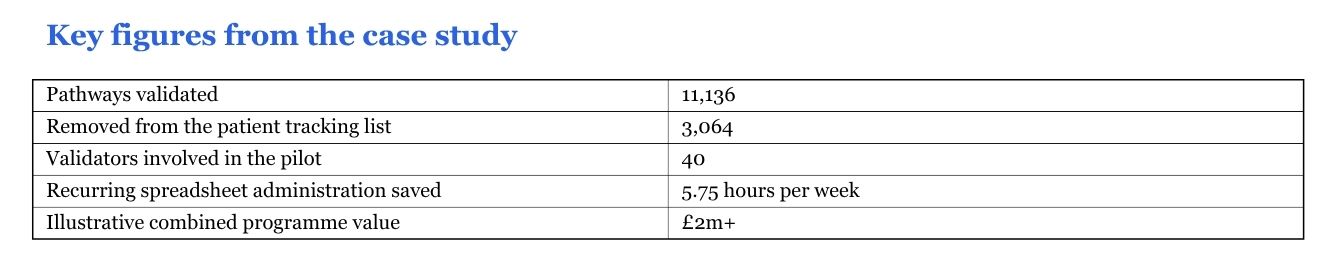
Value note: the £2m+ figure is an illustrative combined value case. It combines annualised workforce capacity released by the observed time savings with the value of platform capability, infrastructure and programme/team support. It is not a source-reported or independently validated cash saving.
Source: internal NHS case study reviewed by Distilled Post. The trust has been deliberately anonymised in this article.