
The operating theatre is ready. The surgical team is available. Equipment has been prepared. Yet the session is not fully utilised. Somewhere in the hospital's administrative systems, a patient's waiting-list status has not been reconciled with staff availability, another appointment has not been scheduled, or a theatre slot remains unfilled. Across a large hospital trust, these seemingly small inefficiencies can accumulate into a substantial loss of treatment capacity.
At University Hospitals Dorset NHS Foundation Trust, a new approach to theatre scheduling has demonstrated what can happen when those gaps are addressed systematically. By connecting waiting-list information with staff rotas and annual leave records, the trust has created the potential capacity for an additional 2,500 surgical treatments each year. Patients can be booked further in advance, clinicians have better visibility of available theatre sessions, and managers can identify opportunities to use existing resources more effectively.
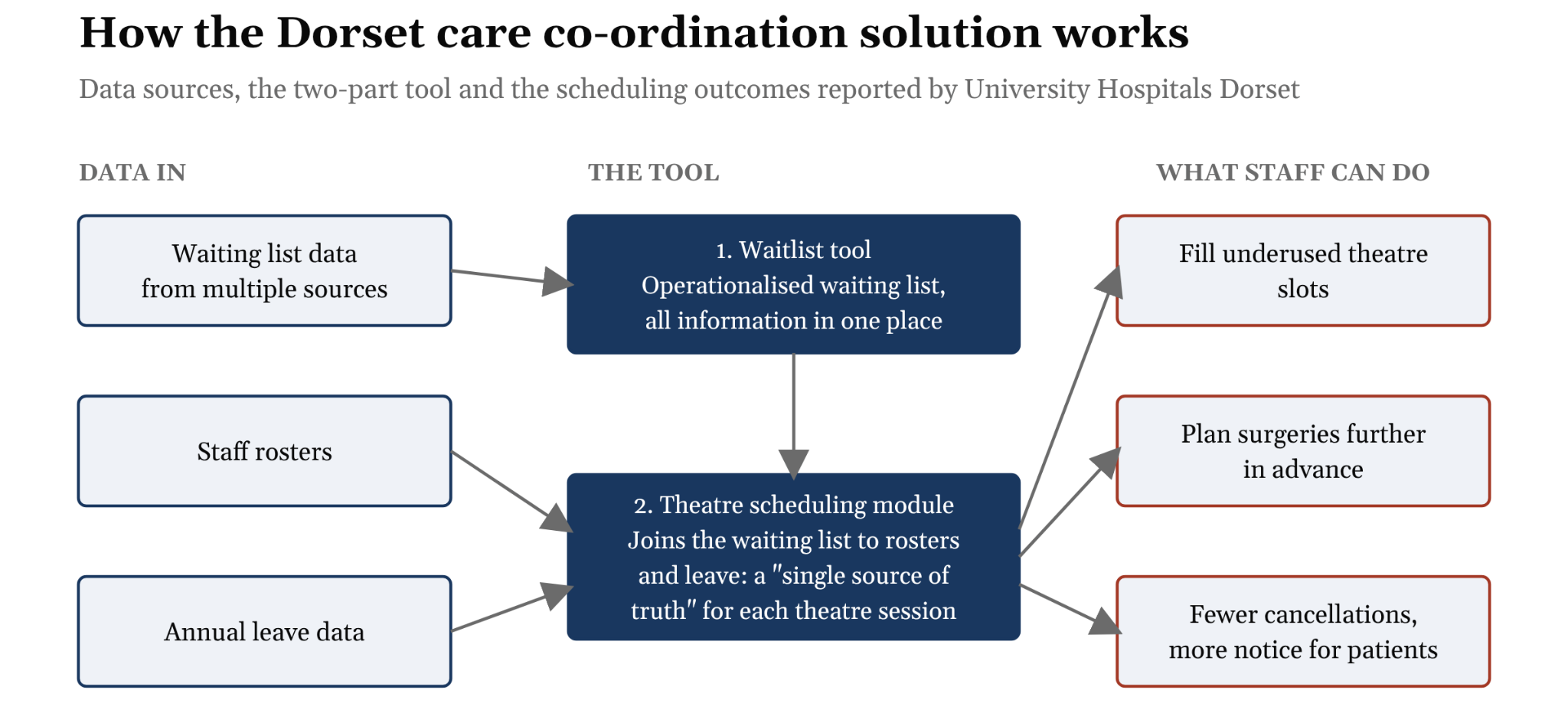
The figure deserves attention because it points towards a problem confronting the NHS well beyond Dorset: the extent to which operational inefficiency is restricting the delivery of care.
England's elective waiting list remains a considerable test of the government's healthcare ambitions. In August 2026, approximately 7.19 million referral-to-treatment pathways were awaiting completion. Only 65.2% of patients were waiting within the 18-week standard, considerably below the government's ambition of 92% by March 2029. The improvement achieved over the previous year has also become less consistent, with progress slowing during the summer.
Expanding surgical activity requires more than additional operating sessions. Hospitals must coordinate surgeons, anaesthetists, nurses, diagnostic services, equipment, beds and recovery facilities. A theatre cannot operate productively simply because a room is available. Its use depends on several interdependent resources being ready at the same time.
This is where Dorset's approach becomes significant. The trust's Care Co-ordination Solution brings together two functions: a waiting-list tool and a theatre scheduling module. The first consolidates information from multiple sources into an operational waiting list. The second connects that information with staff availability and theatre schedules, giving managers and clinicians a clearer view of each session.
Previously, the trust operated across three sites with disparate systems and different theatre-planning processes. As Mark Major, Deputy Group Director of Operations for the Surgical Care Group, explained, there was no single version of the truth for tracking patients. The new framework has helped establish consistent planning across those sites.
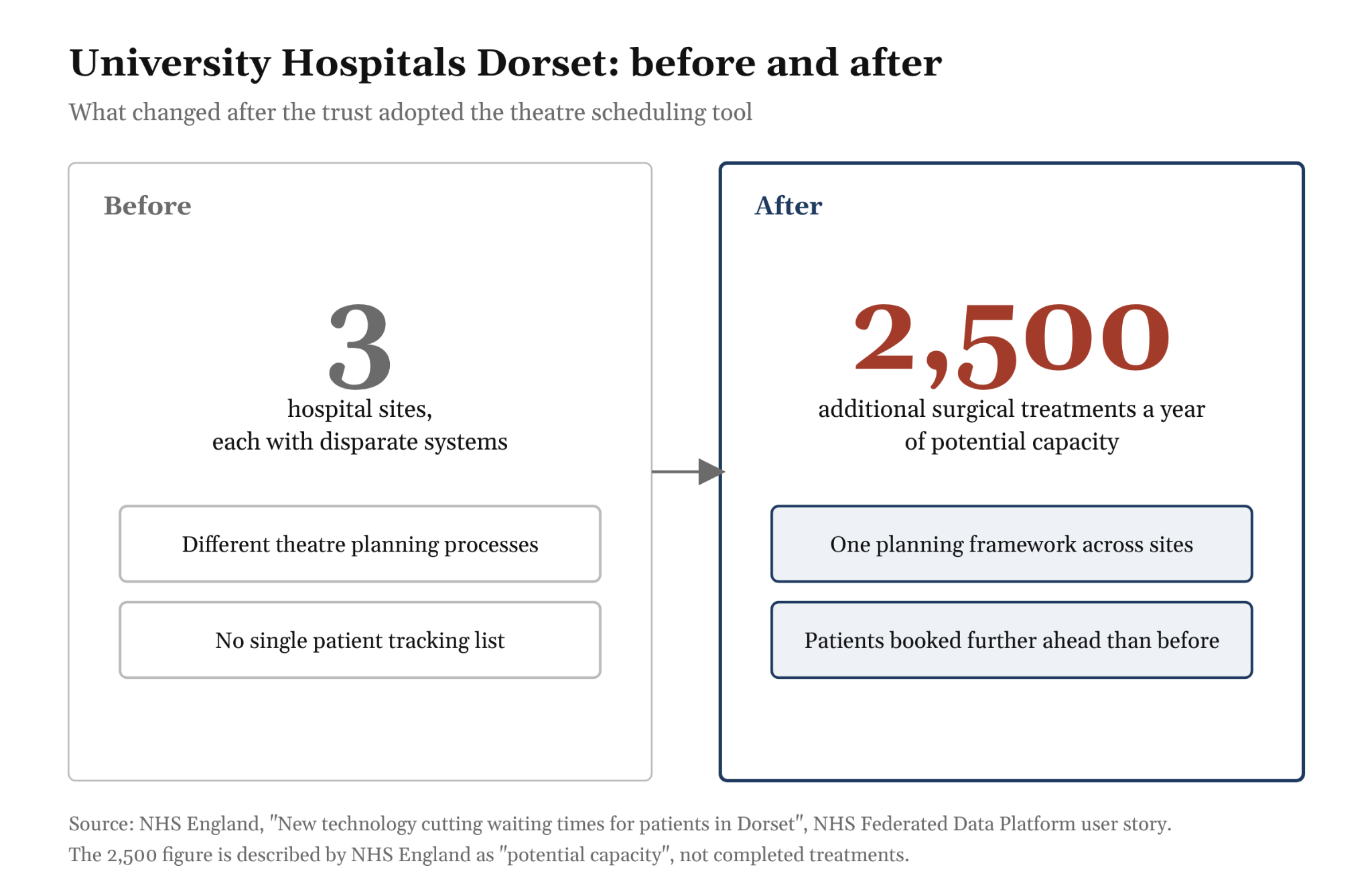
The reported 2,500 additional treatments represent potential capacity created through improved scheduling. That distinction matters. It should not be interpreted as 2,500 additional completed operations without further evidence of activity delivered. Nevertheless, identifying and making available capacity that was previously difficult to use is a meaningful operational achievement.
For NHS trusts facing financial constraints, this approach has practical implications. New hospitals and additional surgical facilities require significant capital investment, while expanding activity through existing infrastructure can offer a different route to improving access.
The challenge is to understand where capacity is being lost. Late cancellations, inaccurate waiting lists, poorly coordinated staffing arrangements and insufficient forward planning can all undermine theatre utilisation. Some of these problems are unavoidable. Others are administrative failures that better information and planning can address.
A more accurate operational picture allows hospitals to identify patients who are clinically ready for treatment, match them to appropriate sessions and give staff greater notice of upcoming commitments. It can also help ensure that patients with the most urgent clinical needs are prioritised alongside those who have waited longest.
This is particularly relevant as NHS organisations face pressure to demonstrate productivity improvements while managing workforce constraints. Better scheduling cannot resolve shortages of specialist nurses or anaesthetists, nor can it compensate for inadequate postoperative beds. It can, however, help ensure that the workforce already available is organised around the demand for treatment.
For staff, predictability has value in its own right. More advance notice of operating schedules can improve workforce planning and reduce the disruption associated with repeated changes. Dorset's experience suggests that digital tools can support different working practices, although their success depends on staff involvement and confidence in the information being used.
Dorset's experience also sits within a larger national programme. The NHS Federated Data Platform (FDP) was developed to help organisations connect information held across separate systems and use it to manage services more effectively.
Its relevance extends beyond elective surgery. The platform supports operational functions including waiting-list management, discharge planning and coordination of patient pathways. NHS England's published figures show that, by March 2026, 39 trusts were reporting benefits from the inpatient theatre scheduling module. Across participating organisations, the platform was associated with a cumulative 111,589 additional patients undergoing procedures in hospital theatres compared with the previous period without FDP use. These are reported observational comparisons, rather than evidence that the platform alone caused every additional procedure.
The distinction is important when assessing the national programme. Technology can connect information, but the improvements emerge when organisations change how they plan and deliver services. A platform cannot independently resolve poor management practices, inconsistent data entry or a lack of clinical capacity.
The political context also makes the Dorset example particularly timely. The FDP's contract, awarded to a consortium led by Palantir, faces a significant decision point. The government must decide whether to extend the initial contract beyond March 2027, with the decision expected before December 2026. Questions surrounding procurement, public trust, supplier dependence, data governance and demonstrable value have become central to the debate.
For NHS leaders, this creates a difficult but necessary distinction. The operational value of tools developed through the platform should be assessed independently of the political and commercial arguments surrounding its supplier. If a scheduling solution improves patient access, that benefit deserves scrutiny and measurement. Equally, the existence of a successful local deployment cannot, by itself, settle questions about the long-term national contract.
The NHS must be able to demonstrate that digital infrastructure produces tangible improvements, that local organisations retain appropriate control over their information and that solutions can remain useful as technology and procurement arrangements change.
The next challenge is replication. NHS England has already supported the wider deployment of Dorset's care co-ordination solution, reflecting the potential for other trusts to benefit from similar improvements. But implementation across the NHS will require more than making software available.
Trusts differ considerably in their digital maturity, workforce arrangements, estate capacity and clinical processes. A model that works across three hospital sites in Dorset will need adaptation elsewhere. Successful adoption will depend on accurate underlying data, clear operational ownership and sustained engagement from clinical and administrative teams.
There also needs to be a more rigorous approach to measuring outcomes. Additional capacity identified should be distinguished from operations actually completed. The NHS should examine theatre utilisation, cancellation rates, time from listing to treatment and the distribution of waiting times across clinical priorities. These measures would help establish whether improvements are translating into better access rather than simply producing more efficient administrative processes.
For patients, the ultimate measure is straightforward: whether they receive necessary treatment sooner, with fewer cancellations and greater certainty about when their operation will take place.
Dorset offers a useful demonstration of what better operational coordination can achieve. Its significance lies in the possibility that similar improvements exist elsewhere, waiting to be identified through more effective use of information and existing resources.
The NHS faces a substantial capacity challenge, and new investment will remain necessary. Yet before every additional treatment is associated with another building, another operating theatre or another round of recruitment, trusts should understand how effectively they are using what they already have.
The 2,500 treatments identified in Dorset provide a compelling starting point. The larger test is whether the NHS can turn that potential into a measurable and sustained improvement in patient access across the country.