
At Chesterfield Royal Hospital, the problem was visible at the end of an operating list. In the six months before a new improvement programme, 78% of Ear, Nose and Throat (ENT) theatre lists finished beyond their scheduled time, running an average of 56 minutes late. Each overrun represented a planning problem with consequences for patients, clinicians and the hospital's ability to make full use of its available surgical capacity. By the time the trust introduced a digital coordination tool, the challenge was clear: more patients needed treatment, but existing theatre time was not being used as effectively as it could be.
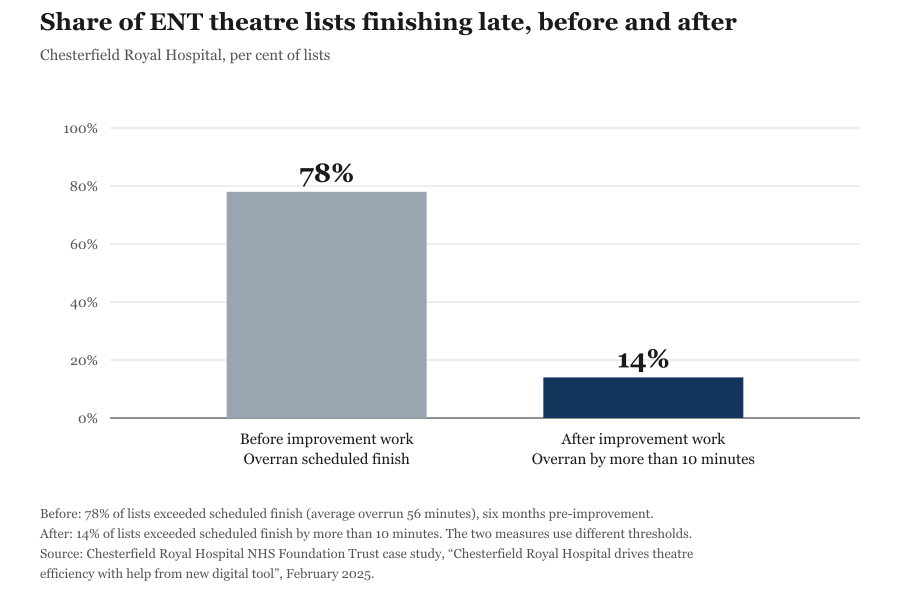
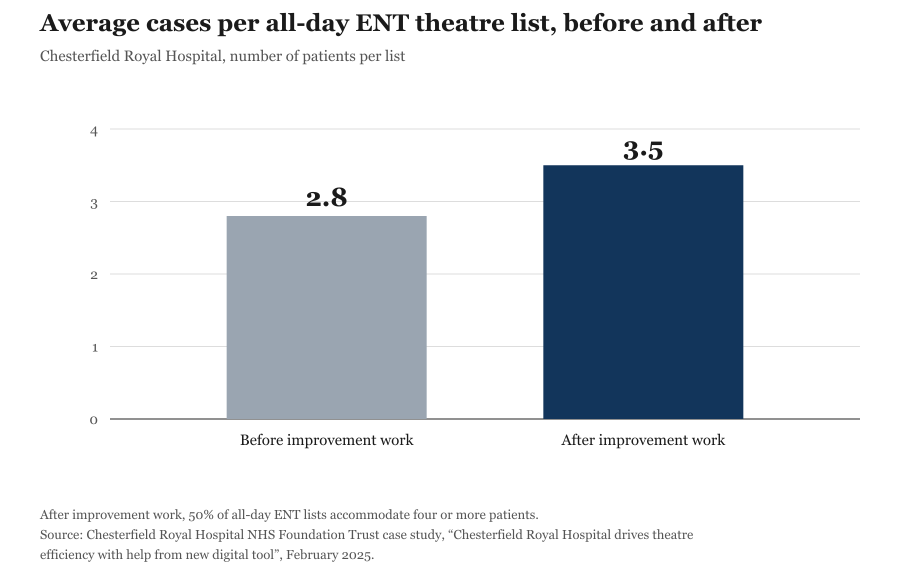
The results were measurable. Between April and December 2024, Chesterfield Royal Hospital NHS Foundation Trust facilitated treatment for 232 additional patients compared with the same period in 2023, representing a 3.7% increase. The number of scheduled theatre sessions also rose by 5%. In ENT, the proportion of lists finishing more than 10 minutes late fell from 78% to 14%, while the average number of cases accommodated in an all-day list increased from 2.8 to 3.5. Half of all lists were now treating four or more patients.
These figures offer a useful insight into one of the NHS's most persistent operational challenges: the gap between the capacity a hospital has and the capacity it can actually deliver.
The NHS waiting list remains a key measure of the government’s ability to deliver on its health commitments. In July 2026, England’s elective waiting list stood at around 7.33 million, with just 65.4% of patients receiving treatment within 18 weeks. Although this represented an improvement over the preceding year, progress remains considerably slower than the government's ambition to restore the 92% standard by the end of the current parliament.
The difficulty is partly structural. Hospitals must accommodate growing referrals while managing limited staffing, constrained budgets, competing clinical priorities and ageing infrastructure. Increasing surgical activity therefore requires more than opening additional appointments or extending operating hours. Trusts must understand how effectively existing resources are being used.
Operating theatres illustrate the problem particularly well. A session that starts late, a patient who is not ready, an unsuitable list order or an unexpected scheduling change can reduce the number of procedures completed. These individual disruptions accumulate across departments and weeks. The resulting loss of capacity is difficult to recover when staff and facilities are already under pressure.
Chesterfield's experience demonstrates what can happen when hospitals gain a clearer picture of these processes. Its Care Coordination Solution (CCS), part of the NHS Federated Data Platform, brought scheduling information together to support theatre planning and coordination. The platform gave clinical and administrative teams greater visibility of upcoming lists, allowing them to identify opportunities to improve how available time was allocated.
The significance lies in the operational changes that followed. The platform was introduced as part of a wider theatre improvement programme, with staff using its information alongside their understanding of daily clinical requirements. The technology supported the decisions; the teams changed the working practices.
The distinction is important for the wider NHS digital transformation programme. Hospitals have spent years introducing digital systems, yet the presence of new technology does not automatically translate into improved patient access.
A scheduling platform can display information more effectively, but its value depends on whether that information reaches the people making decisions and whether those decisions alter how services operate. At Chesterfield, the involvement of local theatre teams was central to the improvement process.
Lee Alexander, Improvement Programme Lead at the trust, described how staff combined information from the platform with their experience of working within individual theatre lists. This relationship between operational data and clinical knowledge is particularly important in complex hospital environments. Scheduling decisions must account for patient needs, procedure length, anaesthetic requirements and the availability of appropriately trained staff.
Dr Jon Cort, Executive Chief Digital Officer and Consultant in Anaesthetics and Intensive Care Medicine, also highlighted the platform's value to anaesthetists planning their workflows. Their involvement illustrates why digital transformation cannot be treated as an administrative exercise. The people responsible for delivering care need to find the information useful in their daily work.
There is wider evidence that this approach may have value beyond one hospital. NHS England reported that, by March 2026, 39 trusts were realising benefits from the theatre module of the Inpatients Care Coordination Solution. Across trusts using the inpatient product, the reported cumulative number of additional patients undergoing theatre procedures was 111,589 compared with the corresponding periods before implementation. These figures are based on observational before-and-after comparisons and should not be interpreted as proof that the platform alone caused the increase. Nevertheless, they indicate the scale of operational improvement activity taking place across the system.
The case for better theatre coordination becomes stronger when considered alongside the broader evidence emerging from NHS trusts. A 2026 analysis of theatre scheduling at another NHS trust found that, following implementation of the FDP scheduling solution, actual theatre utilisation was 12.2% higher than the modelled level expected without the intervention. Booked utilisation was 15% higher. The study also identified differences between clinical specialities, suggesting that implementation and local working practices influence the results.
This is encouraging evidence, although it requires careful interpretation. A digital platform cannot resolve every constraint affecting elective activity. If a hospital lacks anaesthetists, theatre nurses, recovery beds or sufficient post-operative capacity, improved scheduling will have limited room to increase throughput. Filling more surgical lists without protecting staff capacity could simply transfer pressure elsewhere in the hospital.
For NHS leaders, the lesson is to treat theatre productivity as a whole-system responsibility. Digital scheduling should be accompanied by clinical engagement, reliable data, workforce planning and regular assessment of whether additional activity is translating into completed procedures. The number of scheduled sessions is a useful indicator, but actual utilisation, cancellations, waiting times and patient outcomes provide a more meaningful assessment of performance.
There is also a financial argument. With trusts facing substantial financial constraints, making better use of existing infrastructure offers an opportunity to increase activity without immediately requiring additional theatre capacity. However, productivity improvements should not become a rationale for expecting existing teams to absorb indefinitely higher workloads. Sustainable gains depend on having the staff and supporting services required to deliver the additional procedures safely.
The NHS Federated Data Platform occupies an important position in this discussion. Its purpose is to help organisations bring operational information together so that teams can make better decisions about patient pathways and service delivery. Its applications extend beyond surgical scheduling into areas including waiting list management and discharge coordination.
The political significance is considerable. The government has placed productivity and digital transformation within its wider programme for NHS reform, while patients continue to judge the health service through their experience of access and waiting times. Technology that demonstrably improves operational delivery has a stronger case for public investment than systems whose success is measured primarily through implementation milestones.
Yet national adoption should not be confused with national improvement. Different trusts have different infrastructure, workforce profiles, data quality and clinical processes. A solution that produces results in one setting will require adaptation elsewhere. NHS leaders should therefore pay attention to the conditions that made Chesterfield's results possible, particularly the involvement of clinicians and the decision to introduce the platform within a broader improvement programme.
There is an additional accountability question. Digital programmes need transparent evaluation, with clear distinctions between activity scheduled, procedures completed and waiting times genuinely reduced. The NHS must be able to establish whether improvements persist beyond initial implementation and whether additional activity reaches the patients who have waited longest.
Chesterfield Royal's achievement is a relatively modest intervention measured against the scale of the national elective backlog. Its 232 additional patients will not resolve the waiting list crisis. But the results demonstrate something operationally important: meaningful capacity can sometimes be found within existing services when information, planning and clinical practice are brought into closer alignment.
The challenge now is to make that kind of improvement repeatable. For the NHS, the real measure of digital reform will be the number of patients who receive the care they need, and how reliably hospitals can deliver it without exhausting the workforce responsible for making it happen.