
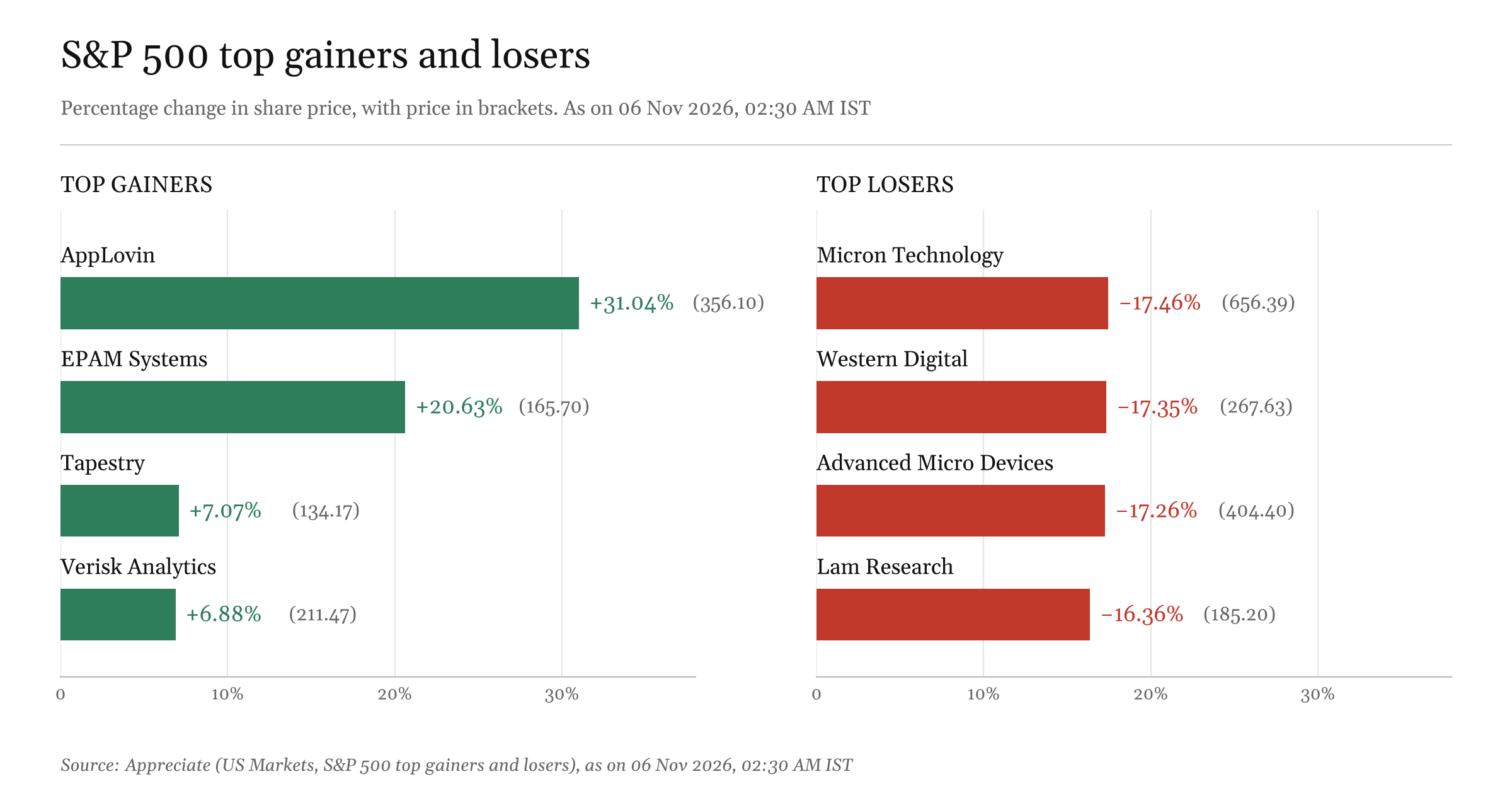
By the close of trading in New York on 5th of November, 2026, about $3 trillion had been erased from the S&P 500 in a single session. The index fell 4.32 per cent and the Dow Jones Industrial Average lost 3.45 per cent. The Nasdaq Composite dropped 5.46 per cent, its worst day in 19 months, and Nvidia alone shed more than $600 billion of market value. Micron, Western Digital, Advanced Micro Devices and Lam Research each fell by roughly 16 to 17 per cent, while AppLovin and EPAM Systems rose by 31 and 21 per cent. Investors pointed to tighter scrutiny of AI infrastructure and weaker chip sales in China, with doubts over how AI will be monetised and a jump in oil prices linked to tension involving Iran adding to the pressure.
The British government has tied much of its case for NHS recovery to the same technology, which gives the sell-off a relevance well beyond Wall Street.
None of this touches the NHS directly. Hospitals do not hold Nvidia shares, and a fall in chip valuations will not close a ward. The link is structural. The ten-year plan promises a shift from analogue to digital, and ministers have repeatedly named automation and AI as the route to productivity gains that funding alone cannot deliver. A market that suddenly doubts the economics of that technology deserves attention from those who have built plans on it.
Begin with oil, because its route into the public finances is the most direct. The Chancellor has narrow fiscal headroom and little room to absorb external shocks. Higher energy costs feed inflation, which lifts gilt yields and the cost of servicing debt, and that erodes the headroom the health budget depends on. The NHS estate is old and expensive to heat. Trusts already struggle to fund backlog maintenance, and a sustained rise in energy prices would draw capital away from diagnostics and surgical hubs. Pay adds pressure. If inflation stays elevated, the next pay review round will be harder to settle, and relations with resident doctors and other unions remain fragile.
Procurement is the second channel. Much of the AI the NHS is adopting comes from suppliers financed by venture capital and priced on growth expectations. When valuations fall, funding becomes scarcer and vendors come under pressure to raise prices or seek acquisition. A trust that has embedded a product in clinical workflows can find that its supplier has changed hands or rewritten its terms. The National Programme for IT, abandoned after years of delay and overspend, taught the service that dependence on a single provider is a financial risk as much as a technical one. Contracts signed at the peak of enthusiasm should be read again with exit rights and data portability in mind.
Regulation, which helped trigger the sell-off, is the third channel. Investors reacted to the prospect of tighter oversight of AI infrastructure, including limits on data centre expansion. Britain has been courting that same infrastructure, with designated growth zones for AI and ambitions to host compute capacity for research. Health stands to gain a great deal from that strategy, since the large datasets held by national research bodies and the NHS are among the most valuable assets the country can offer. If regulation tightens abroad and capital grows cautious, the terms of any partnership will shift in ways the UK should anticipate. The government must decide whether NHS data is a public asset to be protected on public terms or a bargaining chip in a race for investment. That choice has been deferred for too long, and a nervous market makes deferral costlier.
Public trust is also at stake. Patients have been told that technology will shorten waits and ease pressure on staff. Clinicians have heard similar promises before, and many remain unconvinced that digital tools lighten their workload. A visible market reversal hands sceptics a fresh argument. If trusts invest heavily and the gains arrive late or not at all, the political cost will fall on those who made the case. Evidence of benefit, gathered locally and published plainly, is the only credible defence.
Retreat would be the wrong answer. Ambient documentation tools and AI-assisted diagnostic imaging have shown promise in early deployments, and a fall in share prices does not change what a well-designed tool can do for a clinic list. What the moment calls for is discipline. NHS England and integrated care boards should ask suppliers harder questions about financial resilience. Boards should insist on staged contracts with measurable outcomes. The centre should stress-test national programmes against a scenario of higher energy costs and weaker supplier finances. Life sciences and health-tech companies should expect closer scrutiny of their claims and less tolerance for projects that cannot show savings.
The deeper lesson concerns state capacity. Britain has a health service that needs productivity growth and a Treasury that cannot fund it by other means. That pairing makes technology a necessity and leaves the NHS unusually exposed to the mood of global capital. The consequences of a sell-off in New York travel through energy bills, gilt yields and supplier balance sheets until they reach a trust board in the north of England. Reform that depends on favourable external conditions is a bet, and the NHS has too little slack to keep placing bets it cannot hedge.