
Survival in systemic light chain amyloidosis has improved materially, yet the central challenge has not disappeared. Patients can live longer while still carrying profound cardiac limitation, fatigue and loss of independence. For haematology, the next question is therefore more demanding than whether treatment extends life. We must also establish whether patients can walk farther, recover function and experience a life that is recognisably better.
This matters because AL amyloidosis is not a conventional blood cancer story. A small plasma cell clone can produce toxic light chains that deposit in organs, with cardiac involvement often driving urgency and prognosis. Modern therapy can suppress that clone rapidly, and the addition of daratumumab to bortezomib, cyclophosphamide and dexamethasone has helped redefine first line treatment. But a haematological response and an organ response do not always arrive together. The biology may improve before the patient feels stronger, while irreversible organ damage, frailty and treatment burden can continue to shape everyday life. Survival curves remain essential, but they cannot describe the whole recovery. If research measures only laboratory response, hospitalisation and death, it risks overlooking the functional distance between being alive and being well enough to participate fully in family, work and community life.
That is why the six minute walk test deserves more serious attention. The 6MWT is simple: it records how far a person can walk in six minutes under standardised conditions. Yet beneath that apparent simplicity sits an integrated signal of cardiovascular performance, respiratory reserve, muscle strength, balance, fatigue and confidence. In AL amyloidosis, published evidence has shown that baseline walking distance is prognostic, with a distance of at least 350 metres independently associated with better survival. The measure is not a replacement for cardiac biomarkers, staging or clinical judgement. It can, however, add something those measures struggle to capture, namely whether physiological improvement is translating into useful function.
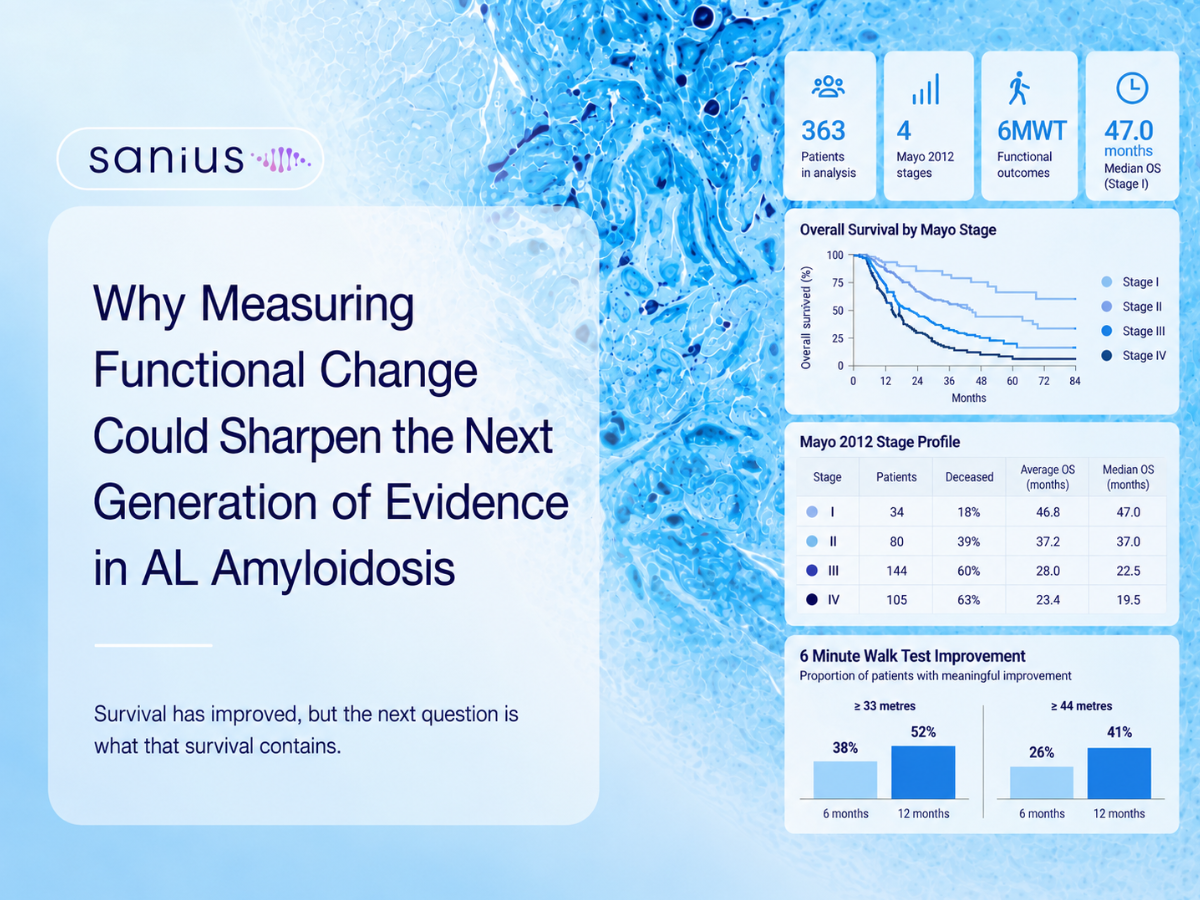
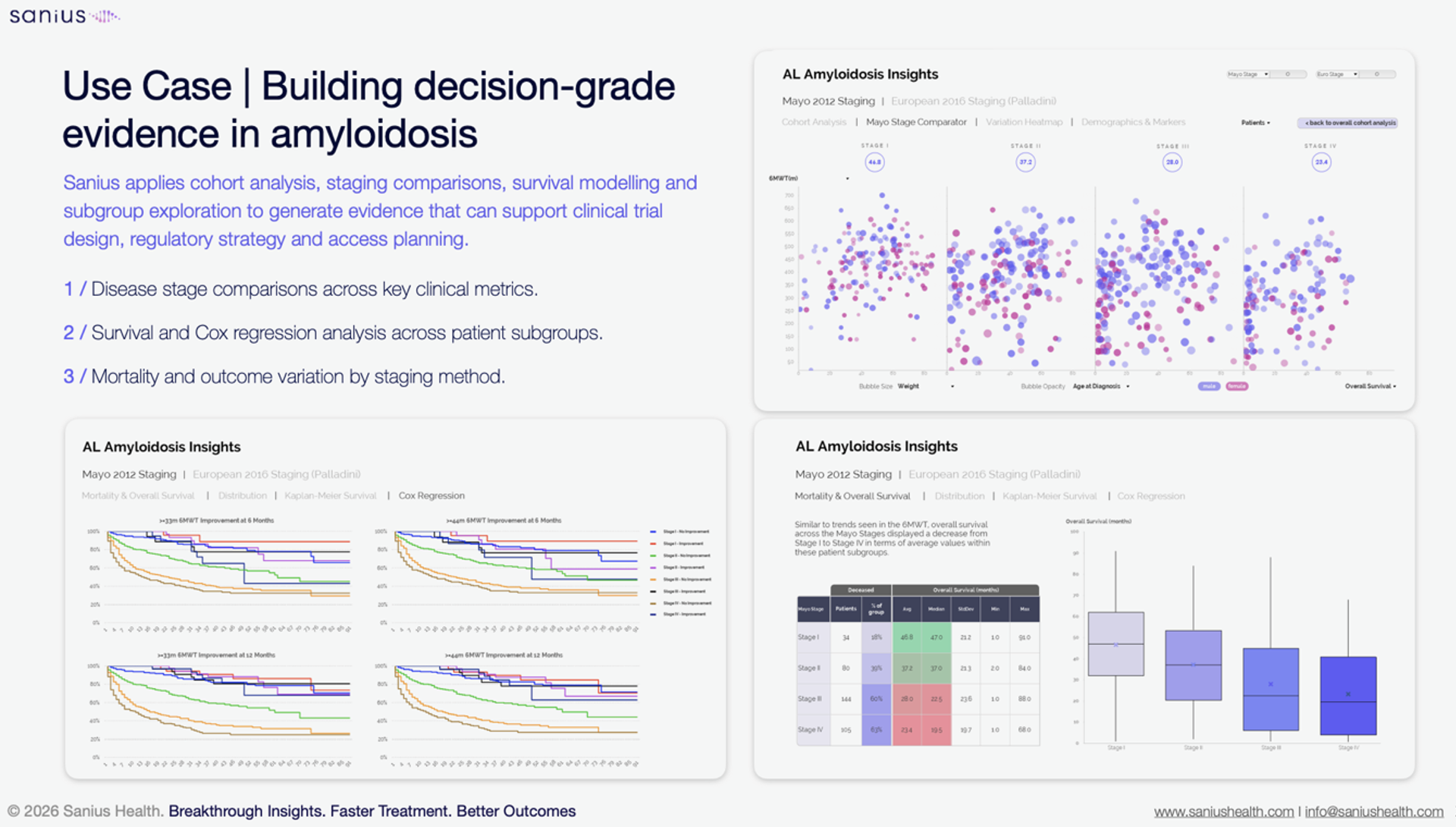
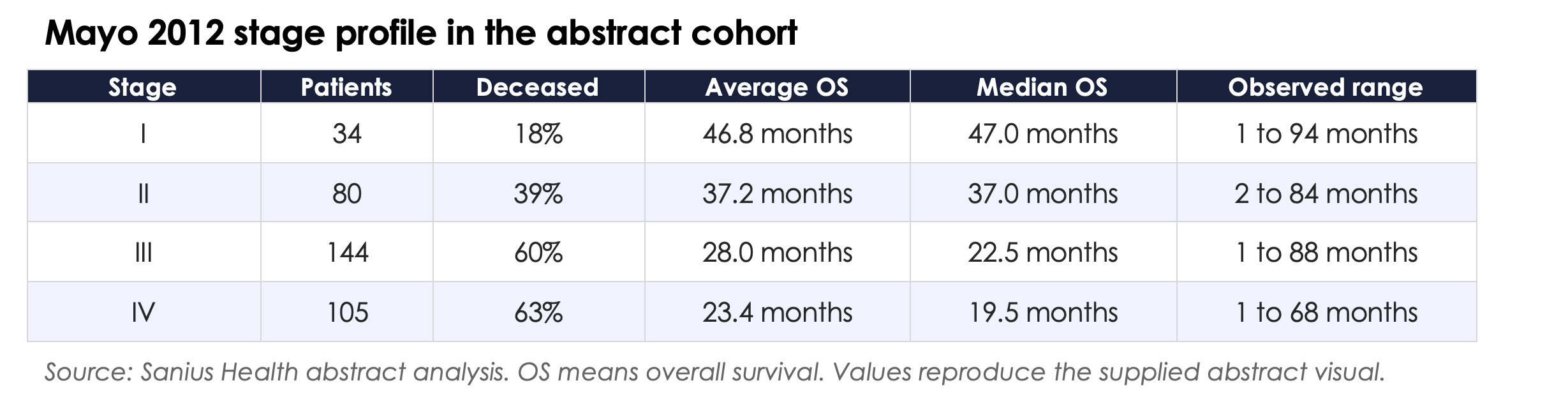
Sanius Health’s exploratory amyloidosis work points in the same direction. The abstract analysis covers 363 patients stratified using the Mayo 2012 system. The proportion recorded as deceased rises from 18% in Stage I to 63% in Stage IV, while median overall survival falls from 47.0 months to 19.5 months. Average overall survival follows the same gradient, declining from 46.8 months in Stage I to 23.4 months in Stage IV. The analysis also examines 6MWT improvement at six and twelve months using thresholds above 33 metres and 44 metres. These findings are observational rather than causal, but the stage gradient is clear and shows why longitudinal functional measurement matters. A single baseline result can identify risk; repeated assessment can reveal trajectory.
This distinction could change how studies are designed. A six month improvement may indicate early functional recovery, while a twelve month measure may show whether that recovery is durable. Combined with patient reported outcomes, symptoms, wearable data, treatment exposure and clinical events, the 6MWT can become part of a richer real world evidence model. Researchers could examine which patients improve despite advanced stage, which plateau after a deep haematological response, and which appear clinically stable while their function is quietly deteriorating. That creates an opportunity to intervene earlier and to understand treatment value beyond a conventional endpoint.
As the company prepares for its next major US study in amyloidosis, Sanius Health’s ambition is to build evidence that can support clinical development, regulatory strategy and access decisions without losing sight of the patient. The company wants to test how 6MWT can be measured more consistently, interpreted alongside established staging systems and connected to survival, hospital use and quality of life. The scientific opportunity lies not in elevating one measure above all others, but in connecting the measures that matter.
For industry, this is also a question of decision quality. A functional endpoint that is collected consistently across sites can help distinguish a statistically positive result from an improvement patients can actually recognise. It can strengthen conversations with regulators and payers, expose important subgroup differences and provide a clearer account of benefit when survival data take years to mature. In a rare disease, every well measured patient journey matters.
The progress made in AL amyloidosis should give the community confidence, not permission to become comfortable. Longer survival is a remarkable achievement. The next advance will come from proving what that survival contains: greater mobility, fewer days constrained by illness and more of ordinary life returned to patients. That is evidence worth building, and work around which clinicians, researchers, patient organisations and industry should rally.



.png)
.png)