Leading clinicians and public health experts are calling on the World Health Organisation (WHO) to immediately update its global infection-control guidance, advocating for respirator-grade masks to be the standard personal protective equipment (PPE) for all healthcare workers in every clinical setting.
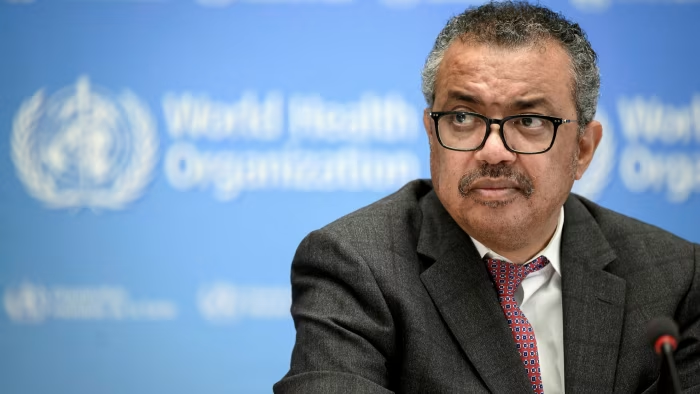
This appeal, presented in an open letter sent to WHO Director-General Dr Tedros Adhanom Ghebreyesus in early January 2026, is driven by new evidence supporting the airborne transmission of respiratory pathogens. The coalition of scientists and clinicians argues that current recommendations, which heavily rely on loose-fitting surgical masks, are outdated and provide inadequate protection against aerosol-borne diseases like COVID-19, influenza, and RSV.
Unlike surgical masks, which were initially designed to prevent droplets from the wearer's nose and mouth from reaching the patient, respirators like FFP2/FFP3 in Europe or N95 in the US are engineered specifically to protect the wearer. They achieve this through a tight facial seal and superior mechanical filtration of airborne particles, making them significantly more effective against infectious aerosols.
WHO’s current Infection Prevention and Control (IPC) guidance recommends medical masks for routine care, reserving respirators mainly for aerosol-generating procedures (e.g., intubation) or confirmed cases of respiratory disease. The experts counter that this narrow approach underestimates the role of aerosols in transmission and insist that protective respirators are justified for routine patient care.
A WHO spokesperson confirmed the organisation will carefully review the letter and all existing evidence as part of an ongoing update to its IPC guidelines for epidemic- and pandemic-prone infections.
However, critics of this policy shift emphasise that global recommendations must carefully consider PPE availability, supply chain constraints, and equity of access, particularly in low- and middle-income countries. Past WHO guidance has reflected these practical concerns. Furthermore, respirators are typically more expensive than surgical masks and require fit-testing and training to ensure a proper seal and maximum effectiveness. The debate reflects a fundamental tension between optimal protection and practical implementation in global healthcare systems.
The timing of this call is critical, as COVID-19, flu, and RSV continue to circulate in early 2026. The outcome of WHO’s review could have important implications for infection control protocols worldwide.
In the UK, NHS PPE guidance currently aligns with WHO’s principles, making surgical masks the standard for many clinical environments and recommending respirators only for high-risk care or procedures deemed to require airborne precautions. For UK health professionals and policymakers, these developments highlight the need to stay current with evolving global standards while balancing practical PPE strategies, healthcare worker safety, and health system resilience.