
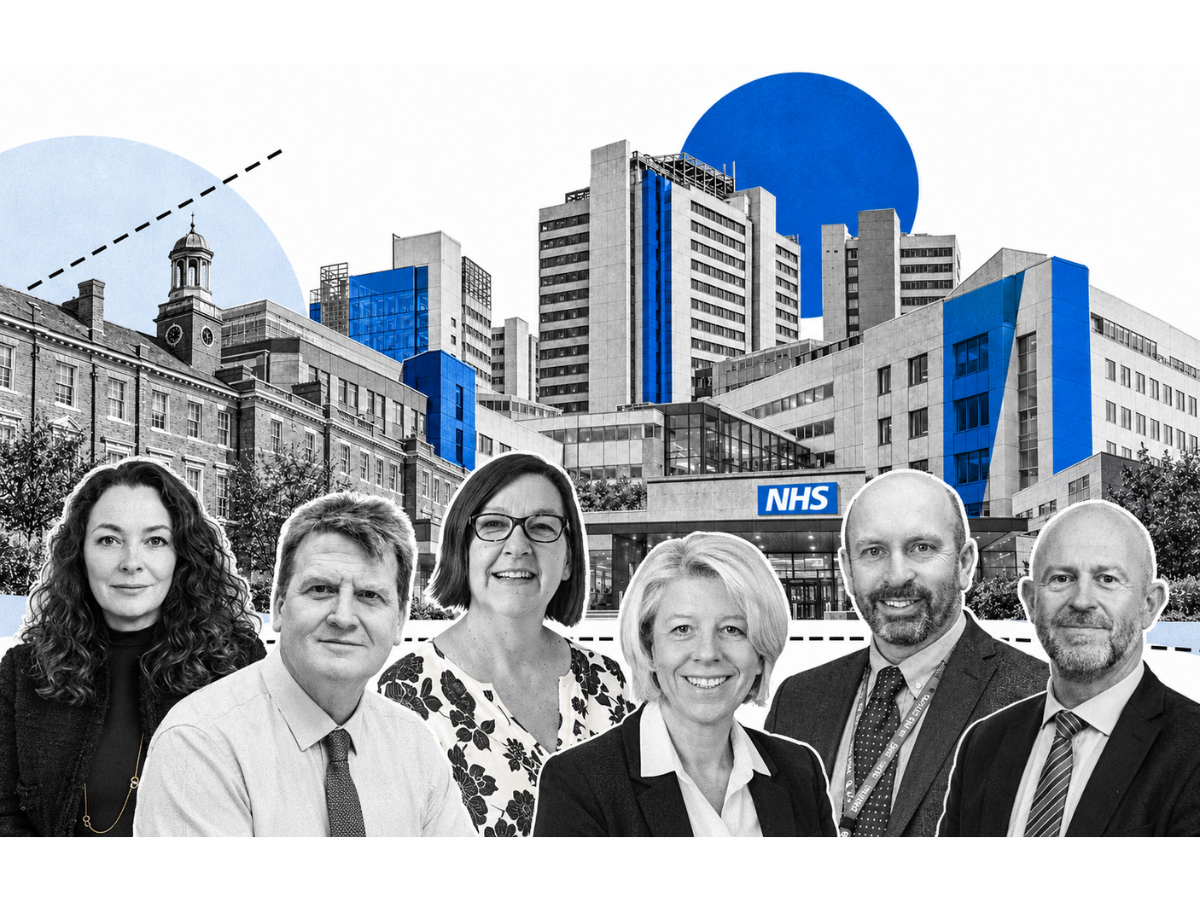
The NHS has rarely relied so heavily on interim chief executives. Since January, more than a dozen hospital trusts and integrated care boards in England have handed the top job to a temporary leader, often just as the organisation was being redesigned. Hospital groups are forming in London, Liverpool and South Yorkshire. ICBs are clustering and merging to meet a national running cost target of £19 per head of population. All of this is happening while trusts face relentless pressure to bring down waiting lists and clear emergency backlogs.
Interims were once seen as caretakers who kept things ticking over until a permanent appointment arrived. This year's group has done far more. Some have overseen measurable gains in performance, and two have already been made permanent.
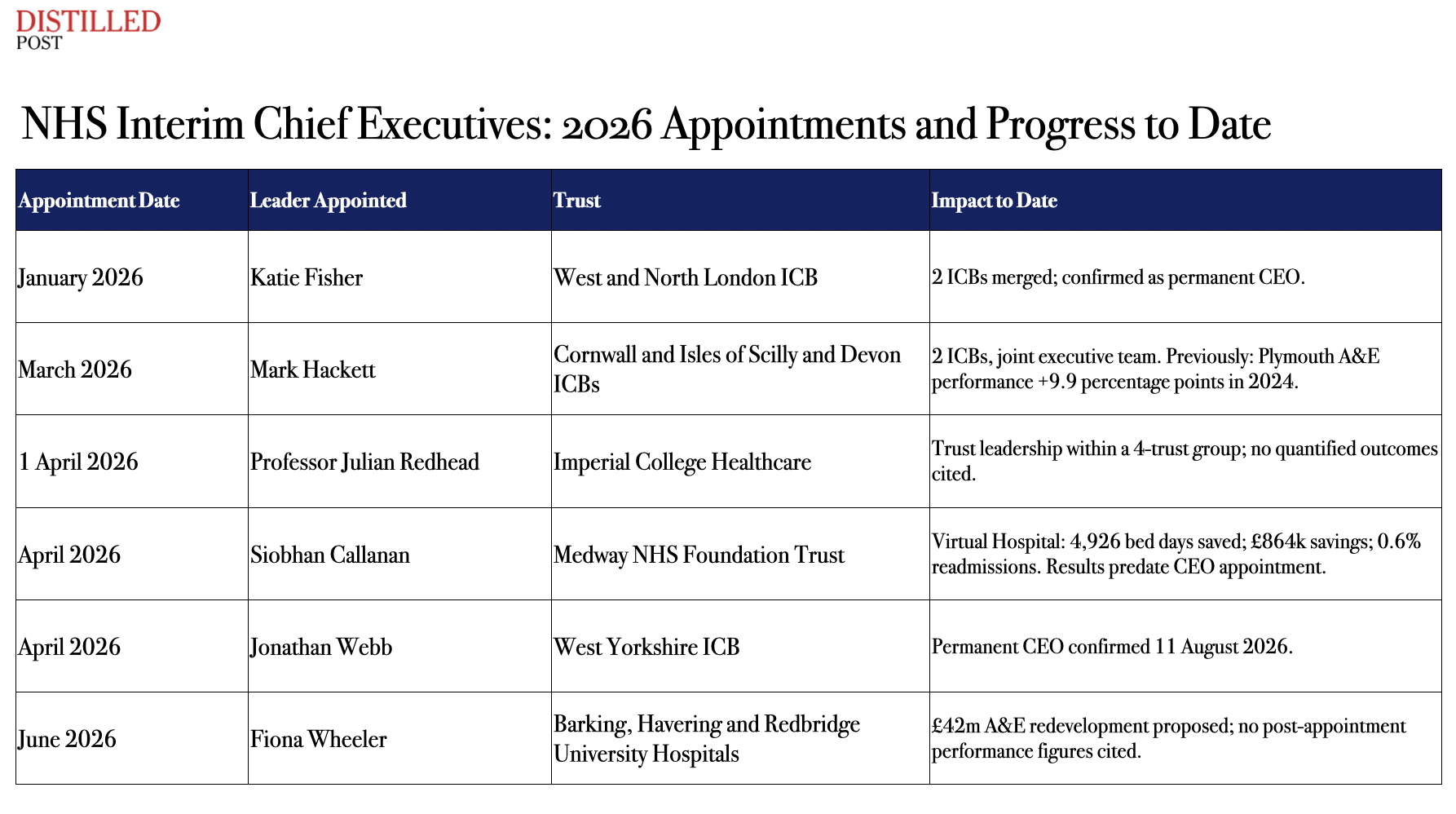
Fiona Wheeler's story is the most striking. She started in the NHS as a Band 4 junior administrator at King's College Hospital. Thirty years later she runs Barking, Havering and Redbridge University Hospitals NHS Trust, having stepped up in July when Matthew Trainer left for King's. As chief operating officer she led the trust's planned care recovery programme, and the results followed. BHRUT went from having one of the worst A&E departments in England to being the most improved for its sickest patients, and in March 2025 it was the best acute trust in London for referral-to-treatment performance.
Since taking charge she has pushed forward plans for a rebuilt A&E at Queen's Hospital in Romford. The trust is seeking £42 million and hopes to begin construction around the hospital's 20th anniversary at the end of this year. It has also doubled its capacity for robotic soft-tissue surgery with two new Sentire robots.
At Medway NHS Foundation Trust, Siobhan Callanan took over in April and within weeks was accepting a national prize. The trust's Virtual Hospital, which gives acutely unwell patients hospital-level care at home through remote monitoring and daily virtual ward rounds, won the Delivering Value Award at the first NHS Excellence Awards in June. In its first quarter it saved 4,926 bed days, the equivalent of 54 inpatient beds a month, and generated £864,000 in savings. Readmissions ran at 0.6 per cent.
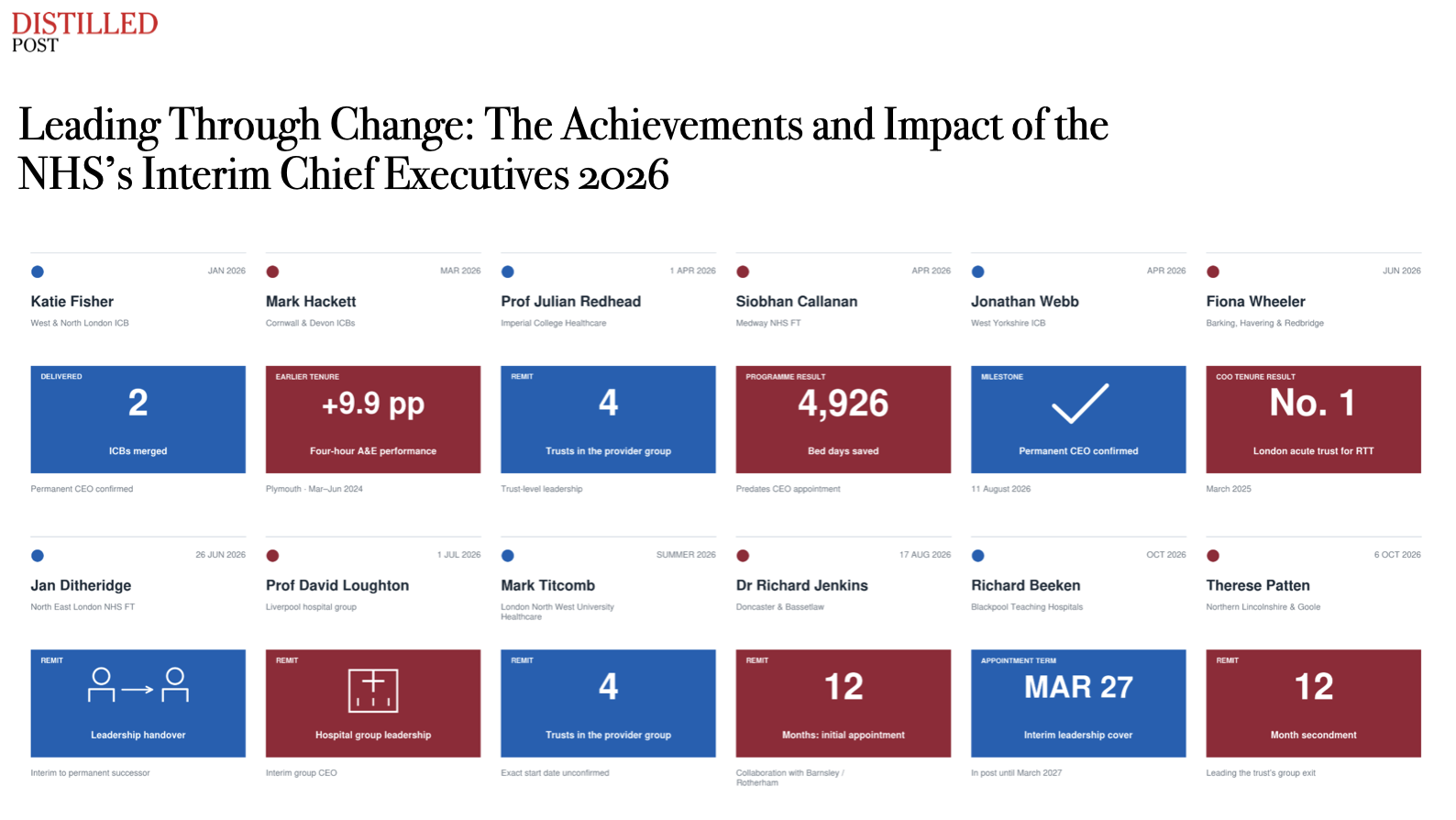
Other interims have been handed the job of joining organisations together. Mark Hackett became interim chief executive of NHS Cornwall and Isles of Scilly and NHS Devon in March, as the two boards move towards a single cluster with a joint executive team ahead of a formal merger. He arrived with a strong record. As interim chief executive at University Hospitals Plymouth in 2024, he saw the share of A&E patients treated within four hours rise from 54.1 per cent to 64 per cent between March and June, and the board extended his contract.
In South Yorkshire, Dr Richard Jenkins has led Barnsley and Rotherham under a shared arrangement since 2020. On 17 August he added Doncaster and Bassetlaw Teaching Hospitals for up to a year, making him chief executive of three trusts at once.
For two interims the temporary title has already gone. Katie Fisher stepped in at North West London ICB in February, oversaw the launch of the merged West and North London ICB in April and has since been confirmed in post. Jonathan Webb, finance director at NHS West Yorkshire ICB, became interim chief executive in April and won the substantive role in August after a competitive process, with his chair praising his system-wide leadership.
Clinical leaders are also stepping up. Professor Julian Redhead, an emergency medicine consultant who joined Imperial College Healthcare in 2004, became its trust-level chief executive in April within the new North West London Acute Provider Group. He continues to serve as NHS England's clinical director for urgent and emergency care. Few people running major London hospitals also hold a national brief for emergency care, and patients at St Mary's and Charing Cross stand to benefit from that connection.
At North East London NHS Foundation Trust, Jan Ditheridge, a nurse by background with 12 years as a chief executive, joined in June to keep the trust steady while a permanent successor was found. Edwin Ndlovu has now been appointed, and the handover is on course for the autumn.
This month Therese Patten took on Northern Lincolnshire and Goole NHS Foundation Trust to lead its exit from its group while remaining chief executive of Bradford District Care. Asking one leader to run two organisations at once shows the confidence the system now places in its experienced chiefs.
The newest arrivals bring long records of their own. David Loughton, who ran The Royal Wolverhampton NHS Trust for 20 years and improved urgent care at Walsall Healthcare, joined the University Hospitals of Liverpool Group in July. Mark Titcomb, formerly managing director of Ealing and Central Middlesex hospitals, now leads London North West University Healthcare. Richard Beeken took charge at Blackpool Teaching Hospitals on 1 October and will stay until at least the end of March, at one of the most challenged trusts in the country.
Not long ago, an interim chief executive was read as a sign that something had gone wrong. The evidence from 2026 suggests a different conclusion. Interim leaders who know how hospitals run are getting results quickly, and boards are rewarding them with permanent jobs or bigger responsibilities. As the NHS reorganises around groups and clusters, the ability to deliver now while preparing an organisation for what comes next looks set to become the standard expected of every chief executive.


.jpg)
.jpg)
.jpg)