
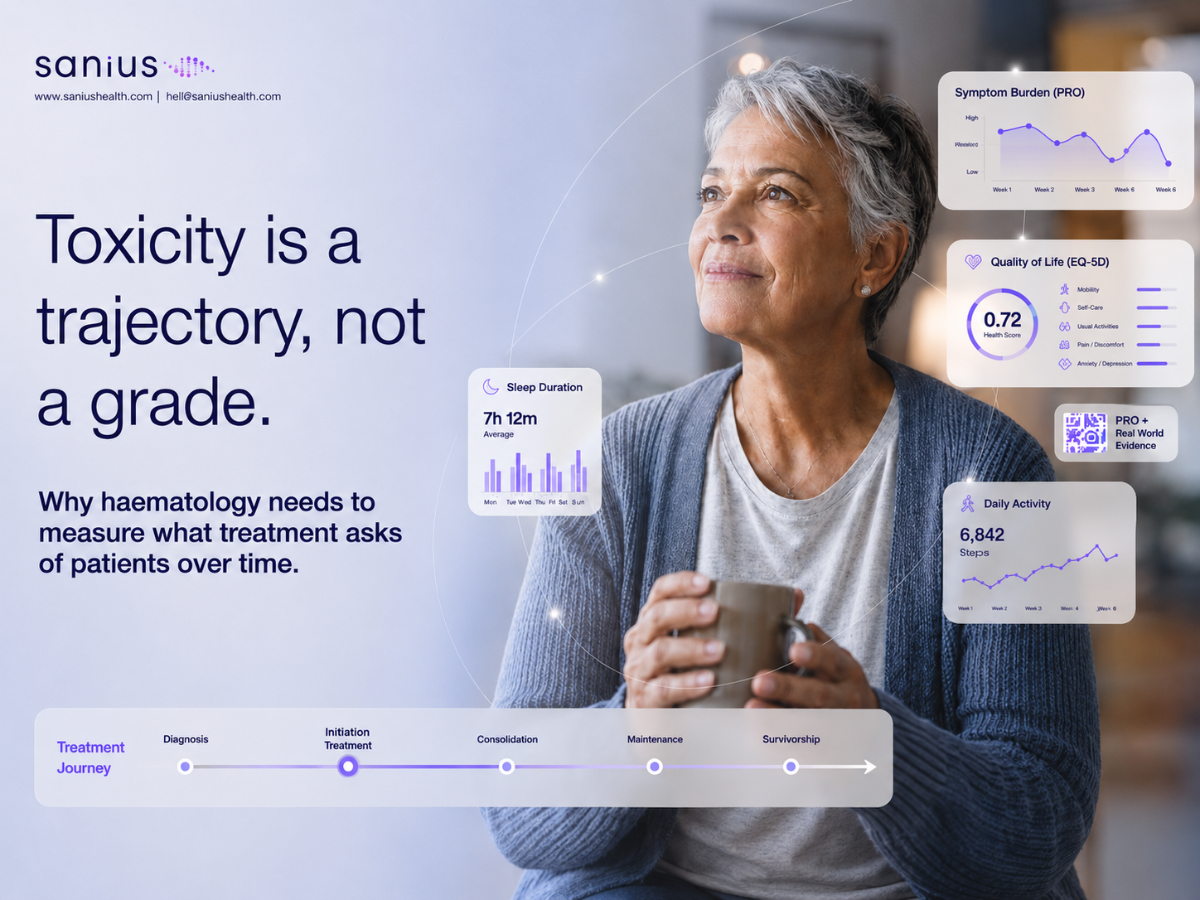
One of the most overused words in oncology is "manageable".
An adverse event can be clinically manageable and still change the structure of someone's life. It can be recorded as Grade 1 or Grade 2, recur across treatment cycles, erode sleep, reduce mobility, weaken appetite, impair cognition and quietly determine whether a patient can stay on therapy. None of that is described well by a single maximum grade.
We have become extraordinarily good at recording the worst moment. We are far less consistent at showing the pattern around it.
A new review in The Lancet Haematology, ‘Beyond maximum grade: the role of real-world digital health technologies to capture, predict, and manage treatment toxicity in haematological cancers’, makes this gap difficult to ignore. The authors argue that electronic patient-reported outcomes, wearables, electronic health records and registries can create a more continuous view of toxicity than current post-marketing assessments. Artificial intelligence (AI) may then help detect complex patterns, while synthetic data and digital twins could eventually support prediction and simulation at a scale traditional methods cannot reach.
The direction is important. The immediate opportunity is also more practical: build a longitudinal evidence layer that can show how treatment burden develops, persists, resolves and affects daily function in the real world.
The Common Terminology Criteria for Adverse Events remains essential. It gives researchers and clinicians a shared language for severity. The problem begins when the highest recorded grade becomes the dominant story of tolerability.
Maximum grade compresses time. It does not show whether a symptom lasted two hours or two months, appeared once or after every dose, remained stable or gradually accumulated. It can miss the combined effect of several lower-grade problems, and it rarely shows what those problems did to sleep, activity, independence, employment or the ability to manage the rest of life.
This matters particularly in haematology, where therapies are increasingly prolonged, sequenced and combined. Acute toxicity, cumulative burden and long-term survivorship can sit inside the same patient journey. A clinic visit captures a moment. Tolerability is the trajectory between those moments.
Electronic patient-reported outcomes can show how patients feel. Wearables can show how they function and recover. Clinical records provide the treatment, laboratory and utilisation context. Connected over time, these sources can reveal a signal that none of them can provide alone. The harder challenge is connecting fragmented EHR, registry, ePRO and wearable data around the same patient and treatment timeline, so that each signal has clinical context.
Multiple myeloma (MM) is a strong example. New therapies have extended survival and created more treatment options, but patients can live through several lines of therapy with changing combinations of disease burden, treatment toxicity and supportive care needs. Treatment line is easy to record. However, it is a poor substitute for knowing how an individual patient is actually tolerating treatment.
Sanius Health’s recent MyMM work involved 99 people with multiple myeloma in the UK, who contributed 45,383 patient-reported and wearable-derived datapoints between January 2025 and February 2026. Participants were followed for a median of 247 days. Across the cohort, weakness or lack of energy was the most severe reported symptom at 4.5 out of 5, followed by drowsiness and poor mobility.
The more revealing finding was that burden did not arrange itself neatly by treatment line. Third-line participants recorded the highest average step count and the highest EQ-5D-5L score. Weakness was greatest in the maintenance and second-line groups, while sleep duration was lowest in those receiving fourth-line or later treatment. These are exploratory findings from small subgroups, and they should not be read as treatment comparisons. They do, however, challenge the assumption that functional burden simply rises in a straight line as treatment advances.
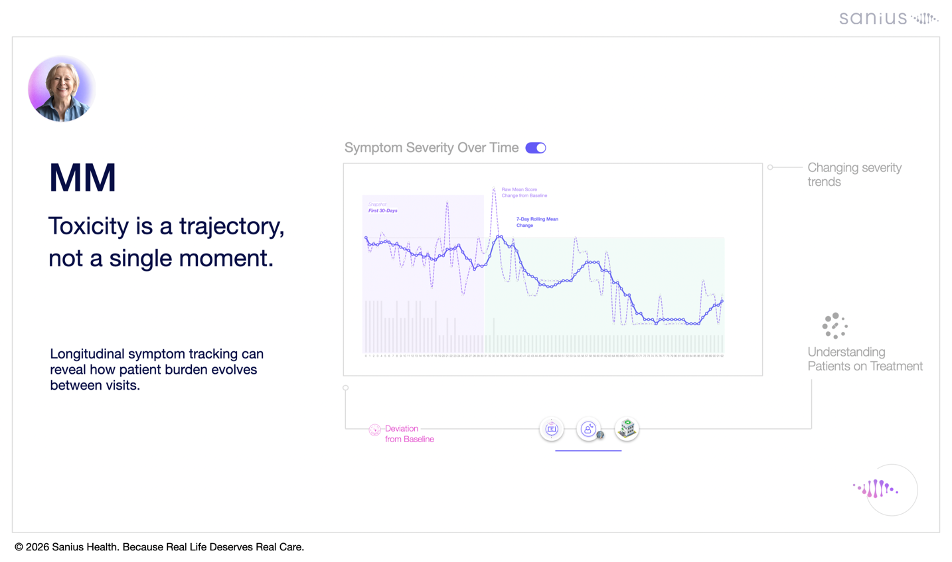
The patient-specific trajectory matters more than the treatment-line label attached to the appointment.
The better questions are therefore more precise. What changed from this patient's baseline? How long did the change persist? Did several modest symptoms combine into a major functional burden? Was recovery between cycles becoming slower? Did a change in sleep, activity or self-reported health appear before dose interruption, urgent care or treatment discontinuation?
Collecting more data is not the same as improving care. A digital programme that measures more but acts on less risks becoming another source of noise for patients and clinical teams.
A useful model starts with a patient-specific baseline, captured before treatment or as early as possible. It combines short, relevant symptom and quality of life measures with passive signals such as activity and sleep, then interprets change in the context of treatment, comorbidity and prior history. Most importantly, it connects those signals to a defined response: reassurance, supportive care, clinical review or urgent escalation.
Data without a response pathway is observation, not care.
This is particularly important for modern immune-directed and cellular therapies, where acute and persistent toxicities may require different monitoring horizons. The technology should not create an indiscriminate alarm system. Every measure needs a clear clinical objective, an agreed threshold for review and a practical route into existing workflows.
Patients also need value in return. The Lancet review describes this as ‘return on engagement’: people are more likely to contribute data when they can see a personal or societal benefit. That means sharing useful feedback, explaining what is being monitored and ensuring that a reported concern does not disappear into a dashboard.
For pharmaceutical companies, this is not another patient engagement layer, but a critical evidence strategy.
In clinical development, longitudinal toxicity data can improve dose optimisation and show the cumulative effect of lower-grade events that conventional summaries flatten. In trials, digital measures can add objective functional evidence to patient reports and help explain why two patients with the same recorded grade experience treatment very differently.
In medical affairs and real-world evidence, continuous monitoring can help test whether tolerability observed in selected trial populations holds in older, frailer and more clinically complex patients. It can also support more useful post-authorisation evidence by linking symptoms and function with treatment exposure, dose changes, discontinuation and healthcare utilisation. That opportunity is becoming more relevant as regulators continue to expand their use of real-world data for safety and post-authorisation evidence.
For market access, the opportunity is differentiation where efficacy alone does not tell the whole story. A therapy that enables better function, more stable sleep, fewer interruptions or a more sustainable treatment experience may create value that is invisible in a maximum-grade table. That value must be measured rigorously, not assumed, but it increasingly matters to patients, clinicians, payers and regulators.
For patient support programmes, the same evidence can move engagement from scheduled contact to responsive support. The goal is not to monitor every fluctuation. It is to recognise meaningful deviation early enough to help.
Digital health does not remove the hard work of evidence generation. It adds new responsibilities. Measures must be validated for their intended use. Missing data, device accuracy, algorithmic bias and model interpretability all need explicit scrutiny. Systems must integrate with clinical workflows rather than create parallel ones. Privacy and governance must be designed in from the start.
Equity is equally important. If participation depends on owning a smartphone, having reliable connectivity, speaking the right language or feeling confident with technology, continuous monitoring can widen the very gaps it is intended to close. Devices, training, human support and alternative routes to participation are part of the evidence model, not optional extras.
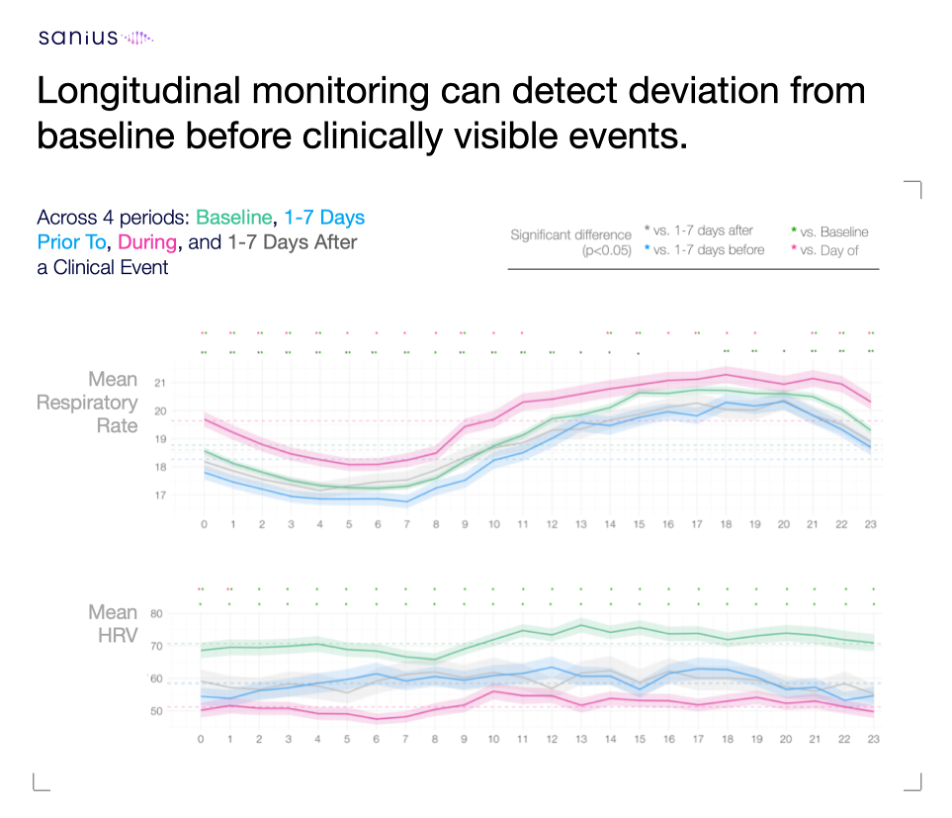
The field also needs consensus on which measures to use, when to collect them, how quickly results should be reviewed and how patient-generated data should enter the health record. Predictive models will only be as trustworthy as the data and operating model beneath them. A published Sanius cross-haematology example illustrates the broader principle: longitudinal monitoring can identify meaningful deviation from an individual baseline before a clinically visible event.
We have spent a decade making haematology treatments more sophisticated. Our measurement of tolerability now has to catch up.
Toxicity is not a point on a case-report form. It is a trajectory through a patient's life. If we can measure that trajectory properly, we can design better trials, make better treatment decisions and build therapies that patients are genuinely able to live with.
Sources


.png)
.jpg)
.png)