
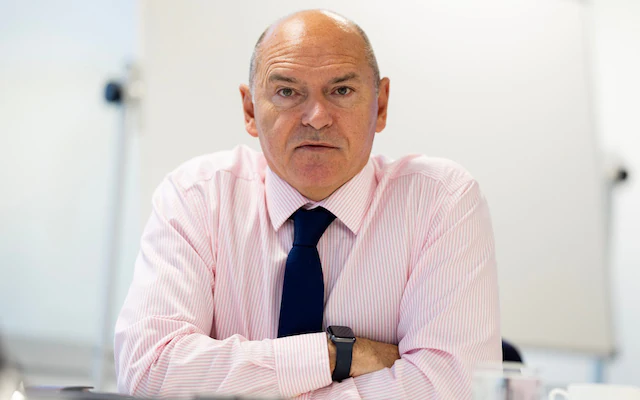
Sir Jim Mackey arrived as the transition chief executive of NHS England with a clear and limited brief. He was asked to stabilise the finances, accelerate elective recovery and support the return of daily operational control to the Department of Health. He was equally clear that he viewed the role as temporary. Newcastle would one day call him home, and he would return once the essentials were done.
The reality of the job has been sharper and slower than expected. The tasks proved more complex, the timelines longer and the pressures more entrenched. The coming winter now serves as the natural endpoint of his stewardship. As that moment approaches, the NHS is presented with a rare period of reflection. The system can step back and consider what qualities the next chief executive should bring as the service looks beyond this decade.
Two broad scenarios shape the months ahead. One is that Sir Jim is asked to remain slightly longer. This would be measured in months rather than years. The other is structural. It would be a return to the pre 2006 model in which the chief executive of the NHS and the permanent secretary of the Department of Health were the same person. The health secretary is advised by people who worked with that model previously. The current permanent secretary also has deep NHS experience rather than a traditional civil service background. The option is no longer theoretical.
Whatever route is chosen, the next appointment will be chief executive of the NHS rather than leader of a large arm’s length body. The role will carry direct responsibility for performance and delivery but not for the wider operational machinery that once sat within NHS England. Over time, many support functions are likely to consolidate under the permanent secretary where accountability is clearer. This shift changes the profile of the job. It no longer requires decades of experience running very large organisations.
Despite this, the gravitational pull of the acute sector remains powerful. Waiting lists dominate politics. Hospital overspending occupies the Treasury. Acute trust leaders carry credibility and have lived through the system’s toughest pressures. Many are logical candidates for the top job and many are already widely discussed.
There is, however, a real counterpoint. If the government intends to deliver the three shifts in the 10 Year Health Plan, the next leader must be able to push change far beyond hospitals. Acute chiefs understand the importance of prevention, digital transformation and stronger community services, but the nature of their roles has limited their exposure to those areas. National and regional acute leaders have faced the same constraint. Their time has been consumed by hospital pressures rather than system redesign.
The next chief executive will need the confidence and freedom to make decisions that challenge hospital centric culture. A leader without deep acute sector roots may find it easier to accelerate change and overcome the perceptions that follow anyone shaped entirely by hospital experience.
That raises the question of where such a leader might come from. Local government has produced some of the strongest strategic public sector leaders, although recent changes have reduced the obvious candidates. Industry, particularly the life sciences sector, has leaders who understand technology, innovation and economic value but less grounding in community care or NHS culture. Community, mental health, primary care and commissioning leaders often align most closely with the reform agenda but may lack credibility among a leadership class that remains dominated by acute organisations.
This leaves one possibility that no longer feels radical. Many health systems overseas have already delivered the kind of reforms the NHS is now seeking. Integrated community based care, modern data infrastructure, new commissioning models and bold prevention strategies have been achieved at pace elsewhere. Recruiting from outside the UK, once seen as politically unlikely, may now be one of the most credible ways of bringing in the mindset and momentum required for change.
An external candidate would arrive without inherited assumptions and without the unwritten rules that shape internal leadership. They could ask different questions, make different calls and accelerate different priorities.
As Sir Jim prepares for what is expected to be his final winter in national leadership, the NHS stands at a moment of uncommon possibility. The conversation is no longer about whether he will stay. It is about what the service should demand from his successor. The next decade of the NHS will be shaped by the philosophy, courage and strategic instincts of the person chosen to lead it.
The choice ahead is not simply about continuity or change. It is about what kind of leadership the future of the service requires, and how bold the system is prepared to be.



.jpg)
.jpg)
.jpg)