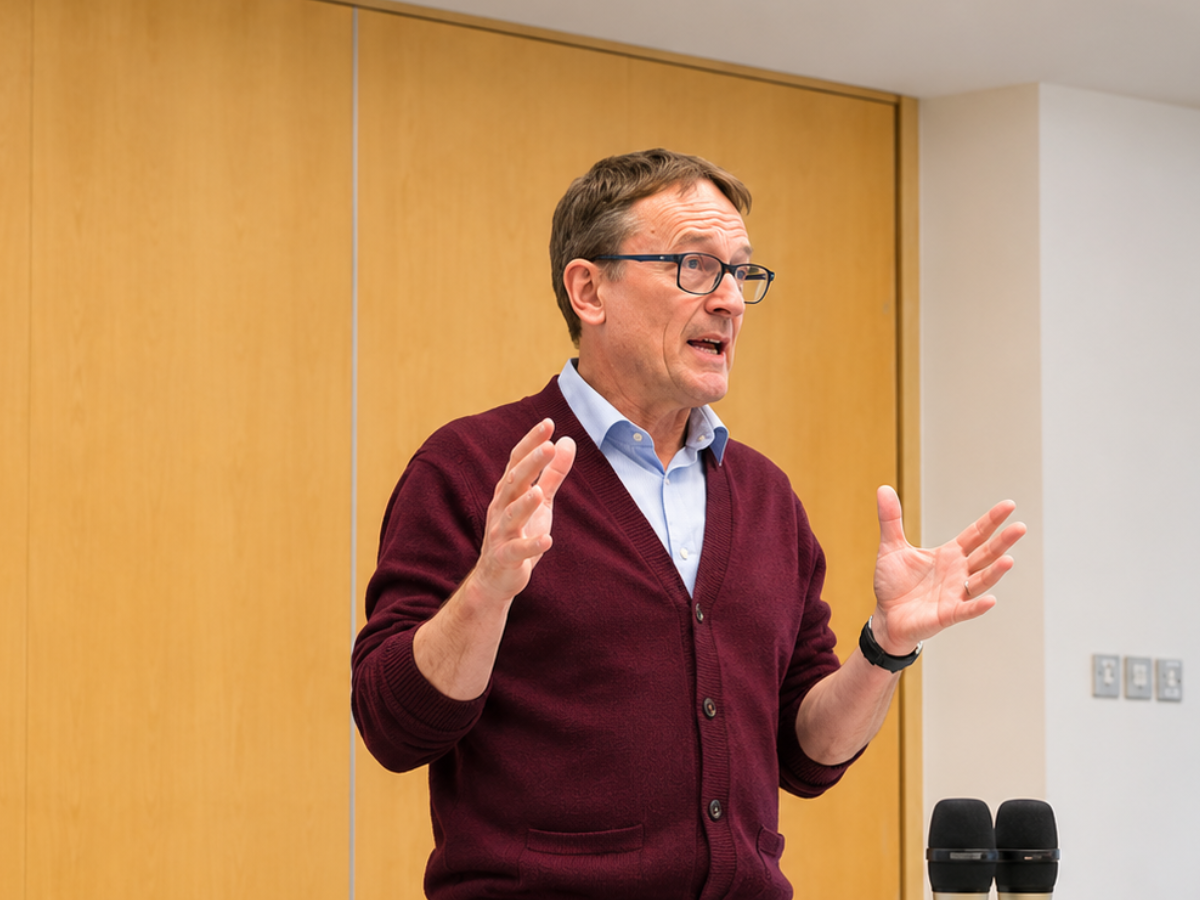
In a Prague conference hall, a surgical registrar from Sussex puts a question to European colorectal specialists that appears on no NHS performance dashboard. After a cancerous polyp has been removed, when does a patient truly need a second operation, and when is the safer course to leave well alone? Nida Khan, who the trust says presented three papers at the annual meeting of the European Society of Coloproctology, addressed that threshold directly. Her colleague Yegor Tryliskyy, a consultant who sits on the society's education committee, chaired a session on surgical complications. Neither contribution will shift a waiting list this winter. Both bear on the thing that eventually will.
The government's plan to recover elective care rests on counting more: more operations, more diagnostic tests, more theatre sessions. Capacity is also consumed by operations that go wrong. A bowel resection that ends in a leak or an infection keeps a patient in hospital for days that were planned for someone else, and may return them to theatre. Avoiding that outcome releases beds and operating time faster than any building programme could. Complication avoidance is the least visible lever on recovery available to the NHS, and the performance regime has almost no means of seeing it.
The Sussex work gives the argument a concrete shape. Roughly a third of people with Crohn's disease need surgery at some point, and a substantial minority need it more than once. The trust takes part in OCEaN, a national randomised trial funded through the NIHR's health technology programme, which is recruiting around 618 patients across more than forty NHS hospitals. Participants receive either six weeks of exclusive enteral nutrition before their operation, a liquid-only diet, or their usual diet. The primary outcomes are quality of life and post-operative complications, and length of stay, readmission and cost-effectiveness sit among the secondary measures. No results have been published, so anyone claiming the intervention works is ahead of the evidence. What the trial offers is the right sequence of questions. Does a cheap preparatory step reduce harm, can that be tested across enough hospitals to be sure, and what does it save the system if it does?
The trust also says it has begun performing specialised procedures for complex Crohn's complications locally, sparing patients journeys out of the region. I could not independently confirm the detail of those procedures, and readers should treat that claim as the trust's own. Even so, the principle holds. A regional unit can only perform difficult surgery safely if its surgeons have trained, argued and compared outcomes with peers elsewhere. Tryliskyy's work on standardising training across borders matters for this reason, since it carries technique to places that cannot generate enough cases of their own. A unit's safety record rests partly on a professional network that no commissioner funds and no league table reports.
Here politics intrudes. Trust boards operating under the present financial reset are being asked to hold down costs, shrink corporate overhead and show productivity gains within a year or two. Study leave, protected research time, backfill for conference attendance and research nursing are easy lines to remove, because the saving arrives at once and the harm arrives later and cannot be traced to any single decision. A surgeon in Prague is a clinic not run in Sussex. The benefit of what she brings home appears years afterwards, spread across patients who will never know. A finance director facing that arithmetic is behaving rationally. The cumulative result is a service that sells the means of its own improvement to meet this quarter's targets.
Sussex appears to have chosen otherwise. Its strategy to 2030 places research near the centre of the trust's ambitions, with the stated aim of becoming a regional leader. It hosts one of the new NIHR commercial research delivery centres, designed to draw industry studies into NHS hospitals. Martin Llewelyn, the trust's clinical director of research and innovation, who also directs that centre, has framed it as a route to inward investment and earlier patient access to new treatments. The trust's own literature goes further and argues that research supports financial sustainability. That is a long bet, and no one yet knows whether it pays back at the scale claimed. One trust's choices show what is possible and say little about what is typical, and a conference press release is thin evidence of improved outcomes. Nobody should conclude from Prague that surgical results in Sussex have changed. That evidence lies elsewhere.
The implications are practical. Trust boards could ring-fence a share of clinical time for research and training, and report complications, readmissions and unplanned returns to theatre with the regularity they give waiting times. National policymakers could add outcome measures that reward harm avoided, because in an activity-driven payment system a prevented re-operation can look like lost work. Life sciences and health-tech companies seeking partners should note that trusts with intact research capacity are the ones able to deliver studies to time. Patients will see little of any of this, since the benefit takes the form of a leak that never happened and an operation that was never needed.
The health service has built thorough machinery for counting what it does and almost none for counting what it spares patients. Until that changes, a registrar presenting a threshold for second operations in Prague will remain an anomaly in the accounts, and one of the better bargains the system is currently getting.