Picture a ward at mid-afternoon. A patient has been medically fit to leave since the morning, and the clinical decision is made. The discharge letter is unwritten, the medicines have not come up from pharmacy, and the community team is waiting on a message sitting in someone's inbox. Until recently, the record of all this at North Tees and Hartlepool NHS Foundation Trust lived in spreadsheets, copied between colleagues and shared with social care providers, and stale shortly after it was sent.
That friction is ordinary in a hospital, and its cost is large. Nearly 350,000 patients a year in England spend more than three weeks in an acute bed. Long stays bring infection risk and physical and mental deconditioning for the patient. Each bed occupied longer than necessary is a bed denied to someone waiting for elective surgery or held in an emergency department corridor. Trusts have understood this for years. What they have lacked is a way to see, in one place and in real time, which specific task stands between a specific patient and the front door.
OPTICA, the Optimised Patient Tracking and Intelligent Choices Application, supplies that view. The trust built it in-house. It connects to existing patient information systems and maps each admitted patient's journey from arrival to the point at which hospital care is no longer needed. Outstanding tasks appear on a shared display that NHS and social care teams can both read. The software makes no clinical judgements. It removes the guesswork about what is holding things up, which turns out to be most of the battle.
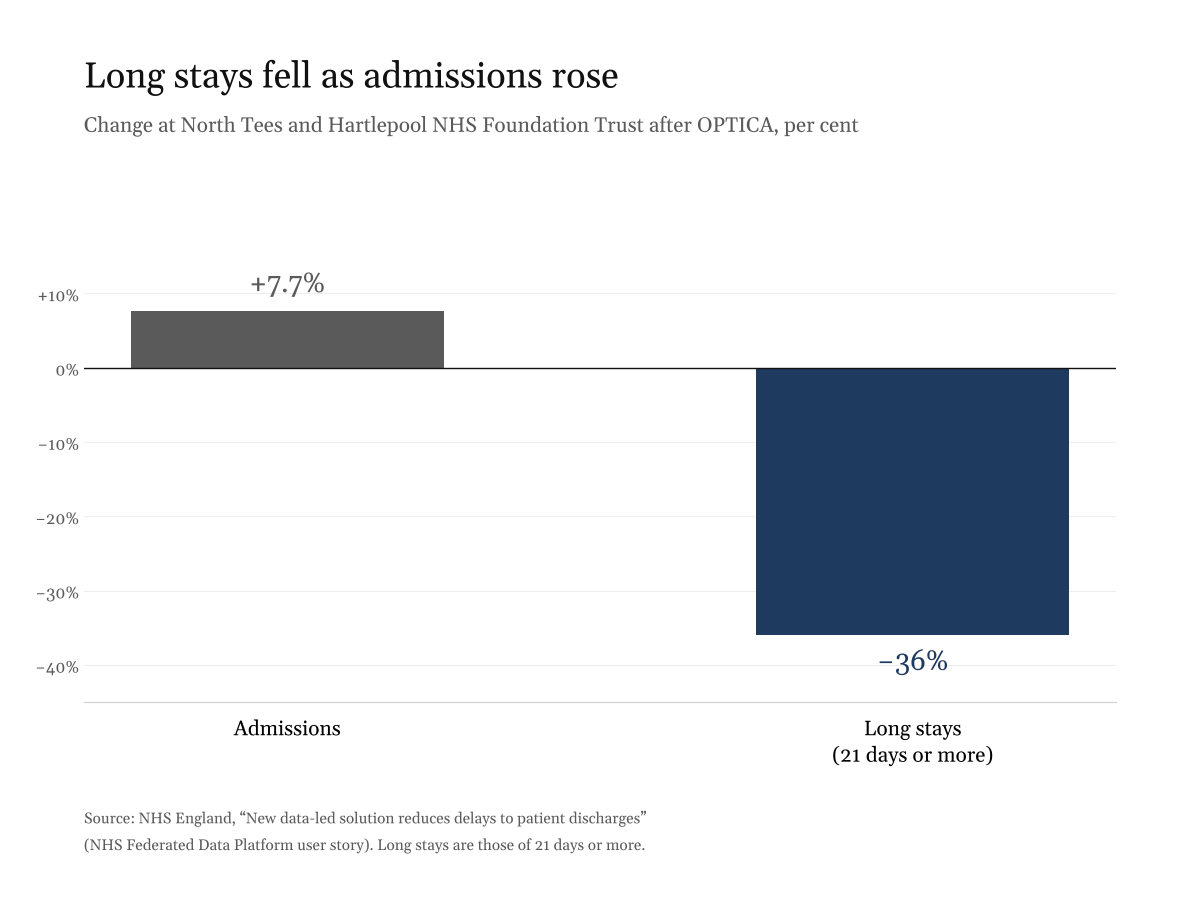
The reported results are strong. Long stays of 21 days or more fell by 36 per cent, in a period when admissions rose by 7.7 per cent. That pairing deserves attention at a time when many efficiency claims quietly assume flat demand. The trust also recovered around 9.5 hours of clinical time each week that had gone on back-and-forth messages to establish where a delay sat. Set against a large acute trust's workforce, that figure is modest. Set against the current mood in the service, where recruitment is constrained and morale is fragile, it is capacity released without hiring anyone, taken from the least rewarding work clinicians do.
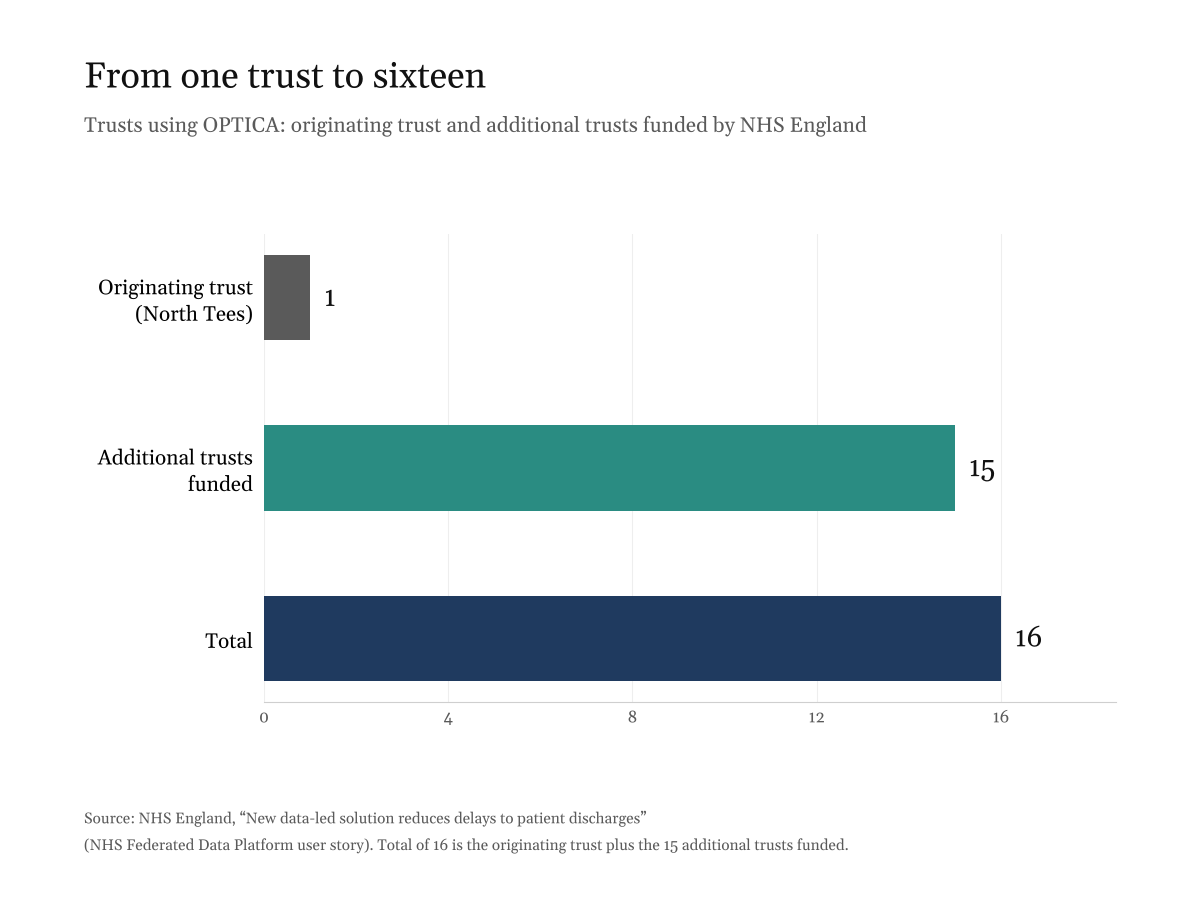
The wider relevance lies in how this happened. Successive governments have promised that digital transformation will carry the NHS through its productivity problem, and the record of large, centrally conceived programmes has been uneven. OPTICA began differently. A trust identified a daily irritant that frontline staff recognised, built a tool for it, measured the result and then handed it on. NHS England has since funded its adoption in a further 15 trusts. A local fix that scales on evidence is the route most digital leaders say they want and few manage to deliver.
It also gives the Federated Data Platform something it needs. OPTICA is among the use cases cited for the platform, which links trust-level data systems while keeping data under local control. The platform has drawn scrutiny over supplier choice and governance, and public trust in health data programmes cannot be assumed. Arguments about architecture rarely persuade an anxious public. A patient who goes home sooner because a pharmacy task was visible on a screen has a different view of what data sharing is for. Early, tangible and patient-facing results are the most credible case the platform can make for itself.
A fair assessment includes the limits. Discharge depends on councils, community providers and care packages that must physically exist. A dashboard can show that a patient is waiting for a domiciliary care visit. It cannot staff the round. Yet the spreadsheet era made it hard to tell how much delay was administrative and how much reflected genuine shortages in the system. Visibility sorts one from the other. Leaders can now separate the delays they can remove through better process from those that require investment or a conversation with the local authority. That distinction is valuable to commissioners and to ministers weighing where the next pound of social care funding should go.
Some practical points follow for each audience. Trust executives would do well to look for the shared spreadsheet that every ward manager maintains in quiet defiance of the official systems, since such workarounds mark the places where software earns its keep. Policymakers should keep funding the spread of tools with measured outcomes and resist the temptation to wrap them in larger programmes before they have proved themselves. Health-tech suppliers face a clear standard, which is a documented result on a real ward, ideally with a clinician willing to vouch for it. The clinical care coordinator quoted in the trust's account describes greater confidence in knowing who is in the hospital and where each person stands in their discharge journey. That is a modest ambition, and it is the one on which the rest depends.
For patients, the benefit is simple to state. Fewer days in a bed they no longer need, and fewer days away from home, are worth more to most people than any amount of technological ambition.
The NHS has spent years hoping a grand digital programme would solve its flow problems. North Tees addressed one of them with a tracker that tells people what remains to be done. If the 15 trusts following its lead reproduce even part of a 36 per cent reduction, the arithmetic of elective recovery looks different. The test now is replication in hospitals with older systems, thinner teams and tighter council budgets. If it passes that test, a spreadsheet will have been retired at the right moment.