
Until June 2024, the team responsible for North Cumbria's elective waiting list could see only part of it. Around 35 per cent of the patient tracking list was under active review, and most of those patients came into view only after they had waited 40 weeks. The trust serves more than half a million people across a largely rural area, and its trackers were working from a map with large parts left blank.
That has changed. After adopting the referral to treatment product on the NHS Federated Data Platform, the tracking team can validate the entire list within a 12-week cycle, which meets national guidance. Weekly pathway validations have risen from between 1,700 and 2,500 to around 3,500 to 4,000 (Figure 1). North Cumbria demonstrates the first step of waiting list recovery, and it is a step that receives too little attention: a list that can be read in full can be managed in full.
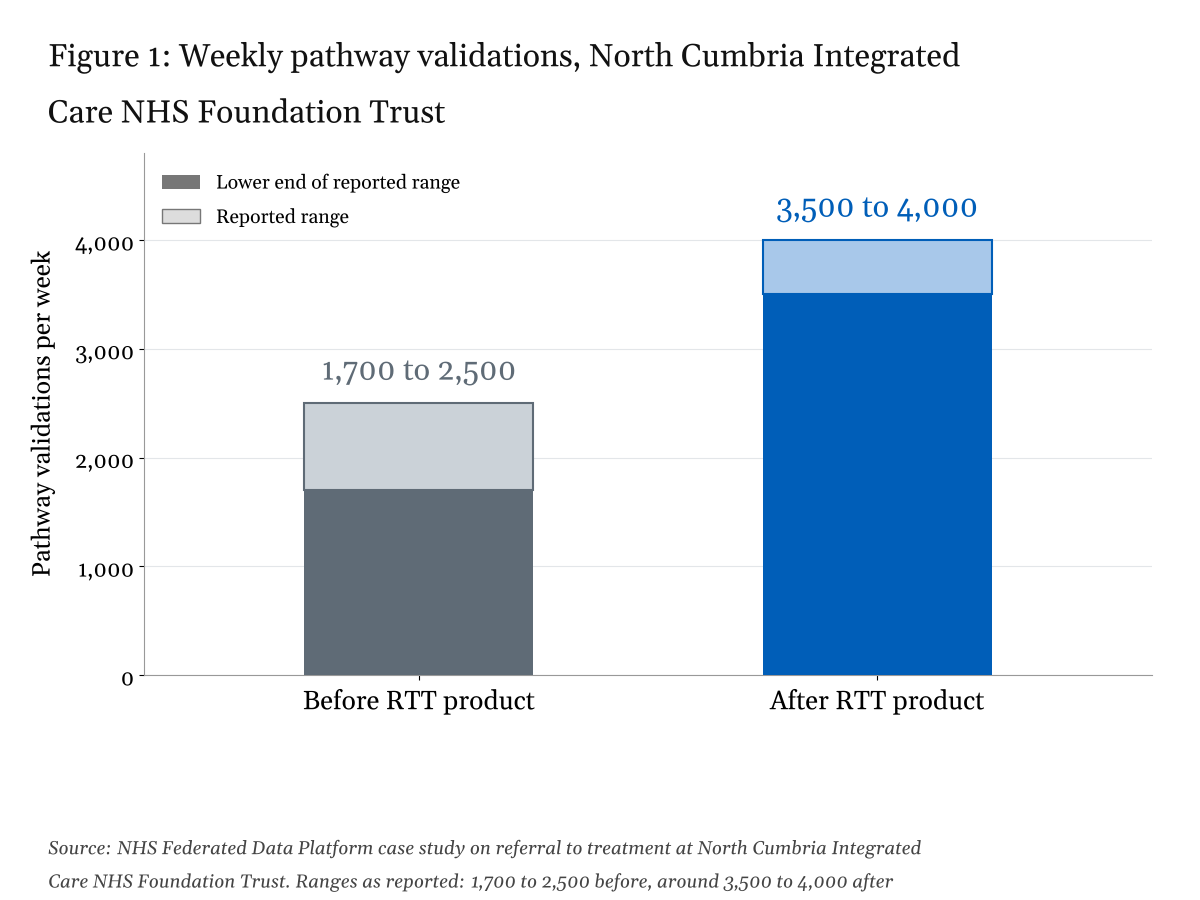
The timing matters. The government has committed to treating 92 per cent of patients within 18 weeks by March 2029, and trusts face public expectations shaped by years in which waiting list headlines barely moved. National debate tends to concentrate on theatres and beds. North Cumbria points to an earlier lever. Seeing long waits sooner, and spotting data quality problems at low week counts before they harden into unexpected long-waiters, lets staff act while action is still cheap. Cohorting patients across trackers and prioritising fast-track cases and the longest waiters turns a static list into a managed one. Pathway closures rose when the module went live, particularly for pathways of seven to 12 weeks, and the monthly total is now stabilising, which points to a list that is becoming more accurate and up to date.
Contact with patients has sharpened the picture further. Digital and postal outreach, as described by the trust's supplier, produced an overall response rate of 80.4 per cent. Some 13.2 per cent of patients came off the list, and 12 per cent said they no longer needed care. About one patient in eight had been waiting for treatment they no longer wanted. Each of those pathways closed frees an appointment for someone who does need it and spares booking teams a fruitless chase. Anyone who has run an outpatient office will recognise the value.
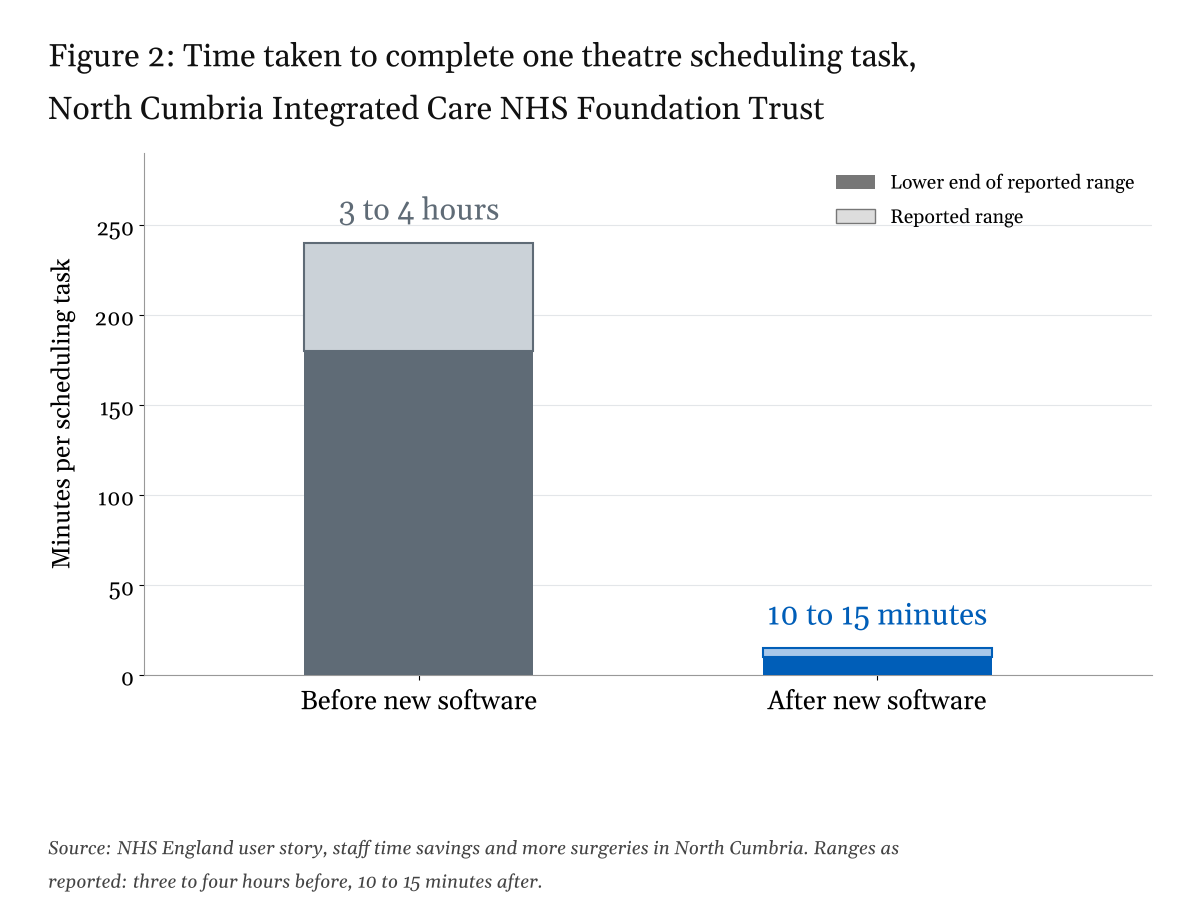
The same discipline has reached the operating theatre. Booking and scheduling once relied on basic spreadsheets and manual entry, so lists were often out of date by the time they were shared. The new software brings the information into one place. A scheduling task that took three to four hours now takes 10 to 15 minutes (Figure 2). Theatre planners save more than three hours a week, and the trust reports that it can perform up to 10 per cent more surgeries, with more cases per list than in the six months before the tool arrived. It now uses the system to plan all elective appointments. These figures come from the trust and its partners and merit the usual scrutiny, yet the logic is sound. Accurate information fills lists that would otherwise run short.
The regional picture lends weight to the local one. The North East and North Cumbria system reported the strongest referral to treatment performance in England in October 2024, with 68.8 per cent of patients waiting under 18 weeks. Part of that position reflects cleaner lists and part reflects extra treatment. Boards that report validated removals as a separate line from treated discharges would let the public see both contributions, and would give a result that deserves confidence a firm footing.
The wider policy setting favours this kind of work. The NHS has been asked to deliver more elective activity from a workforce and an estate that are largely fixed, and better information is one of the few levers that cost little to pull. A trust that finds an extra operating slot through a scheduling tool has created capacity without building a single new theatre. Integrated care systems seeking to spread good practice across neighbouring providers will find a worked example in North Cumbria, where a dispersed rural footprint tests the approach against long travel distances and scattered services. If it holds there, it should hold in more compact urban settings.
People make the system work. Validation depends on staff at Bands 4 and 5 who understand referral to treatment rules and will telephone a patient who has not replied. Separating routine tracking from complex data quality fixes has given the tracking team a more varied caseload and lifted morale. The lesson for NHS leaders is direct. Several of these posts were recruited on fixed-term contracts, and moving experienced validators onto secure funding would protect the gains for the long term.
For executives, the immediate step is modest. Ask how often each pathway is validated and who owns the answer. Public trust in waiting list figures is fragile, and a trust that can explain precisely what is on its list, and why, starts from a stronger position than one that cannot.
The platform's single commercial supplier keeps data governance and public confidence on the agenda. North Cumbria offers a constructive reference point. Independent evaluation of trusts such as this one, with patient benefits stated plainly, would strengthen the case. Health-tech businesses can draw a practical conclusion. The readiest buyers are organisations that already have someone accountable for data quality, and NHS England is funding deployment across the country, so the experience of a rural trust may travel widely.
For patients the effect is concrete. A trust that knows who is waiting can act on the person at 30 weeks before they reach 52, and can stop sending appointments to people who recovered long ago. Clean data has done its job in North Cumbria. The task now is to turn that clarity into operations performed and waits shortened, and the groundwork gives the trust every reason to expect the coming year's treatment figures to show it.