
Until June 2024, North Cumbria Integrated Care NHS Foundation Trust could track roughly 35 per cent of its patient tracking list. Most of those patients came into view only after they had waited 40 weeks. For the rest of the list, a trust serving more than half a million people was working without a map.
That condition will be familiar to many NHS managers. Debate about waiting lists usually settles on capacity, on theatres and beds. North Cumbria's recent history suggests the difficulty begins earlier. A list cannot be managed until it can be read, and reading it requires patient-level data, regular contact with the people on it and staff with the time to do the work.
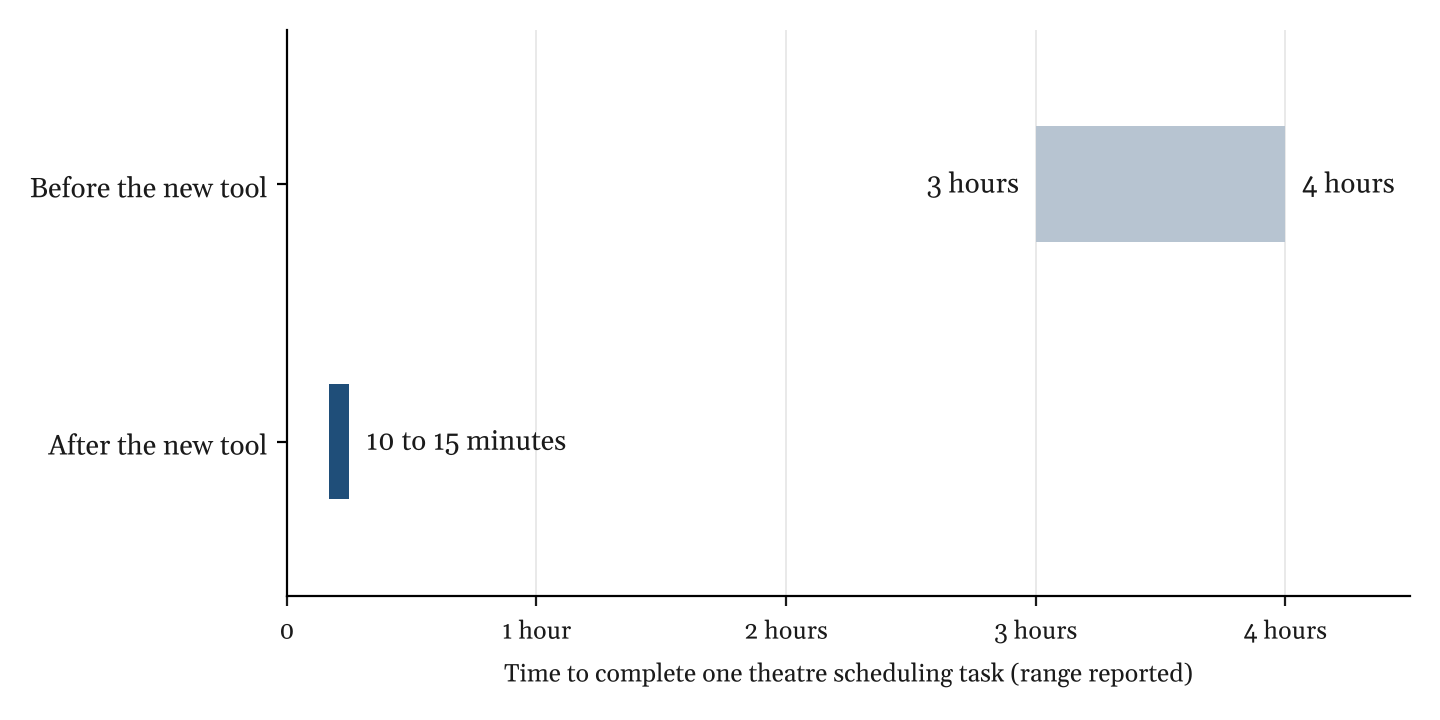
The trust has spent the past two years building that capability on the NHS Federated Data Platform. It reports that theatre planners save more than three hours a week and that it can perform up to 10 per cent more surgeries. A scheduling task that once took three or four hours now takes 10 to 15 minutes (Figure 1). Those figures are the trust's own, published by organisations with a stake in the outcome, and should be read with the caution that implies. They are nonetheless credible. Fuller information about who is waiting, and for what, tends to fill theatre lists that would otherwise run short.
Figure 1: Time taken to complete one theatre scheduling task, North Cumbria Integrated Care NHS Foundation Trust
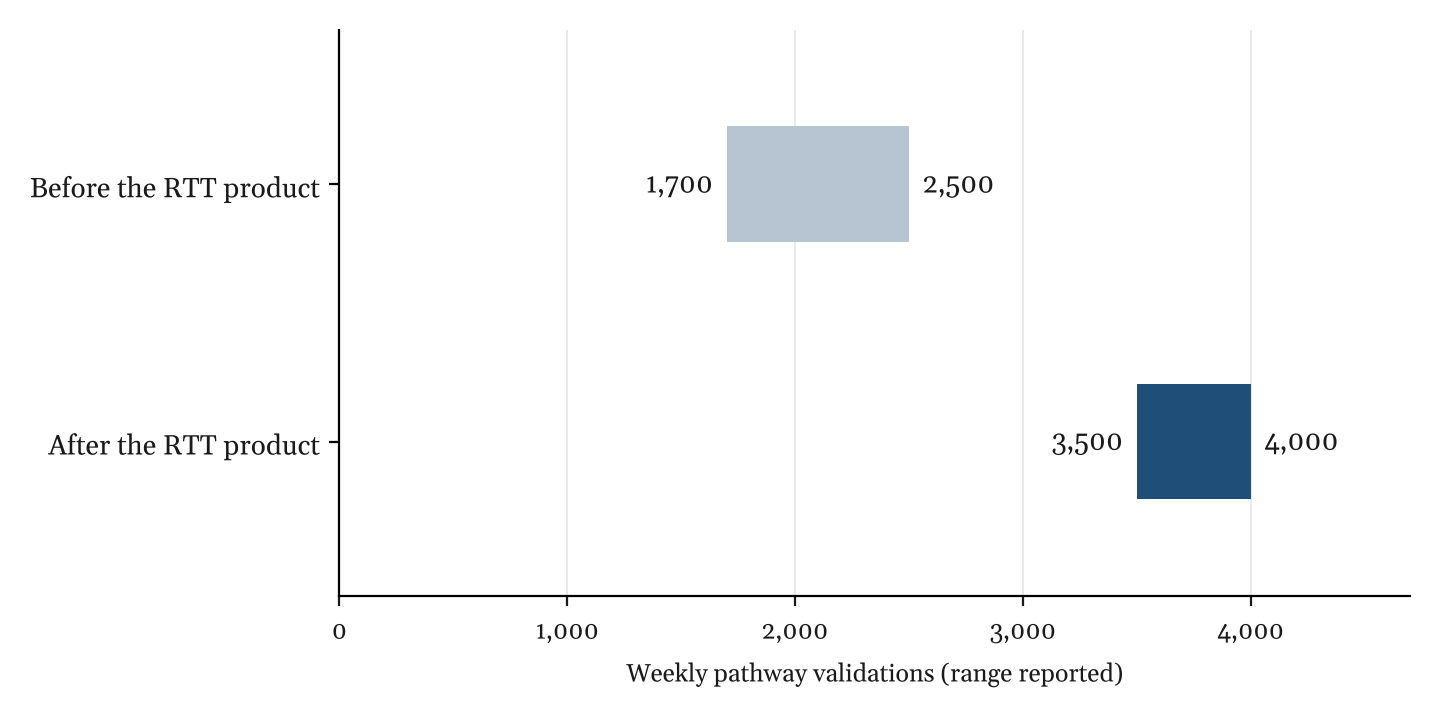
Validation is the more instructive part of the story. Using the referral to treatment product on the platform, the tracking team can now validate the entire patient tracking list within a 12-week cycle, which meets national guidance. Weekly pathway validations have risen from between 1,700 and 2,500 to around 3,500 to 4,000 (Figure 2). A supplier's account of the trust's outreach by text, email and letter reports an 86 per cent digital response rate and an 80.4 per cent response rate overall. Some 13.2 per cent of patients came off the list, and 12 per cent said they no longer needed care. About one patient in eight was waiting for treatment they no longer wanted.
Figure 2: Weekly pathway validations, North Cumbria Integrated Care NHS Foundation Trust
That result is welcome, because it removes work from the queue and frees booking teams. It also exposes how much of any national list is clerical residue: patients treated elsewhere, patients who recovered, pathways opened twice. A validation exercise can reduce the total without a single additional operation being performed. The list falls and nobody has been treated.
This matters because the political pressure is considerable. The government has committed to restoring the 18-week standard, with 92 per cent of patients treated within that time by March 2029, and national validation sprints ran through 2025. The North East and North Cumbria system has reported the strongest referral to treatment performance in England, with 68.8 per cent of patients waiting under 18 weeks in October 2024. Some of that position reflects delivery. Some reflects cleaner lists. A trust that cannot say how much belongs to each will struggle to persuade a public that has heard claims of improvement for years and still waits. Boards could help themselves by reporting validated removals as a separate line. It would cost little and would protect their credibility.
Staffing deserves more attention than it receives. Validation and pathway coordination at the trust depend on roles at Bands 4 and 5, and some of those advertised have been fixed term. Software shortens each task. It does not replace people who understand referral to treatment rules and are willing to telephone a patient who has not replied. If sprint funding ends or experienced staff leave, the discipline lapses and lists drift back towards their earlier condition. Leaders who regard this workforce as overhead will find the gains hard to hold.
The politics of the platform itself will not fade. It is supplied by a single commercial provider, and its introduction has drawn sustained concern over data governance and public trust. The most persuasive reply is independent evaluation of trusts such as North Cumbria, with patient benefits stated plainly and limits acknowledged. Suppliers hoping to sell into the NHS will find the readiest buyers among organisations that already have someone accountable for data quality. A good demonstration cannot create that accountability.
For patients, the practical effect is modest and worth having. A trust that knows who is waiting can plan for the person at 30 weeks before they reach 52, and can stop sending appointments to people who recovered long ago. That is the precondition for recovery. The measure of progress remains operations performed and waits shortened. Cleaner data has put North Cumbria in a position to deliver both. The next year of treatment figures will show whether it has.