
A waiting list ages quietly. A patient is referred, added to the queue and told to expect a call. Months later the symptoms have eased, or care has been found elsewhere, yet the name stays where it was, holding a slot that someone else needs. Across a whole hospital trust, the list stops describing demand and starts describing history.
The NHS Federated Data Platform includes a tool designed to address this challenge.Patient Led Validation, a module built on the platform, is available to any trust that runs it, following pilots at London North West University Healthcare NHS Trust, Chelsea and Westminster Hospital NHS Foundation Trust and North Cumbria Integrated Care NHS Foundation Trust that concluded in November 2025.
The mechanics are straightforward. Staff group patients into cohorts, such as every cardiology patient waiting more than 50 weeks, and schedule messages by SMS or post. Patients reply to confirm whether they still want their appointment. Where someone says they do not, a clinical team reviews the response against local protocols, and if discharge is appropriate the system produces letters to the patient and their GP at the click of a button. The tool connects to whichever patient portal or letter provider a trust already uses.
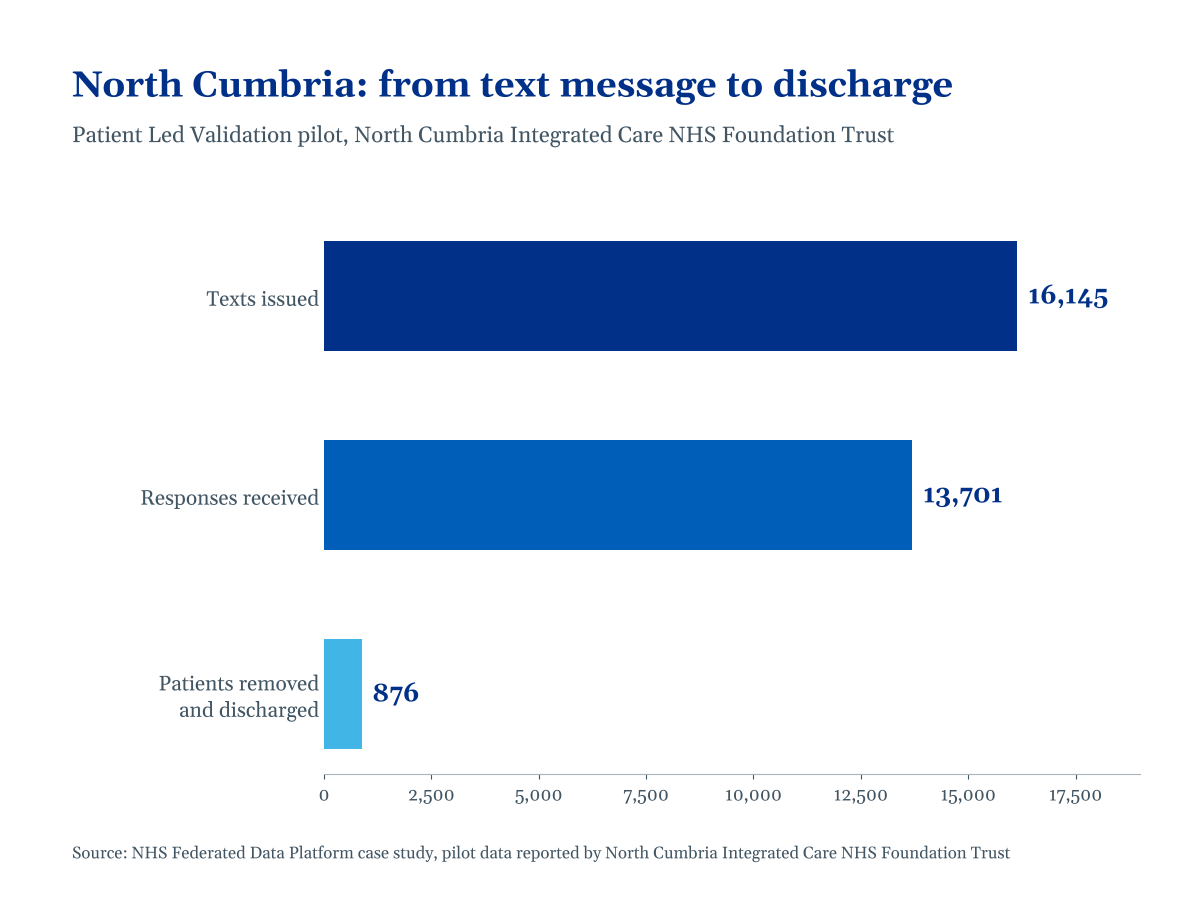
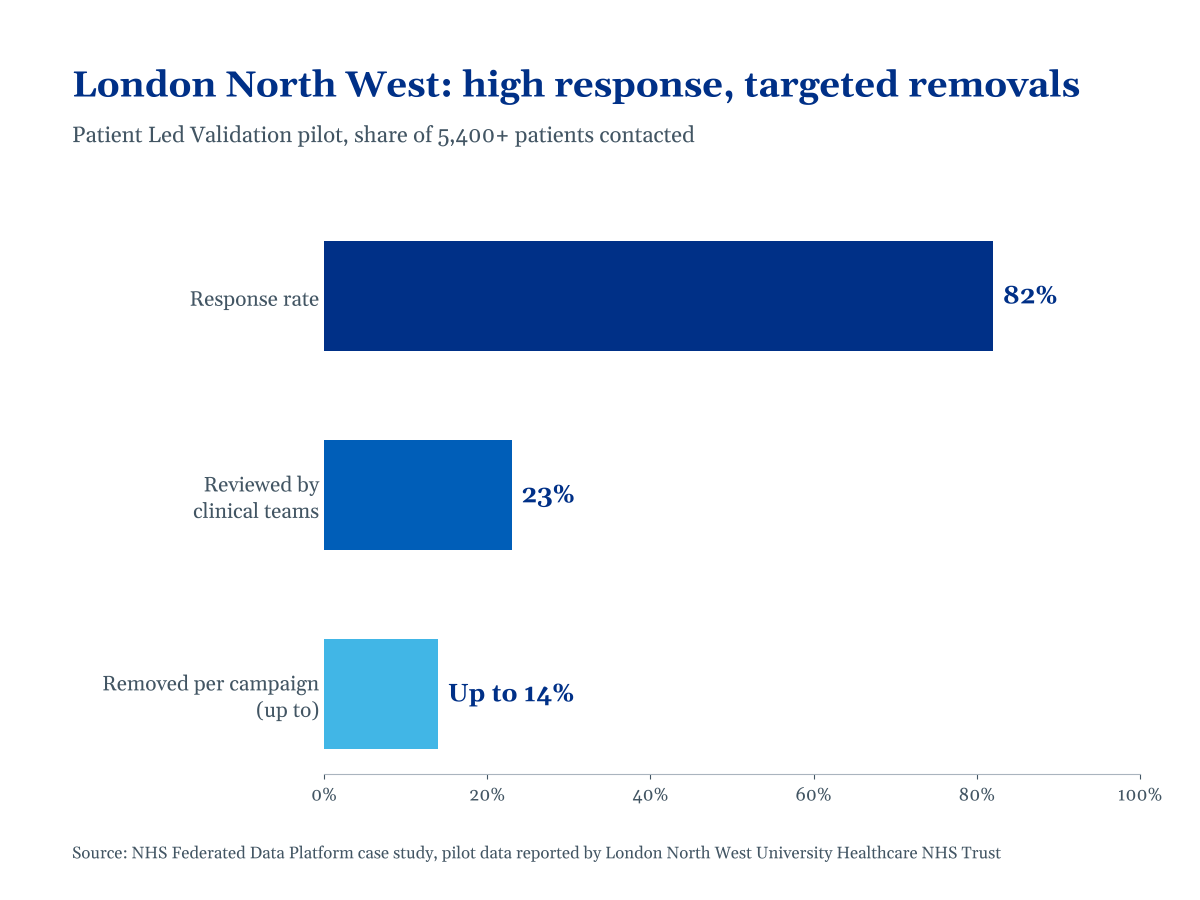
The pilot figures give the module a measurable record. North Cumbria sent 16,145 texts and received 13,701 responses, which led to 876 patients being removed from the list and discharged. London North West contacted more than 5,400 patients and achieved an 82 per cent response rate. Clinical teams there reviewed responses from 23 per cent of those contacted, and up to 14 per cent of patients per campaign were removed after confirming they no longer needed to attend. The trust reports that more than 500 appointments were freed up, and patients who still need care are booked into clinics proactively. Chelsea and Westminster removed nearly 900 patients from its lists in two months.
The trust leaders involved describe a shift in how the work feels. Tim Marshall, Head of Elective Care at London North West, says a lengthy, admin-heavy process has become quicker and easier to track, with clinicians able to step in when a case needs review. Dr Roger Chinn, Chief Medical Officer at Chelsea and Westminster, points to fewer missed appointments and lists that stay accurate, which lets the trust treat patients in order of need and length of wait. Colin Holmes, Head of Planning and Strategy at North Cumbria, notes that people drop off lists for ordinary reasons, including symptoms that have cleared up, and says integrating the process with the platform let his team automate much of what had been manual.
For Ayub Bhayat, NHS England’s Chief Data and Analytics Officer, Patient Led Validation provides precisely the kind of evidence the platform needs. The programme has moved beyond deployment, and the live question is whether shared data infrastructure changes how hospitals run day to day. A module that clears hundreds of unneeded appointments from a single trust's list answers that in terms operational managers recognise. It also shows the design logic of the platform. Trusts that helped develop and test the product now see it offered to every other trust on the same foundation. National consistency and local input sit within one workflow, a balance that earlier NHS technology programmes found hard to hold.
Deployment will begin with trusts that already use the platform's Referral to Treatment product, which the validation tool runs alongside. That sequencing suits compatibility and gives early adopters a short route to results. Trusts will look for the gains the pilots reported, which include fewer missed appointments and lists that match current need. A validated list is the starting point for every other decision about capacity, and the platform now gives trusts a direct way to build one.