
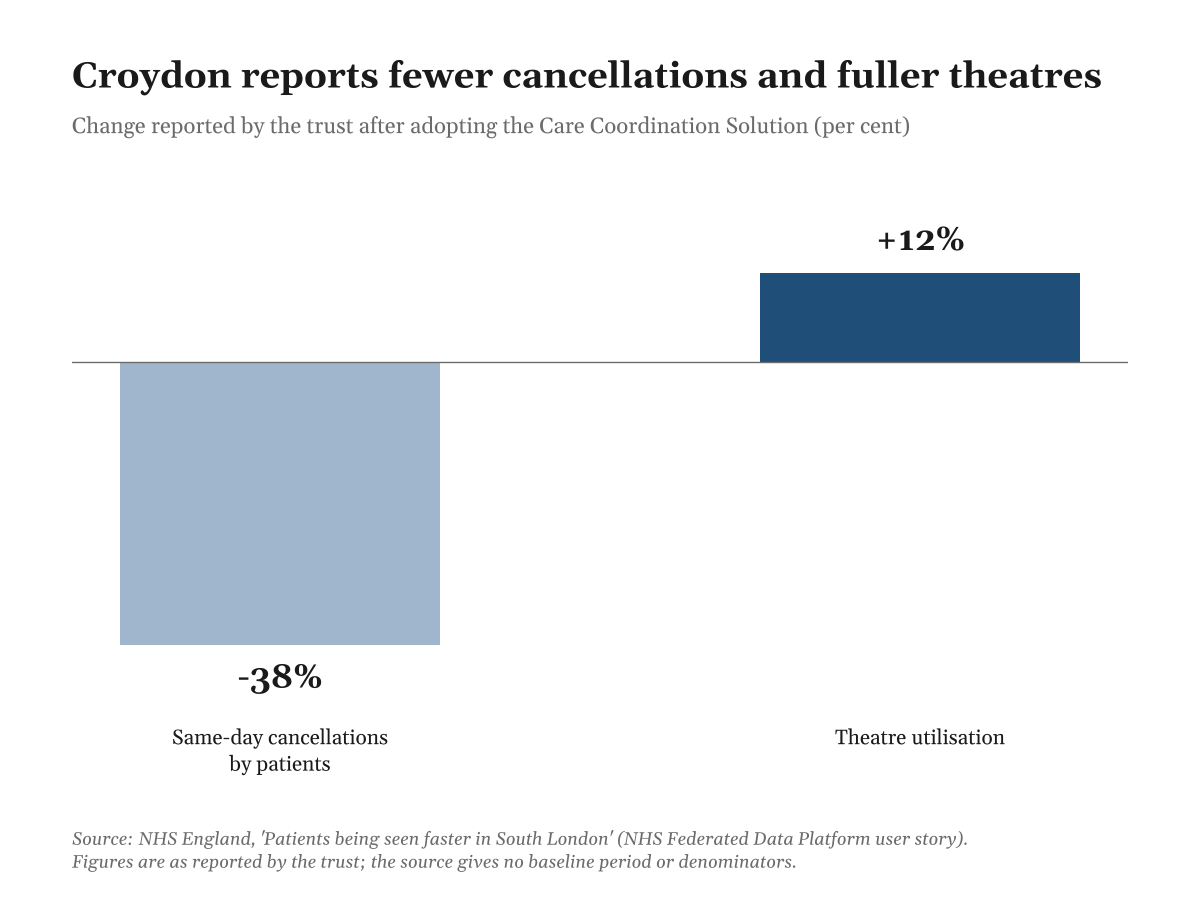
Two sets of figures about the same piece of NHS software now sit uneasily together. A south London trust says same-day cancellations by patients fell by 38 per cent after it adopted the tool, and that theatre utilisation rose by 12 per cent. Elsewhere, a freedom of information request and a newspaper investigation have cast doubt on how many other trusts are seeing any benefit at all.
Cancelled operations are where those claims meet real patients. The waiting list stood at about 7.4 million in August, and the government's pledge of 92 per cent of patients treated within 18 weeks by the end of this Parliament depends on operating theatres being used to their limit. A cancelled case is a double loss. The hospital has paid for staff and a recovery bay that produce nothing, and the patient has lost a date around which work and childcare had been arranged. For the patient the cost is practical and immediate: a day of fasting, arranged leave and an operation that moves to an unknown date while the condition that required surgery carries on progressing.
Croydon Health Services NHS Trust has offered one of the more specific accounts of how to reduce that loss, and its clinical director also serves as a national clinical lead for elective care, which gives the account additional weight. It attributes the gains to a care coordination tool that draws on existing hospital systems and shows waiting lists, theatre schedules and pre-operative assessment in near-real time. The 38 per cent figure covers cancellations made by patients, a narrower category than every case a theatre loses, but one likely to respond to earlier notice and better preparation. The mechanism is unglamorous, which is part of its credibility. Lists planned further ahead and pre-assessments visible before the morning of surgery leave fewer empty slots.
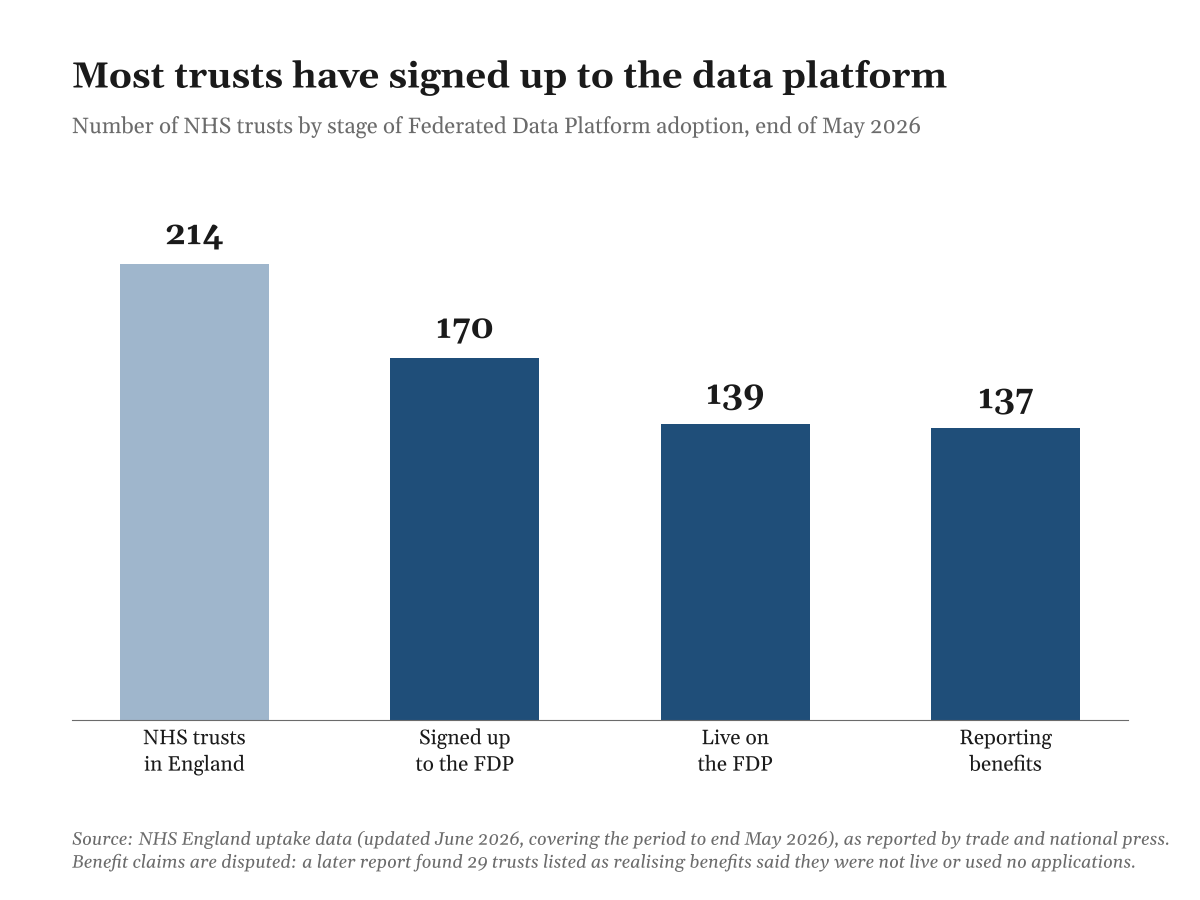
The tool runs on the NHS Federated Data Platform, and that makes Croydon more than a local story. The platform is now the most contested piece of digital infrastructure in the health service. NHS England says 170 trusts have signed up, 139 were live by the end of May and 137 report benefits. Within weeks, a freedom of information request by a campaign group suggested that nearly a third of live trusts were performing fewer procedures than before go-live. This month, a newspaper investigation found 29 trusts listed as realising benefits that said they were not live or used none of its applications. Reports last week indicate that ministers have decided against using the break clause in the Palantir-led contract and will extend it by two years.
Croydon sits awkwardly in this argument. It shows that a well-implemented tool, applied to a defined problem, can release capacity. It is also a case study published by the body that was then procuring the platform, with no baseline period, no denominators and no account of what else changed in the trust. Neither point makes the result false. Together they describe the weakness in the national case, which rests on local anecdotes at one end and a count of signed-up trusts at the other.
Whether the Croydon result travels depends on factors that software can display but cannot supply. Theatre utilisation is set by anaesthetic and nursing rosters, bed availability on the day, sterile services capacity and a culture in which someone owns the list. A platform that exposes a pre-assessment backlog helps only where a clinic has the staff to clear it. A trust with vacancies in theatre nursing or strained industrial relations will see the problem in near-real time and still lack the people to resolve it. The variation between trusts, with almost four in ten missing their interim 18-week targets, suggests that local management matters at least as much as the tooling.
NHS leaders can take a practical lesson from this. Measures worth tracking before any go-live include utilisation by session and the share of patients fully pre-assessed a fortnight before surgery, set beside cancellations split by cause and by who initiated them. Recording a baseline allows improvement to be separated from the seasonal and staffing swings that move theatre activity in any year. Health-tech suppliers face the same discipline. In a climate where sovereignty and public confidence are both under scrutiny, a vendor that can show a method and a baseline will persuade more boards than one that cites the number of sites.
For ministers, an extension buys continuity and avoids a migration while trusts are trying to shrink a waiting list above seven million. It also buys time to assemble the evidence the contract has lacked. A multi-year independent evaluation has begun, and its full findings will arrive well after the decision. Publishing trust-level results on theatre productivity and cancellations, with the denominators attached, would let sceptics and supporters argue from the same numbers.
Patients will judge all of this by a narrower test. Someone who has been cancelled once is unlikely to be moved by adoption figures or by arguments about contract structure. They want to know whether the operation happens on the date they were given. A cancelled operation is the point at which the service's promise meets its capacity to keep it. If data platforms are to justify their cost and their political burden, they will do so there, one list at a time, in figures that a sceptical trust board could replicate. Croydon has supplied a hypothesis. The service still needs the proof.