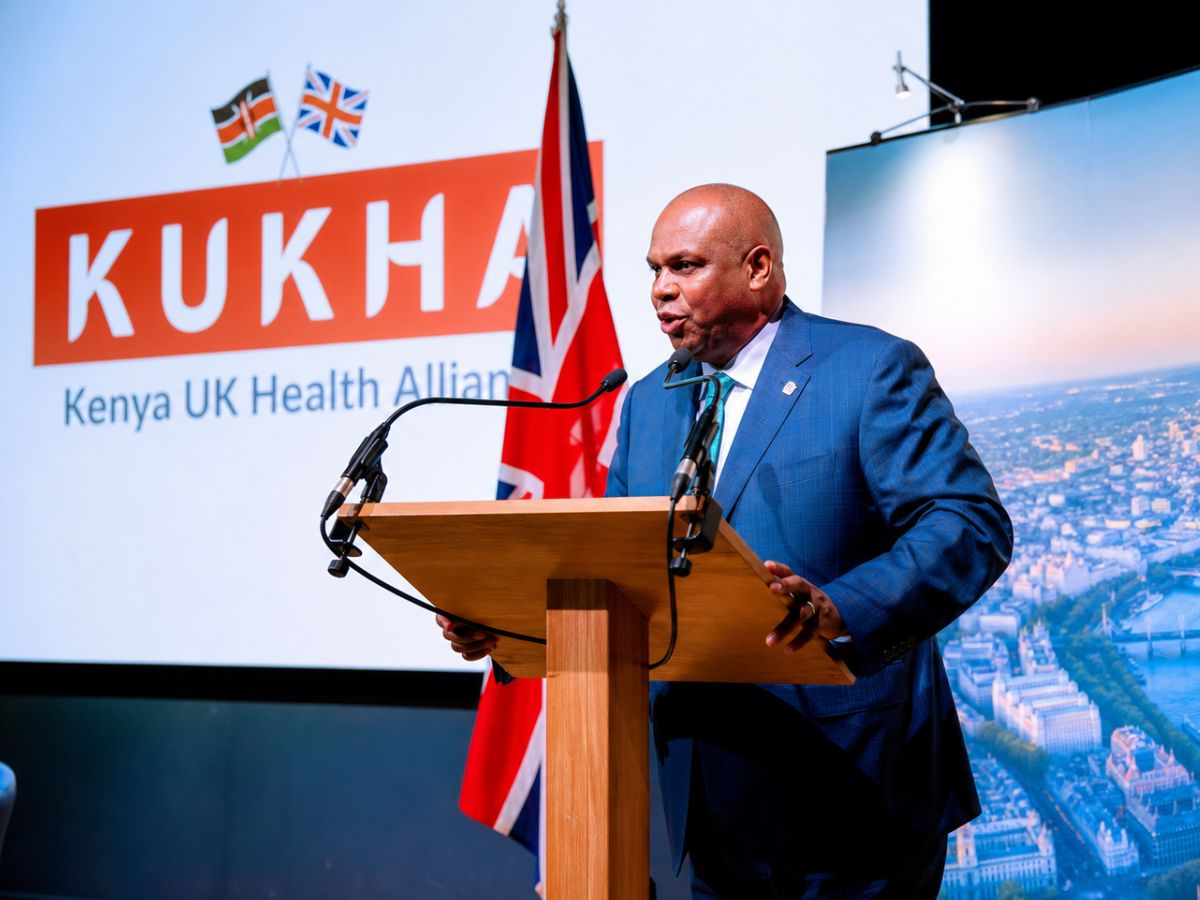
Kenya has called for a fundamental change in the structure of its health partnership with the United Kingdom, urging a move away from donor-recipient arrangements towards a model built on co-financing and shared accountability. The appeal came from Dr Ouma Oluga, Kenya's Principal Secretary for Medical Services, speaking at the fifth anniversary conference of the Kenya-United Kingdom Health Alliance (KUKHA), held at King's College London.
For UK institutions that have supported the alliance since its inception, the proposal marks a shift in what participation will require. Universities, hospital trusts and private firms accustomed to providing training and technical expertise are now being asked to consider longer-term financial and infrastructural commitments, a change that will test how far British health bodies are prepared to embed themselves in Kenya's domestic reform agenda rather than in discrete, time-limited projects.
The conference opened with a review of what the alliance has delivered since 2020. Dr Oluga pointed to the establishment of advanced molecular imaging facilities and the rollout of specialised breast cancer programmes in Mombasa and Kisii, alongside mobile diagnostic units that have extended screening into areas previously without access. Joint training schemes have produced more than 100 oncology professionals, a figure officials cited as evidence that the partnership has built lasting clinical capacity rather than delivering short-term aid.
These achievements formed the basis for Dr Oluga's argument that the relationship should now evolve. He told delegates that shifting global economic conditions, including tighter aid budgets across donor countries, make the traditional funding model increasingly difficult to sustain. In its place, he proposed an approach that is country-led, jointly financed and mutually accountable, with Kenya taking greater ownership of the direction and financing of specific programmes rather than relying primarily on external grants.
This pivot is closely tied to domestic changes already under way in Kenya. The country is in the process of transitioning to the Social Health Authority, alongside the Taifa Care initiative, both intended to widen access to health coverage through domestic financing mechanisms. Dr Oluga presented the UK partnership as a means of reinforcing these reforms rather than substituting for them, a distinction he said was central to the alliance's next phase.
Looking ahead, Kenyan officials outlined specific areas where they want to deepen cooperation. Chief among these is health industrialisation, including the local manufacture of vaccines, medicines and medical technology, a goal that would reduce Kenya's reliance on imported supplies and, officials argued, improve resilience during future health emergencies. Beyond manufacturing, Dr Oluga pointed to genomics, organ transplantation, precision medicine and digital health infrastructure as fields where Kenya is seeking to build specialised capacity in partnership with UK institutions. For NHS bodies and British universities, this list signals a request for engagement in higher-skill, higher-investment areas than the diagnostic and training work that has characterised the alliance so far.
To track progress under the new model, Kenya has proposed a unified sector framework accompanied by a standardised scorecard, intended to give both governments a consistent means of measuring commitments and outcomes over time. Officials suggested this would replace the more ad hoc reporting that has characterised previous phases of the partnership, giving both sides clearer visibility into where funding and expertise are being directed.
The conference drew a wide range of stakeholders, including government officials from both countries, university leadership from King's College London and other institutions, and representatives from the private sector. Their presence was taken by organisers as an indication of continued high-level interest in the alliance, even as its underlying structure is set to change. Whether UK partners will accept the terms of a more equal, co-financed relationship is likely to shape the alliance's next five years as much as any clinical outcome.


.jpg)
.jpg)