
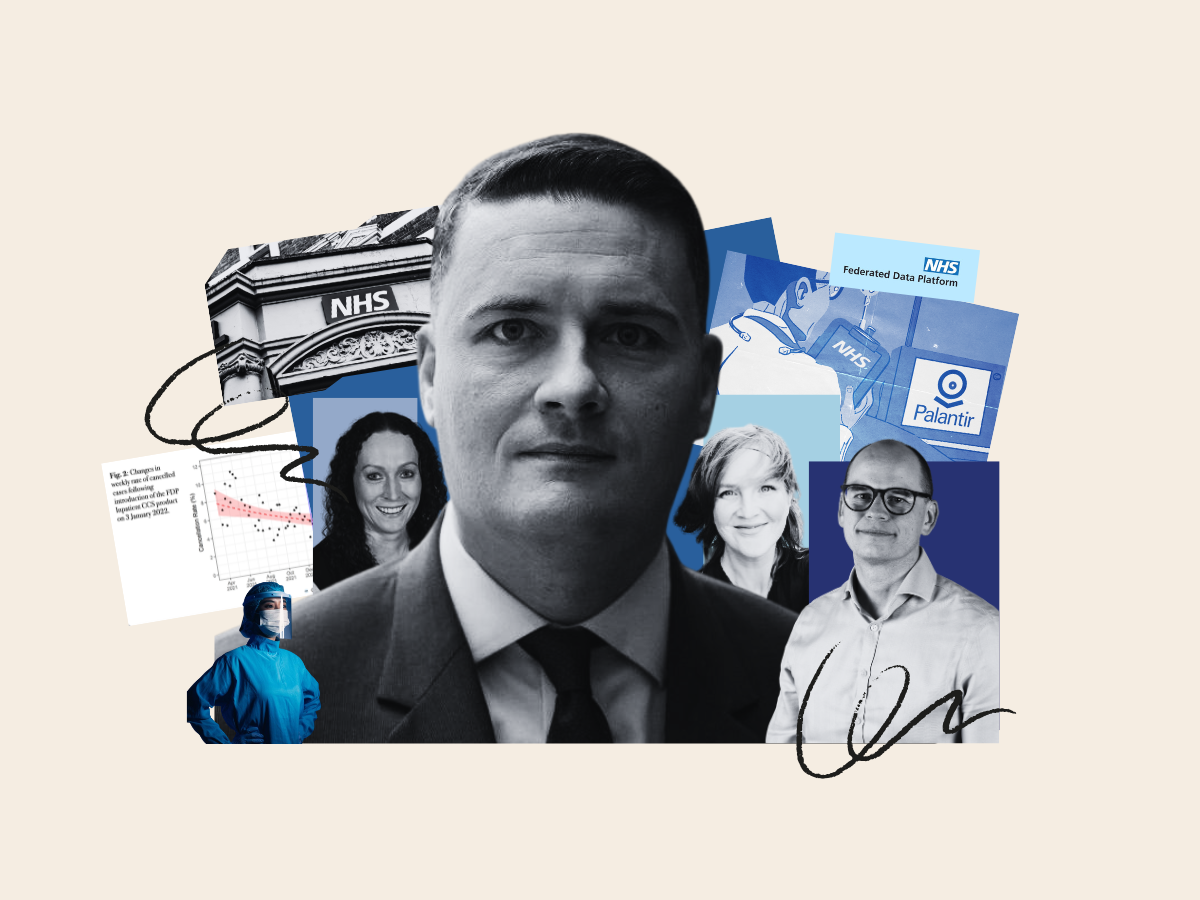
Few technology programmes in recent NHS history have generated as much debate as the Federated Data Platform. Since Palantir won its £330 million contract in November 2023, the FDP has attracted intense scrutiny from politicians, patient groups, and health technologists alike. Some of that scrutiny has been valuable. Much of it has focused on the wrong questions.
Spend time in a large NHS trust and you will encounter a particular kind of administrative exhaustion. A theatre coordinator checks one system for the waiting list, another for the roster, a third for equipment availability, and then reconciles all three in a spreadsheet that will be out of date by morning. Nobody designed it this way. It accreted, system by system, procurement by procurement, over decades of IT investment that was never coordinated at scale. The data exists. It is just scattered, siloed, and extraordinarily difficult to act on in real time.
This is the problem the FDP was contracted to address. It is not, at its simplest, a clinical system. It is an operational intelligence layer, a means of pulling fragmented data into a single interface so that hospitals can see what is happening across their organisation and act on it. That sounds straightforward. It is not. The NHS operates through hundreds of independent trusts, each with their own procurement histories, IT architectures, and data governance cultures. Building anything that works across that landscape, at scale, consistently, is genuinely hard.
Maturity matters enormously in health IT. The NHS has a long history of adopting systems that took years to deliver measurable value, not because the systems were poor, but because integration into clinical and operational workflows is slow, contested, and dependent on local leadership. The FDP is running live in 123 organisations, and the trusts that have committed most fully to the platform are beginning to show what it can do. Will Monaghan, chief digital information officer at University Hospitals of Leicester and University Hospitals of Northamptonshire, captures it well: "Bringing these functions together can deliver clear benefits," he says, adding that the real value comes when organisations "invest time and effort into feeding it with the right data." His analogy is a jigsaw: "You only see the full picture once enough of the right pieces are in place."
That picture is becoming clearer in the trusts where engagement has been deepest. At University Hospitals of Northamptonshire, Jennie Walker, deputy chief operating officer for planned care, describes a before and after that speaks directly to the coordination failures the FDP was built to fix. "Previously, nobody could see each other's patients," she says. "Now we can see differences in waiting times and move patients accordingly." The practical result has been more than 1,000 patient transfers between hospitals, with people being seen faster than they otherwise would have been. Becky Taylor, who runs the FDP programme at UHN, is direct about its value: "We've found it to be such a helpful way for us to pull all of our data together. Before, we had very manual processes, Excel spreadsheets being updated weekly, and this has taken that away." Her test for whether the platform earns its place is equally straightforward. "We wouldn't be using it if our clinicians said it wasn't working."
At Kettering General Hospital, one of the trusts with some of the longest waiting times in England, staff report that the platform has meaningfully reduced manual workloads and improved the quality of patient care. These are not marginal gains in a comfortable environment. They are operational improvements in one of the most pressured parts of the health system.
Across the programme as a whole, the numbers are significant. The FDP has contributed to 110,000 additional operations, removed 800,000 patients from waiting lists, and delivered a 15 per cent reduction in discharge delays across participating trusts. The number of patients receiving a cancer diagnosis within 28 days of referral has risen by 6.8 per cent where Palantir's Cancer 360 tool is in use. For a programme still in relatively early deployment, with adoption continuing to build, these figures represent a meaningful start.
The cost argument is worth addressing directly. The contract value of £330 million, with lifetime costs expected to exceed £1 billion, is substantial. But cost must be assessed against the scale of the problem it is addressing. Waiting list backlogs carry enormous financial and human costs. Discharge delays, patients who are clinically ready to leave hospital but cannot be moved due to coordination failures, absorb significant bed capacity every single day. A platform that materially reduces those delays across dozens of trusts changes the financial calculation considerably. The question is not whether £1 billion is large in isolation, but whether it represents value relative to what it is solving and what the credible alternatives actually are.
What the FDP represents, stripped of the political debate surrounding it, is an attempt to do something the NHS has tried and failed to do for a long time: create a functional, interoperable operational data layer across a fragmented system. Previous attempts collapsed under the weight of complexity, underfunding, or the difficulty of getting independent organisations to change how they work. The FDP is not immune to those pressures. But it is further along than most of its predecessors, and the trusts seeing genuine results are those that have committed to making it work.
Health secretary Wes Streeting has described the FDP as "absolutely critical" to the NHS's future, arguing that "there aren't many platforms and providers in the world who can do this." The evidence, at this stage, supports that confidence. The programme will require continued investment, rigorous outcome measurement, and the kind of institutional patience that large-scale health IT rarely receives. What it does not require is to be judged as a failure before the jigsaw is anywhere near complete.



.png)
.png)
.jpg)