
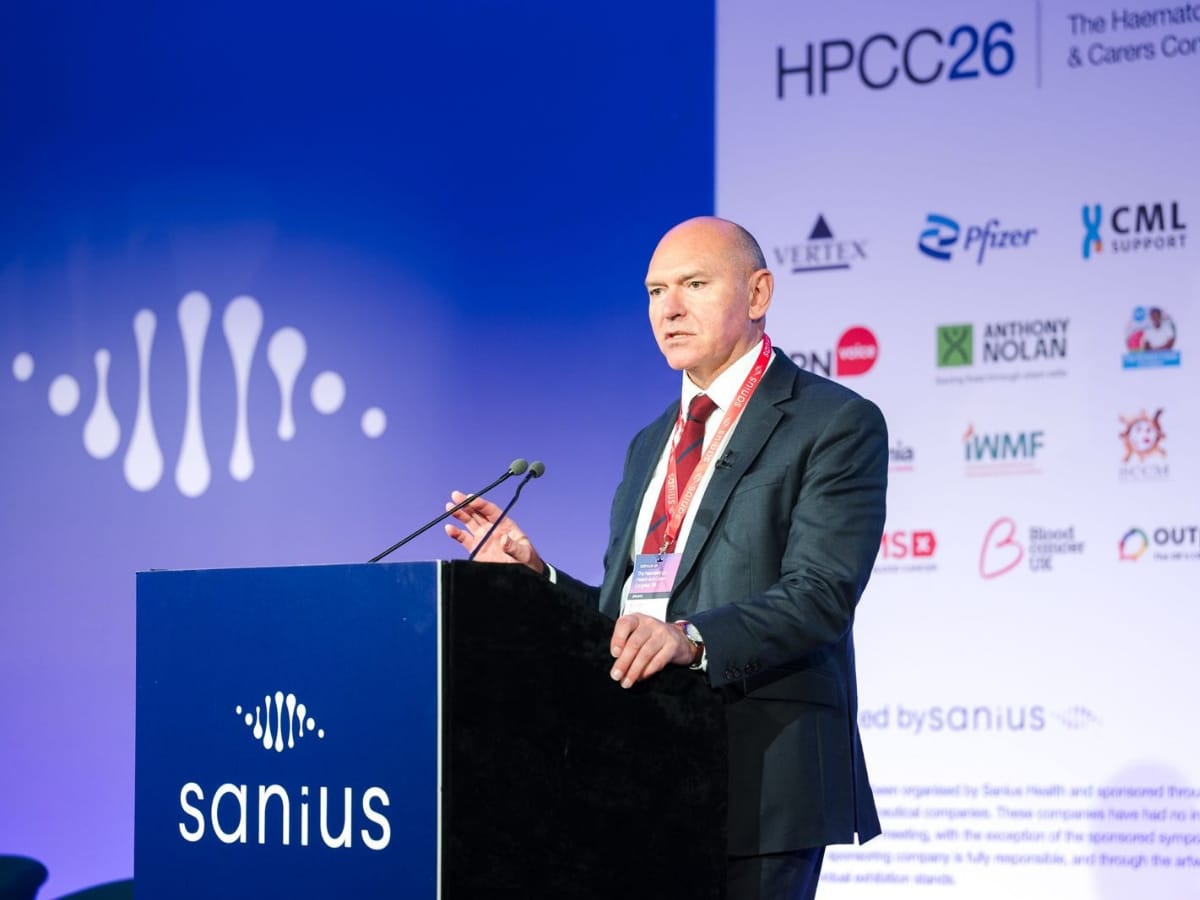
For years, conversations about the future of the NHS have tended to happen at a distance from the people most dependent on it. Policy is announced, technology is unveiled, targets are set, and somewhere beneath all of it patients attempt to navigate systems that rarely feel designed around the reality of being ill. The Haematology Patient and Carers Congress in London collapses that distance. At HPCC 2026, senior NHS leaders, clinicians, technology executives and patients shared the same room, and the discussion that emerged was less about future vision than present failure: fragmented records, exhausted staff, unequal access to care, and a health service struggling to absorb a wave of scientific and technological change already arriving faster than its infrastructure can manage.
The Haematology Patient and Carers Congress returned to London for its third year under the banner of Sanius Health, the healthcare technology company that founded and runs it, bringing together people living with sickle cell disease, multiple myeloma, chronic lymphocytic leukaemia and Waldenström's macroglobulinaemia alongside representatives from Blood Cancer UK, Myeloma UK, MPN Voice and Leukaemia Care. It has become one of the larger patient-centred gatherings in British haematology. More importantly, it has developed a reputation for allowing difficult conversations to happen in full view rather than smoothing them into consensus. The people having those conversations increasingly include senior NHS leadership.
Sir Jim Mackey arrived with the authority of someone who has spent a year confronting the practical condition of the NHS rather than its political mythology. His address was blunt without becoming theatrical. He described inheriting a service already under severe pressure before the pandemic: billions in financial strain, workforce shortages built gradually over years, and an institutional exhaustion that left little room for further shock. Covid then intensified problems that had already become structural. The backlog that followed still shapes almost every public discussion about the NHS.
Yet the tone was not despairing. Waiting times have improved in some areas. Public confidence, according to the British Social Attitudes Survey, has shown signs of recovery. Mackey acknowledged progress directly. When he said the NHS is "absolutely not out of the woods yet", the line carried weight because the audience already knew it to be true. Many in that room live inside the consequences of delayed care and fragmented systems every day. What mattered more was his insistence that stabilisation alone is no longer enough. "This year has to be the year where we start that really big reconnection again, with the population, our patients, with staff."
Two policy developments gave that ambition some shape. The appointment of a senior responsible officer for the single patient record addresses one of the most common frustrations in modern healthcare: patients repeating the same medical history across disconnected systems because records fail to travel with them. Mackey's view was simple enough. The record should belong to the patient rather than the institution. It sounds obvious when stated plainly, which is perhaps why the NHS has struggled with it for so long.
He also described the creation of a National Patient Experience Director. The logic behind the role was practical rather than grand. Organisations cannot improve what they fail to examine properly. Patients, he noted, most often complained about basic experiences: room temperature, delayed responses from staff, having to repeat information. None of these issues are especially glamorous. They are still the things people remember after treatment.
Orlando Agrippa, founder and chief executive of Sanius Health, brought a complementary perspective. He wears his own company's monitoring device and shares continuous health data with his physician, so his arguments about digital care did not sound lifted from a pitch deck. His keynote traced the company's growth over the past year: a £3 million clinical trial in multiple myeloma with The Christie, an observational study in myeloproliferative neoplasms with St Thomas' Hospital, 35 new hospital partners, and expanded sickle cell programmes across the United States, Africa, Asia and parts of the Caribbean.
A vaso-occlusive crisis prediction tool for sickle cell patients has entered early deployment after three years of development. A digital health wallet gives patients portable access to records. Audio-to-text diary tools have been piloted in hereditary angioedema. Future plans include work in lymphoma and haemophilia alongside a small innovation fund for patient organisations pursuing digital projects. The obstacle, Agrippa admitted, is no longer building the technology itself. The harder task is integrating it into an NHS records infrastructure that still operates unevenly between trusts.
That tension surfaced repeatedly during the private patient panel with Sir Jim Mackey that followed. Ian, a multiple myeloma patient treated across two trusts using different records systems, described months spent trying unsuccessfully to reconcile his own clinical information between institutions. Mackey acknowledged the problem without pretending a quick fix existed. The single patient record is intended to solve precisely this issue, but many NHS systems were procured independently over decades with little expectation they would need to communicate with one another.
The sharpest moment came from Rhea, a sickle cell patient and mother of three, who asked what support exists for children when parents are hospitalised without family backup. The answer was stark. Local authorities place children into foster care, creating a formal record against their names. Mackey did not attempt to soften it. No national solution exists. Nor, he admitted, is one likely soon.
Anna, chief medical officer at Heidi Health, presented data from more than two million monthly consultations supported by ambient AI transcription. Documentation time had fallen sharply in primary care, with larger reductions reported in some community settings. One anecdote landed particularly well in the room: a nurse asking midway through a consultation whether she could record the conversation instead of typing notes manually. Demand for these systems is already ahead of national policy.
Dr Shelley, a haematologist at University College Hospital, said the same pressures emerged repeatedly at international clinical meetings: administrative overload, fragmented records, delays in access to medicines. She adopted ambient recording less because she found the technology exciting than because divided attention during consultations had become clinically risky.
The larger tension beneath the congress was impossible to miss. Scientific progress in haematology is moving faster than the health system distributing it. Bispecific therapies are already changing outcomes in multiple myeloma. Predictive monitoring tools are already in patients' hands. Mackey's remark about Newcastle expanding from five surgical robots to sixty within five years sounded less like future planning than a system struggling to catch up with decisions already made elsewhere.
The expectation that patients will collect, hold and share their own health data is no longer speculative either. What remains unresolved is whether digitally enabled care will narrow inequalities or deepen them. Systems tend to reward the people best equipped to navigate them.
What HPCC 2026 demonstrated, across a long day of panels and keynotes and exchanges that had no easy answers, was that the quality of the conversation has genuinely changed. Mackey's willingness to speak plainly about where the NHS stands, and Agrippa's commitment to building care infrastructure around the patient rather than around institutional convenience, set a tone that carried through the day. Progress on the single patient record, the National Patient Experience Director, and the growing clinical adoption of ambient AI tools all point in a consistent direction. Whether they converge quickly enough to make a measurable difference to people living with haematological conditions is the question HPCC 2026 posed but could not yet answer. What it demonstrates is that the right people are asking it together, and that the answers will be more useful for having been tested in the same room as the patients waiting for them.



.jpg)
.jpg)