.png)
The ShinyHunters cyber-extortion group claims it has stolen 284 million patient-related records from McKesson, one of the world’s largest healthcare companies, and demanded more than $55 million for their return. McKesson has confirmed that it discovered a cybersecurity incident on 25 August 2026, although the scale of the alleged theft has not yet been independently established. If the hackers’ account proves accurate, this would be an extraordinary concentration of healthcare information in criminal hands.
The data allegedly taken goes considerably beyond names and email addresses. Reports suggest it could include addresses, Social Security numbers, medical records, diagnoses, medications and other personal information, alongside data relating to employees, physicians and clinics. ShinyHunters also claims it obtained doctor-patient communications. McKesson has said that data associated with customers within its Oncology & Multispecialty and Medical-Surgical businesses may have been involved.
This is not simply another data breach.
It is a warning about how healthcare now works.
Hospitals have become vast digital ecosystems. Pathology, prescribing, imaging, patient administration, referrals, workforce systems and increasingly medical devices depend on connected technology and outside suppliers. A cyberattack therefore no longer remains inside the IT department. It can reach the ward, the laboratory and the operating theatre remarkably quickly.
For the NHS, we already know what that looks like.
In June 2024, a ransomware attack struck Synnovis, the pathology provider supporting major parts of south-east London. King’s College Hospital and Guy’s and St Thomas’ were among the organisations most severely affected.
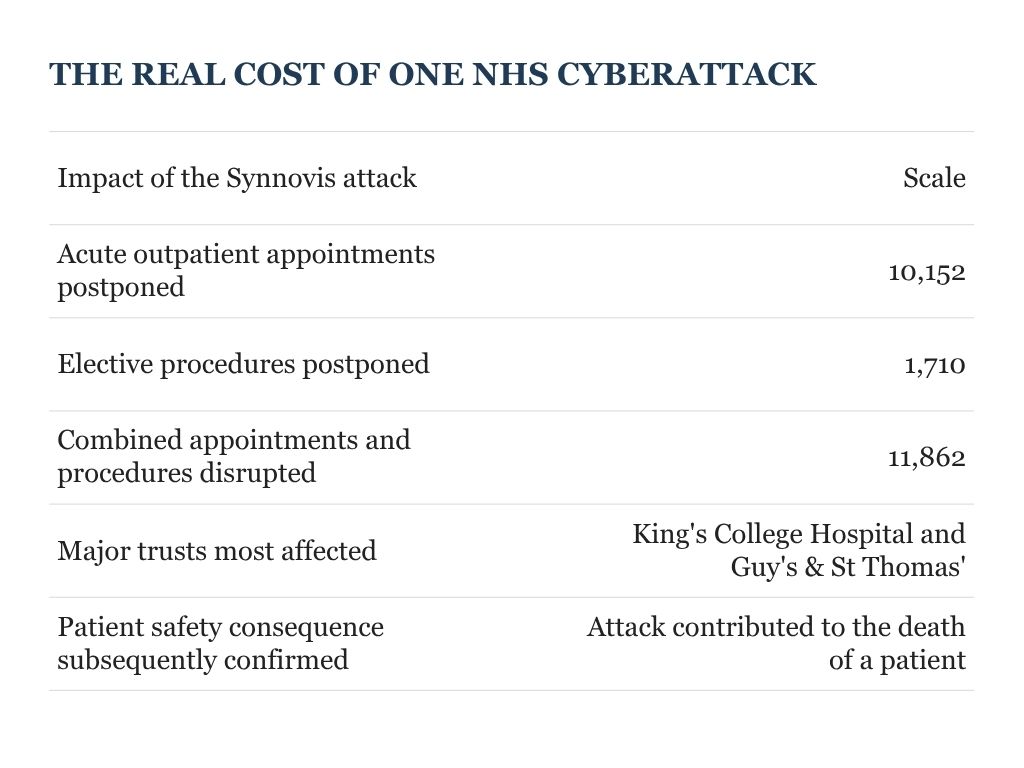
The disruption went far beyond cancelled appointments. Affected laboratories temporarily lost the ability to perform normal electronic blood cross-matching, increasing dependence on universal O-type blood and placing additional pressure on already stretched national supplies.
Two years later, the implications became even more serious. In July 2026, the Government told Parliament that the Synnovis attack had delayed more than 11,000 outpatient and elective appointments and had, tragically, contributed to the death of a patient.
That changes the conversation.
Healthcare organisations have traditionally treated cybersecurity through the language of information governance, business continuity and data protection. Those remain essential, but they are no longer sufficient. When a cyberattack can delay an operation, interrupt pathology, disrupt transfusion services or contribute to clinical harm, cyber resilience belongs alongside infection control, medicines safety and emergency preparedness.
The uncomfortable problem is that the NHS attack surface continues to expand.
That is partly because the NHS is doing exactly what it should be doing. More services are becoming digital. Records are becoming connected. Artificial intelligence is moving into clinical and operational workflows. Remote monitoring is growing. Cloud infrastructure is replacing legacy technology. Hospitals are becoming increasingly dependent upon platforms owned and operated by third parties.
The answer is not to slow digital transformation.
It is to make resilience part of digital transformation.
The UK has already seen repeated warnings. The 2022 ransomware attack on software provider Advanced disrupted NHS and social-care services and potentially affected information relating to tens of thousands of people. More recent incidents have disrupted services in Liverpool and the Wirral. Individually, these attacks differ in scale and method. Collectively, they point to the same structural problem: healthcare is increasingly dependent on digital infrastructure that can fail far beyond the walls of any single hospital.
That starts with suppliers.
NHS organisations can have strong internal cyber controls and still be exposed through pathology providers, software companies, cloud platforms and thousands of connected partners. Boards should know which suppliers can access clinical information, which systems are mission critical, how quickly compromised credentials can be disabled and how long essential clinical services can operate without their normal technology.
Multi-factor authentication should be universal. Access should be continually verified rather than permanently trusted. Sensitive datasets need effective segmentation. Backups need to be recoverable, rather than simply existing somewhere. Hospitals also need rehearsed clinical fallback procedures for prescribing, pathology, diagnostics and patient communications.
But technology alone will not solve this.
The alleged McKesson breach is particularly instructive because ShinyHunters claims employees were targeted through voice phishing before credentials were used to gain access to corporate systems. If that account is correct, the front door was not some extraordinary piece of malware. It was a convincing conversation with a member of staff.
That matters enormously.
The most sophisticated health systems in the world can spend millions on technology and still be compromised through identity, access and human behaviour. Cybersecurity therefore needs to move beyond annual training exercises and compliance checklists. Staff need to understand how modern social-engineering attacks work, while organisations need technical controls that assume credentials will eventually be compromised.
For NHS boards, the question should no longer be whether a serious cyber incident is possible.
It should be what happens to patient care when one occurs.
Healthcare is becoming more connected because better connectivity can produce better care. AI, interoperable records, digital diagnostics and remote monitoring will become increasingly central to modern medicine. But every connection also creates dependency.
The organisations that succeed will not be those that retreat from digital healthcare.
They will be those capable of continuing to deliver care when part of the digital estate fails.
The McKesson incident may ultimately prove to be one of the largest healthcare breaches ever reported.
For the NHS, however, the lesson is already clear.
The next cyberattack may not simply steal patient data.
It may disrupt patient care.



.jpg)
.jpg)