
A theatre list is only as good as the information behind it. In a booking office, the morning begins with an inbox that has grown overnight and a spreadsheet that was last accurate some days ago. A coordinator checks one system, then another, then retypes what she found into a third. Nobody in the room considers this unusual. It is how elective care has been scheduled across much of the NHS for years.
Kingston Hospital NHS Foundation Trust in southwest London worked this way until April 2023, when it adopted the NHS Federated Data Platform and began using the Inpatients Care Coordination Solution. The product draws patient and scheduling data from several trust systems into a single view, so booking and theatre staff no longer log into each source or enter data by hand. The trust reports that this saves hours of staff time every week and supports theatre utilisation that was already strong. It also credits improvements to its source systems and ways of working.
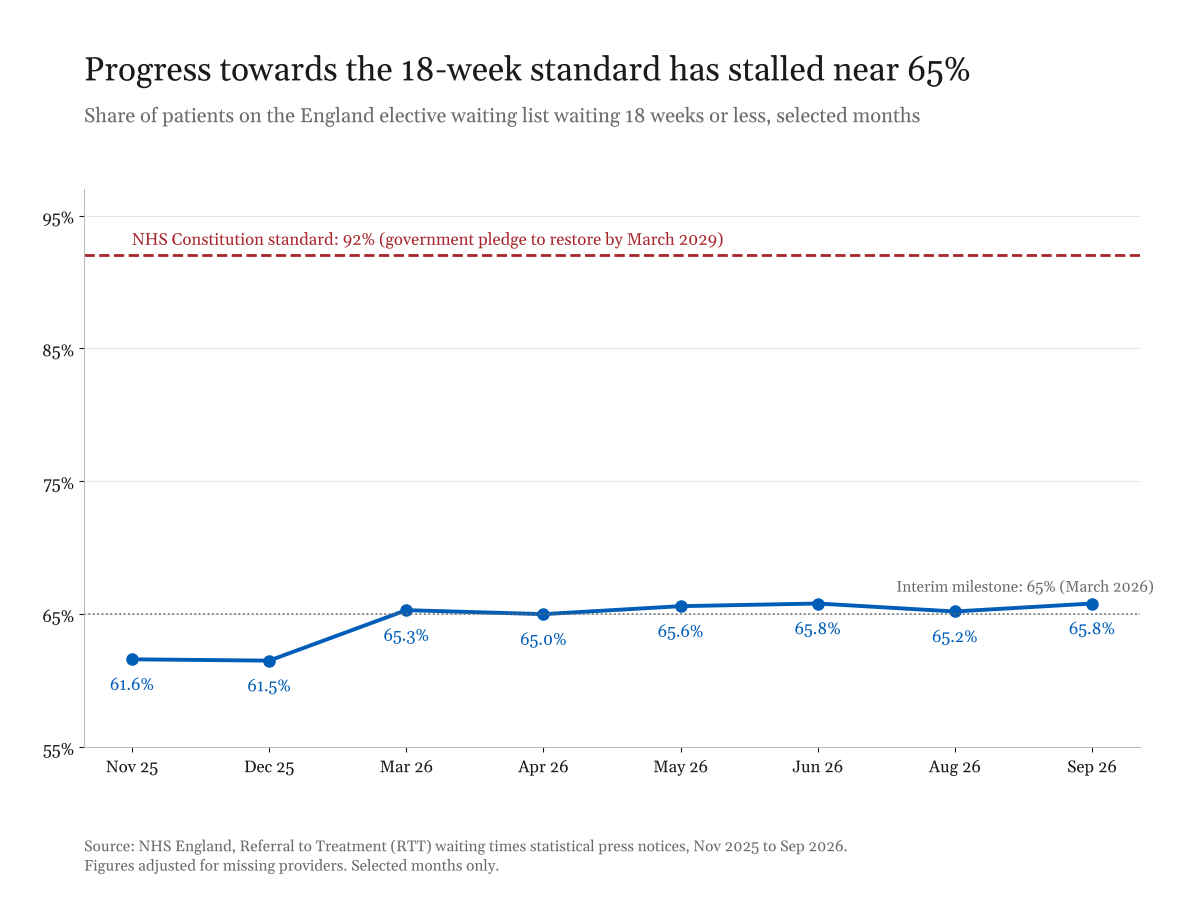
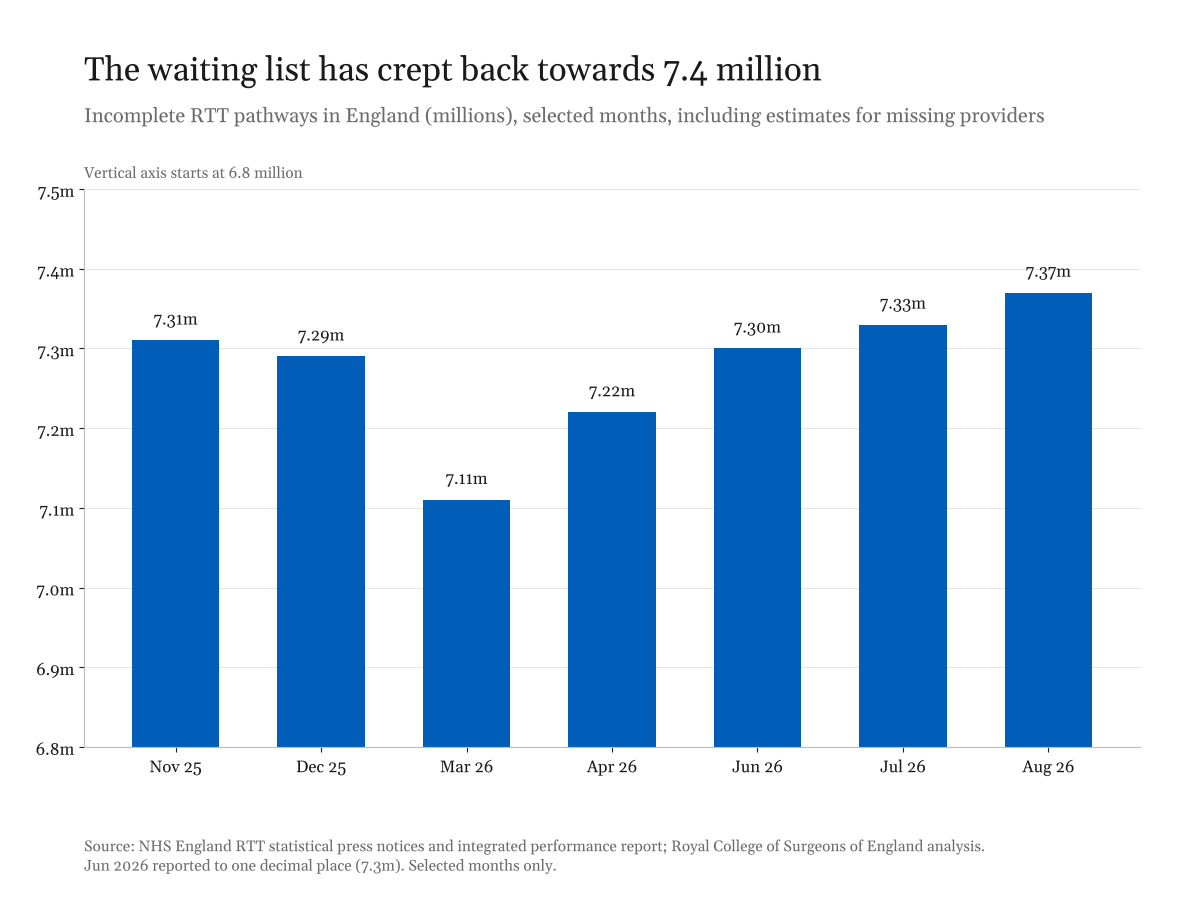
The case lands at an awkward point for the health service. In September, 65.8% of patients on the England waiting list had waited 18 weeks or less, which clears the interim milestone of 65% set for March 2026. It remains more than 26 percentage points short of the 92% standard the government has promised to restore by March 2029. The list itself stood at around 7.4 million pathways in August, and it has drifted upwards since the spring. Hospitals cannot build theatres or train surgeons on the timescale the pledge demands. Scheduling is one of the few levers that needs neither capital nor recruitment, which explains why a booking office in Kingston now interests people in Whitehall.
The more consequential feature of the Kingston account is a function that flags anomalies and discrepancies in waiting list records. Using it, the trust has reduced its gynaecology and urology lists by ensuring that only patients who actively need appointments are prioritised. Policymakers should read this carefully. A list that shrinks after validation tells us the record previously held entries that no longer described a waiting patient. That is valuable for planning and for honest reporting. It leaves the number of operations performed unchanged. National headline figures contain the same ambiguity, and leaders who present a falling list as faster care will eventually be asked to show the theatre activity behind it.
Robyn Hollins, the trust's Transformation and Adoption Lead, says the platform helps teams use every available slot so that patients are seen faster. Her advice to other trusts is to engage the right clinical and administrative teams early, because hurdles that surface late cost time. Anyone who has delivered a digital programme in an NHS organisation will recognise this. Adoption depends on staff who are rarely given the hours to shape the tool before it arrives, and the trust that budgets for that time tends to move faster than the one that treats it as an afterthought.
The next phase is harder. Theresa Kirkham, the trust's General Manager, says that with theatre booking addressed, the priority is to improve the quality of the cases being booked and so reduce short-notice cancellations on the day. A cancellation on the day of surgery often originates upstream, in pre-operative assessment, patient contact or bed availability. A scheduling tool can surface those problems but cannot resolve them alone. Kingston is also reviewing other products on the platform, and the trust's willingness to say what remains unsolved makes its account more credible than most.
There is a political dimension that sits uneasily beside the operational one. The platform remains contested. Its supplier, the scale of the national contract and the governance of patient data have drawn scepticism from some clinicians and privacy campaigners, and public trust in how the NHS handles data is not a given. Evidence from individual trusts will decide whether the platform is accepted as ordinary infrastructure. A case study published by the national body, without figures, is not that kind of evidence. Chief operating officers weighing adoption should ask for hours saved, theatre utilisation before and after, the size of the validation adjustment and the on-the-day cancellation rate. Health-tech suppliers will find that procurement credibility follows measured outcomes.
Freeing a booking coordinator from retyping data is a real gain, and Kingston has plausibly achieved it. Whether the platform has changed the number of patients treated is a separate question, and the answer will emerge only when trusts publish figures that a finance director could audit.