Before a weekly cancer review can discuss a patient, someone has usually had to find them. In many hospitals that means pulling records from separate clinical systems, reconciling them by hand in a spreadsheet and hoping nothing has slipped between versions. For the hours that takes, a person waiting to learn whether they have cancer is a row in a document that may already be out of date. This is the unglamorous machinery on which national cancer targets depend, and it is where the NHS is now placing a considerable bet.
From June, ten further hospital trusts in England are due to begin adopting Cancer 360, a software tool built on the NHS Federated Data Platform. It creates a single, secure patient tracking list paired with real-time dashboards. The stated aims are to shorten the path to diagnosis and treatment and to take clerical work off the hands of clinical staff. Those are modest-sounding goals, but they address two of the problems that most frustrate the service: long waits for cancer care and the diversion of scarce clinical time into administration.
The strongest evidence so far comes from Chelsea and Westminster NHS Foundation Trust. The tool was first trialled there in gynaecology between August and December 2022, then extended across all cancer types. It now supports 46 teams and 239 users, and has processed more than 52,000 patients. The headline result concerns the 28-day target for diagnosis. Between November 2022 and November 2024, urgent suspected cancer referrals at the trust rose from 2,343 to 2,480, an increase of just under 6 per cent. Over the same period, the proportion of patients diagnosed within 28 days climbed from 71.5 per cent to 84.7 per cent. Demand went up and performance improved by more than thirteen percentage points.
That is a striking outcome, and it deserves scrutiny proportionate to its importance. Two points in time at a single trust cannot establish that software alone produced the gain. Trusts that adopt new tools often change staffing, escalation habits and local governance at the same moment, and those changes matter. A fair reading is that Cancer 360 is a plausible contributor to the improvement, and that the evidence justifies wider testing under varied conditions. The coming rollout will do more to settle the question than any further pilot report.
Cancer referrals rose while timely diagnosis improved at Chelsea and Westminster
Chelsea and Westminster NHS Foundation Trust, November 2022 and November 2024
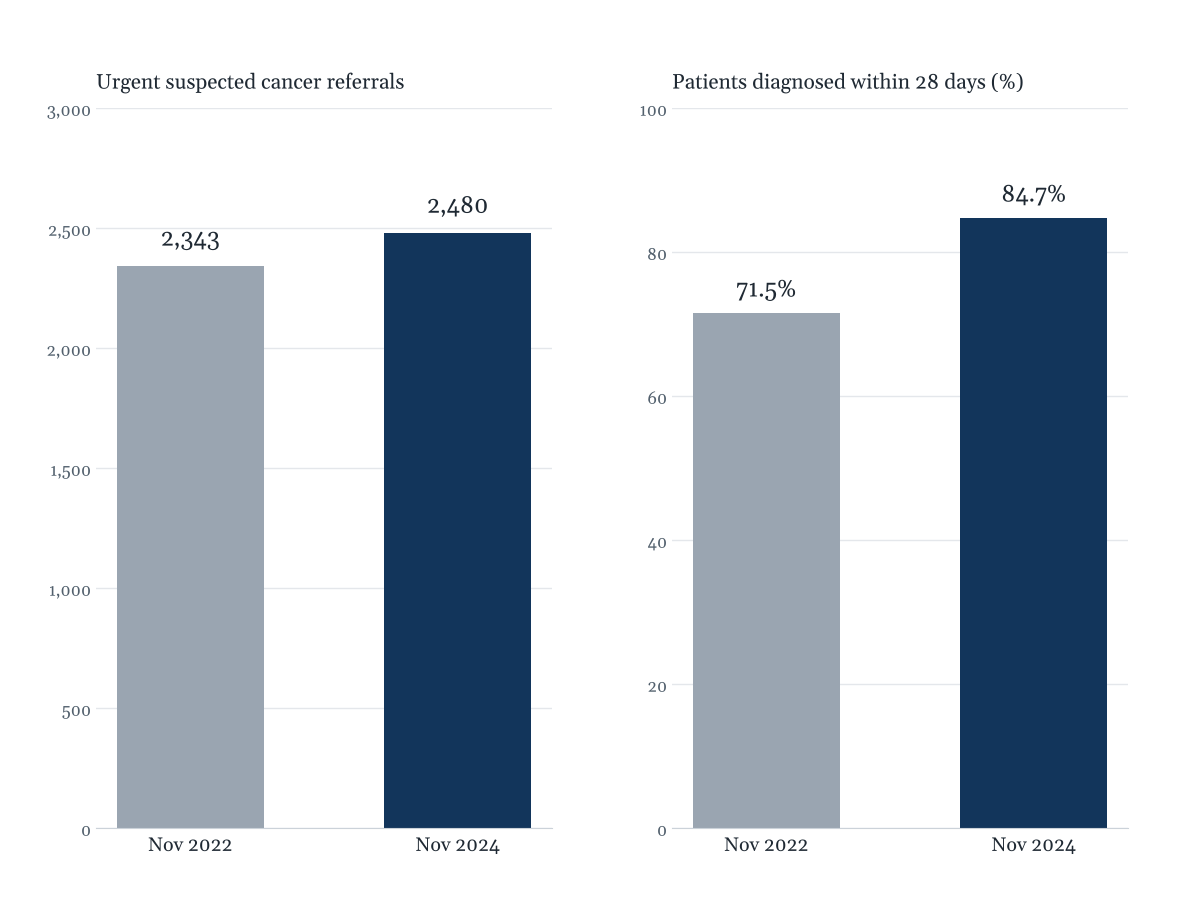
Source: Chelsea and Westminster NHS Foundation Trust figures published with the Cancer 360 rollout announcement.
The mechanism is easy to follow. Previously, clinicians extracted patient data by hand across disconnected systems, a slow process prone to clerical error. A single tracking list removes that step and gives every team the same view of where each patient stands. Recent upgrades allow staff to filter by clinical team and by patient risk level. Managers can see where a pathway is stalling and direct attention to the highest-risk cases first, which matters when capacity is fixed and the queue is not.
Suraiya Abdi, a consultant obstetrician and gynaecologist at Chelsea and Westminster, describes the change in practical terms. Patient pathways can be monitored more safely because delays become visible sooner. In weekly reviews, queries that once circulated by email can be escalated across teams on the spot. The time her colleagues previously spent on paperwork has shifted towards direct patient care. Each of these is a small operational improvement, and together they describe what productivity looks like in a hospital, as opposed to the version found in Treasury spreadsheets.
The geographic spread is already under way. Royal United Hospitals Bath began a pilot in colorectal services in November 2024 and has since extended it to upper gastrointestinal care. University Hospitals of Derby and Burton is implementing the system as the third pilot site. The June onboarding of ten more trusts would turn a set of local experiments into something resembling national policy, and it is at that scale that the harder questions arrive.
The first is political. The Federated Data Platform has attracted sustained public and professional scrutiny over procurement, data governance and who ultimately benefits from NHS data. Cancer 360 gives the programme something it has needed, which is a concrete clinical use that patients and staff can understand. If the tool delivers faster diagnoses, it strengthens the case that centralised, well-governed data can improve care. If results fade outside London, the argument for the platform weakens at the moment ministers most want it to carry weight. Public trust will track outcomes more closely than it tracks assurances.
The second question concerns capability. Trusts differ greatly in digital maturity, data quality and the spare managerial capacity needed to change how teams work. A tool that performed well in a large London teaching trust may meet more resistance where staffing is thinner and legacy systems are older. NHS leaders adopting it should expect to invest in process change as well as software, and should resist the temptation to treat go-live as the finish line. Commissioners of the rollout, for their part, ought to publish trust-level results in a form that allows independent analysis.
For health-tech suppliers the message is plain. Products that remove a specific, measurable burden from clinical teams find a receptive system, while broad promises of transformation do not. For patients, the benefit is easier to state. A faster route to a diagnosis is worth more than almost any other improvement the service can offer, and shaving days from a pathway that begins with fear has a value no dashboard captures.
The ten new trusts will show whether Chelsea and Westminster's result was a local achievement or a replicable one. If the improvement travels, the NHS will have found a rare thing, a digital intervention whose benefit can be counted in diagnoses made on time. If it does not, the programme will have learned that out in the open, which is its own kind of progress.