.png)
Asked which healthcare events they are most likely to prioritise, 10% of respondents said none of those listed. Among those planning to attend, however, the preference is striking.
NHS Executive Conference preferences:
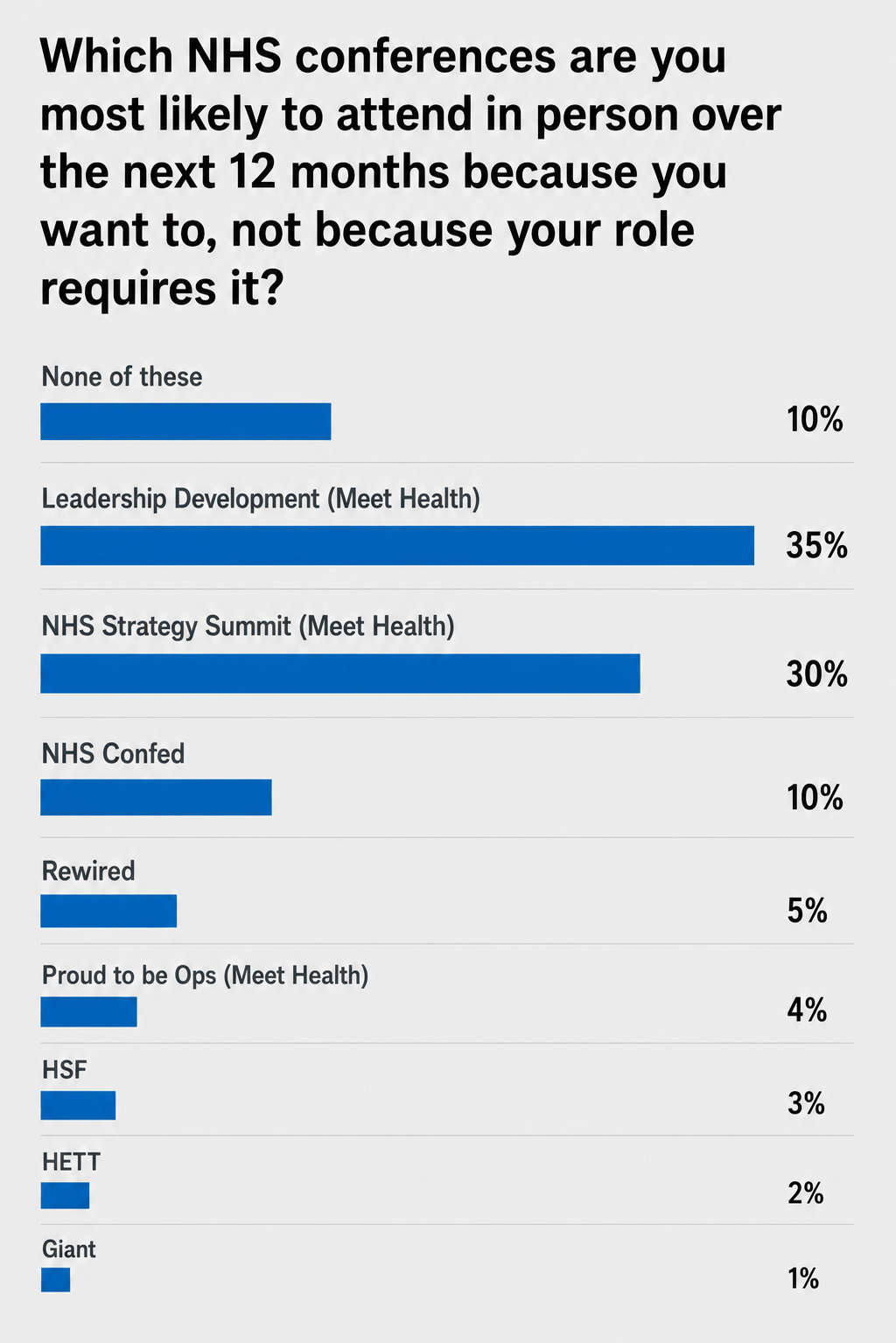
The chart makes the pattern clear. Leadership Development and the NHS Strategy Summit, both run by Meet Health, account for 65% of responses between them, putting them well ahead of the rest of the field. NHS Confed follows at 10%, while the remaining events attract smaller but still notable levels of interest.
That points to a wider shift in what NHS leaders appear to value from conferences and events. Large national gatherings still have a role, particularly for networking, visibility and policy discussion, but the strongest pull now seems to come from smaller, more targeted forums with a sharper practical focus.
The strongest proposition appears to be relevance rather than scale.
Events centred on leadership, strategy and operational delivery create a different kind of environment. Attendees are more likely to spend time with peers facing similar challenges, have more substantive conversations and come away with ideas that can be applied directly within their organisations.
Leadership Development leads the table at 35%, closely followed by the NHS Strategy Summit at 30%. That is not a marginal lead, it is a commanding one. It suggests there is significant appetite for spaces that move beyond broad conference programming and instead focus on the real issues senior NHS teams are dealing with every day.
NHS Confed remains an important fixture at 10%, reflecting its continued standing within the sector. Rewired, at 5%, still has relevance, particularly for those focused on digital transformation. Proud to be Ops, HSF, HETT and Giant attract smaller shares, but together they still show that specialist and niche events retain a place in the market.
There is also an important message in the 10% who selected none of these. With NHS organisations under sustained operational and financial pressure, many leaders are becoming more selective about where they spend time. Attendance increasingly has to justify itself. Event organisers are not just competing on profile, they are competing on usefulness.
The results suggest that the advantage is moving towards curated forums with a clear audience, a defined purpose and enough room for serious conversation.
In an increasingly congested healthcare events market, bigger does not automatically mean better. Relevance, seniority and the quality of the room may now matter considerably more.


.jpg)
.jpg)