
.jpg)
I recently had a call from my doctor in London. Before we began, I was told the practice was trialling a new Oracle AI solution and asked whether I was comfortable with the consultation being written up by artificial intelligence. A few days later, I walked into a specialist appointment at the Shard and heard almost exactly the same question. Two different settings, two different clinicians, one unmistakable signal: AI has moved out of the conference hall and into the consulting room.
That matters because healthcare is becoming one of the most important proving grounds for artificial intelligence. AI can listen to consultations, draft clinical notes, analyse scans, interpret laboratory results, predict deterioration, manage waiting lists and increasingly support clinical decisions. The opportunity is enormous. But as deployment accelerates, a more fundamental question is emerging: what do patients actually think about all of this?
A new Pew Research Center survey of U.S. adults provides one of the clearest answers yet. Patients are not simply rejecting AI. What they are demanding is transparency, understanding and significantly more control over when it is used in their care.
“Patients are not saying stop AI. They are saying: bring us with you.”
The headline number
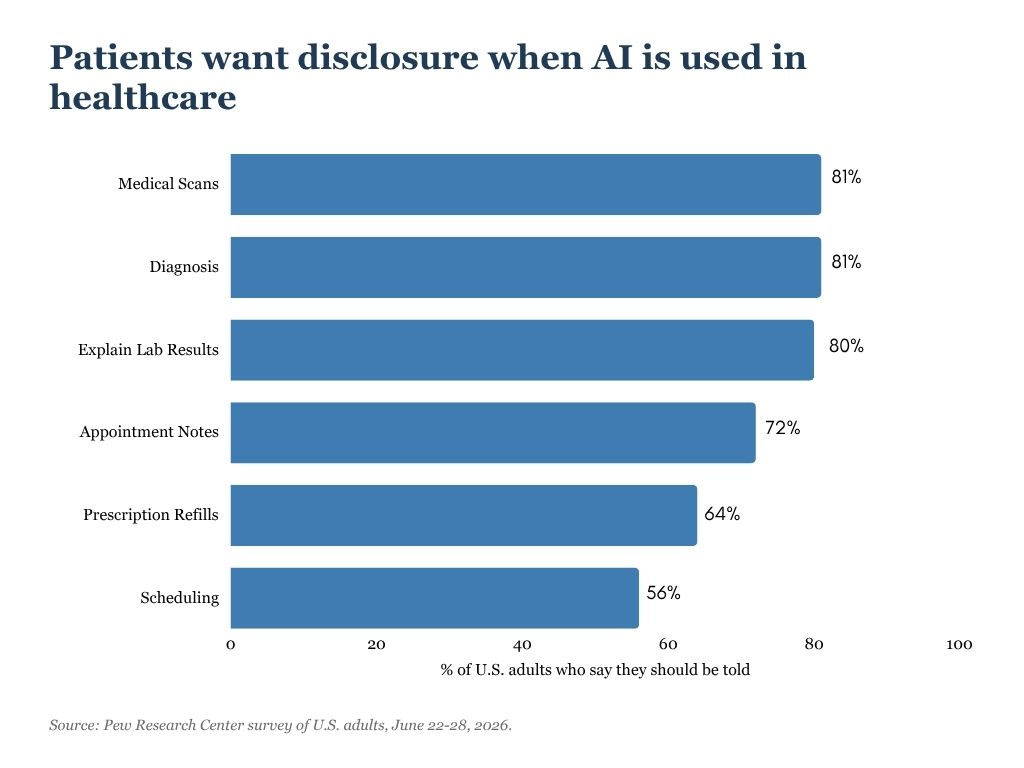
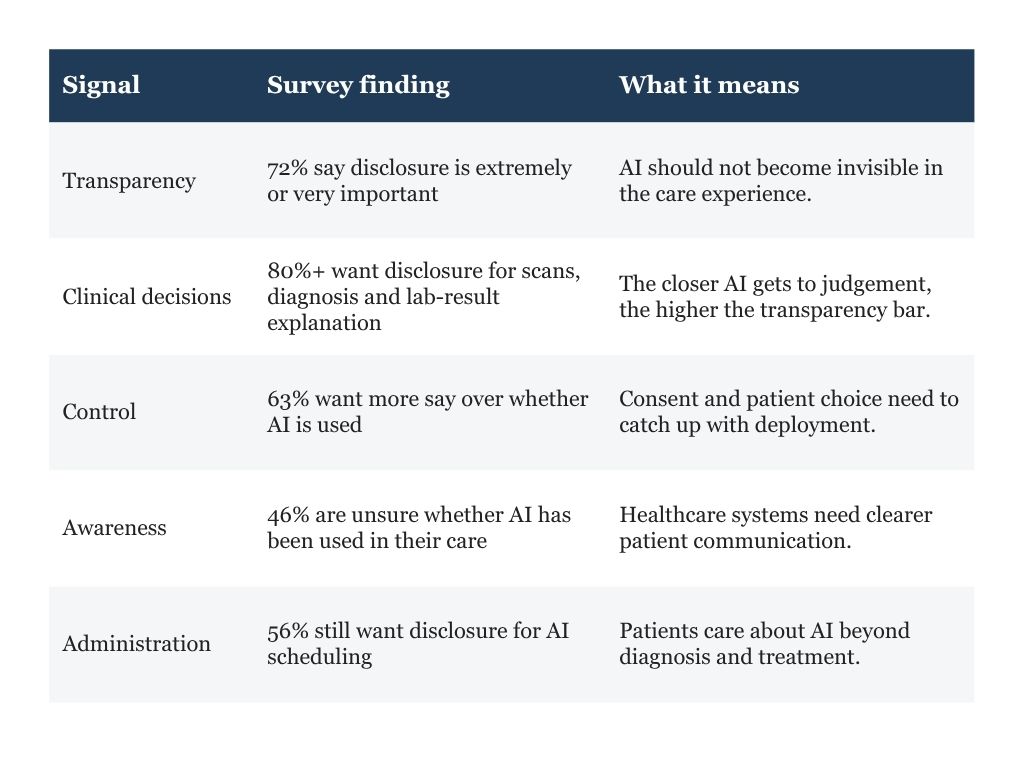
Some 72 per cent of American adults say it is extremely or very important that a doctor or healthcare professional tells them when AI is being used in their healthcare. That view cuts across age, gender, education and racial groups.
The closer AI gets to a clinical decision, the stronger the expectation becomes. Eight in ten or more say they should be told when AI is analysing medical scans, making a diagnosis or explaining laboratory results. Even ambient note-taking, one of the fastest-growing uses of generative AI in medicine, triggers the same instinct: 72 per cent want disclosure.
What the survey is really saying
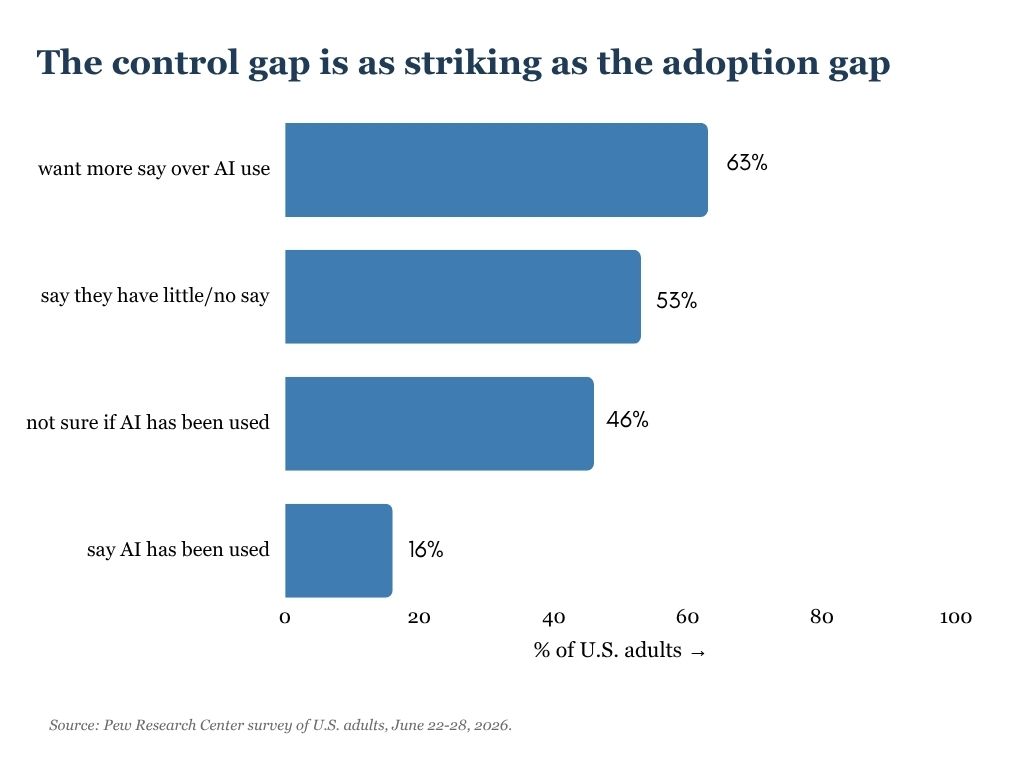
The most important finding may not be disclosure at all. It is agency. Fifty-three per cent of Americans say they currently have little or no say over whether a healthcare provider uses AI in their care. Yet 63 per cent say they would like more say. Only 21 per cent are comfortable with the amount of control they currently have. Americans are therefore three times more likely to want greater input than to be satisfied with the status quo.
That is not an anti-AI finding. It is a warning that technology adoption is moving faster than the social contract around it. For years, digital transformation has largely been judged through the needs of institutions: can a system save clinician time, improve productivity, reduce administrative burden or help hospitals treat more patients? AI adds another constituency to the discussion: the patient whose voice, image, symptoms, records or behaviour are being analysed.
The patient awareness gap
Many patients do not even know when that is happening. Only 16 per cent of adults surveyed said they knew AI had been used in their healthcare. Thirty-seven per cent believed it had not been used, while 46 per cent were unsure. Among people who know AI has been used, just 22 per cent said they understood extremely or very well how it was being used. Nearly a third said they understood it not too well or not at all.
The technology may be sophisticated. The patient experience surrounding it often is not.
What patients are telling healthcare leaders
Why the NHS should pay attention
Britain is moving rapidly into the same territory. AI scribes, diagnostic algorithms, predictive models, scheduling platforms and data systems are entering NHS and private healthcare. Used well, they can be transformative. A doctor who spends less time typing may spend more time listening. An AI-supported radiologist may identify disease earlier. A system capable of predicting demand could help hospitals use theatres, beds and staff more effectively. AI could make healthcare more personalised, preventative and responsive.
But every one of those benefits becomes harder to defend if the patient discovers only afterwards that AI played a role. Healthcare runs on trust. AI does not reduce the importance of that trust; it amplifies it. That does not mean hospitals need a lengthy consent form every time an algorithm works in the background, nor should we create so much friction that useful technology becomes impossible to deploy. It does mean drawing a clearer line between routine automation and technology that records, interprets or materially influences care.
A practical patient compact for healthcare AI
• Clear disclosure when AI records, interprets or materially influences a patient encounter.
• Plain-language explanations of what the technology is doing, what data it uses and where the clinician remains accountable.
• A higher standard of consent and governance as AI moves closer to diagnosis, treatment or prioritisation.
• Visible routes for patients to ask questions, challenge outputs and understand whether a human has reviewed an AI-supported decision.
• Independent clinical governance, auditability and strong limits on secondary uses of patient data.
The next AI divide will be about permission
The organisations that succeed in healthcare AI will not necessarily be those deploying the most algorithms. They may be those that make patients feel most informed, protected and involved. The next phase of AI adoption therefore cannot be driven by capability alone. It will be determined by permission.
Patients are not asking healthcare to stop innovating. They are asking to be brought with it. That should be seen as an advantage, not an obstacle. Trust can become an adoption strategy.
AI is here to stay. The question is whether its arrival in healthcare feels like something being done with patients, or something being done to them. The patient survey suggests the public has already begun to answer. Healthcare would be wise to listen to.


.jpg)
.jpg)

.jpg)