The NHS is not just the largest integrated health system in the world, it is one of the most networked. Decisions do not sit in a single boardroom. They are shaped across hundreds of conversations happening every week in events, forums and closed-door sessions. For executives and vendors alike, knowing where those conversations happen is the difference between access and irrelevance, between pipeline and noise.
The Map of Influence: Where NHS Decisions Are Actually Shaped
Across the 2026 and 2027 calendar, the NHS events landscape has matured into a clear hierarchy. At the top sit highly curated executive environments where ICS leaders, Trust CEOs and national stakeholders align on priorities, funding and delivery models. Events such as NHS Strategy Summit have become focal points for these conversations, not because of scale, but because of intentionality in who is invited and how interactions are structured.
Alongside these are system-wide gatherings like NHS Confed Expo, where policy, national direction and system-wide narratives are shaped. These environments provide breadth and visibility, but their real value lies in understanding where the NHS is heading, rather than closing immediate deals.
Below this layer sits a dense ecosystem of digital, innovation and specialty events. Here, platforms like Digital Health Rewired and HETT Show dominate. These are where innovation is showcased, partnerships are explored and market positioning is established at scale.
The Vendor Reality: Pipeline Is Built Differently in Healthcare
For vendors, the NHS is not a traditional sales environment. Deals are rarely won on a stand, and almost never in a single meeting. Instead, events act as accelerators of trust. They compress timelines, create repeated exposure and enable informal validation between stakeholders.
Our direct exposure to delegate lists and commercial dynamics shows a consistent pattern. The highest conversion rates come from environments where introductions are curated and conversations are structured. This is why executive forums consistently outperform large exhibitions on deal progression, even when they host a fraction of the attendees.
Large-scale events still matter. They are critical for visibility, brand reinforcement and top-of-funnel activity. But without a follow-on strategy into smaller, higher-trust environments, their impact is diluted. The most effective vendors in 2026 are those that treat events as a connected system, not isolated moments.
Cost vs Access: Where the Money Actually Goes
The financial commitment required to participate meaningfully in NHS events continues to rise. Premium exhibition space, sponsorship packages and speaking opportunities at scale events such as Digital Health Rewired and HETT Show represent significant investment.
However, the relationship between cost and access is not linear. Some of the most expensive environments deliver visibility rather than access, while more curated forums deliver direct engagement at a lower overall cost.
The table below reflects observed positioning across cost, seniority and commercial return:
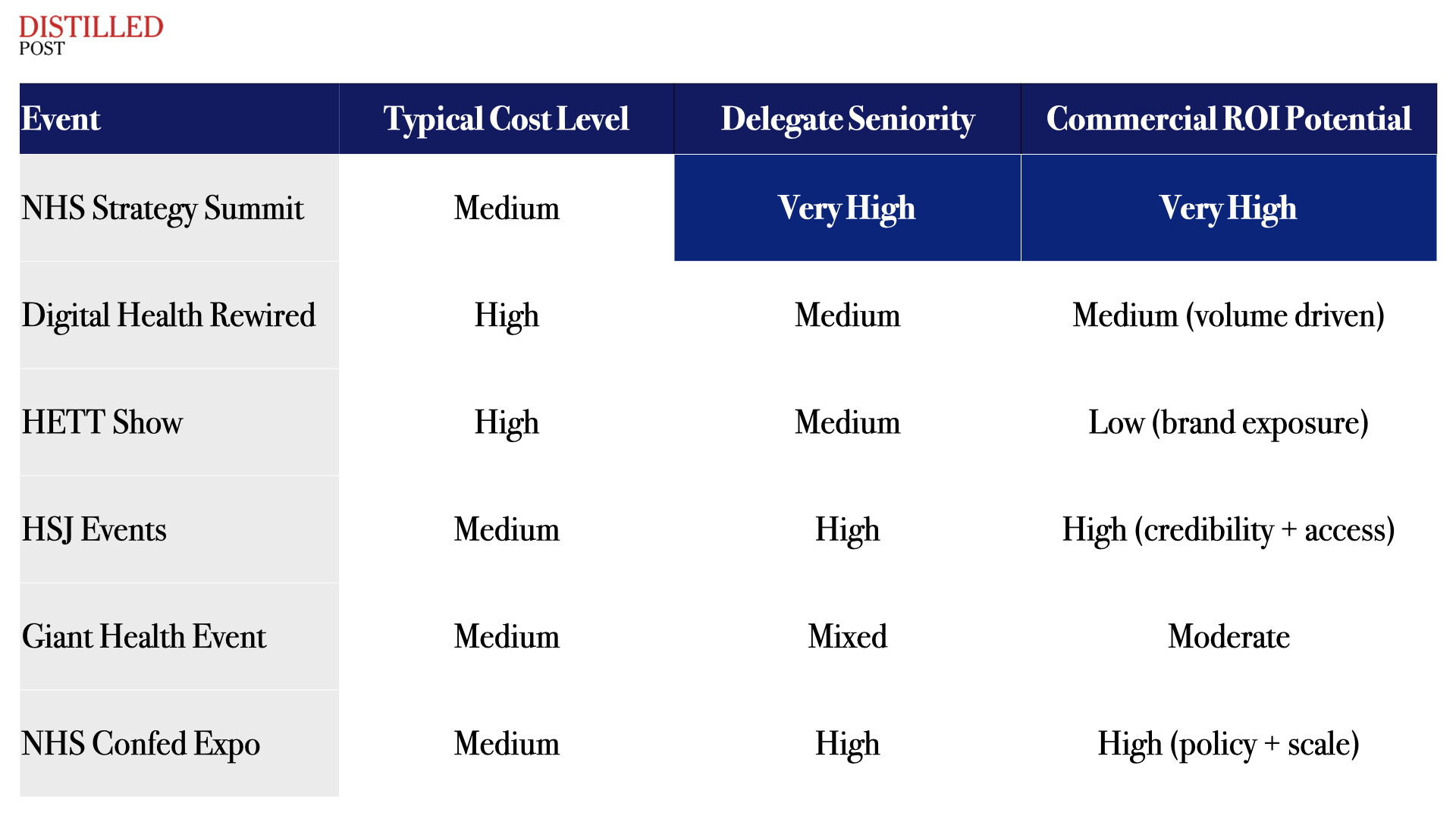
The key takeaway is straightforward. Spend should follow access, and access should follow intent.
The Delegate Experience Shift: From Passive to Engineered
The best NHS events are no longer passive experiences. They are engineered environments designed to maximise interaction. Structured networking, pre-arranged meetings and data-driven matchmaking are becoming standard at leading forums.
Events such as HSJ Events and the NHS Strategy Summit are leading this shift, creating formats where every hour spent translates into measurable engagement. This is particularly valuable for NHS executives, whose time is increasingly constrained, and for vendors, who need efficient routes into complex organisations.
By contrast, traditional exhibition formats are under pressure. While still valuable for scale, they are being forced to evolve toward more curated interaction models. The future of healthcare events will belong to those that can combine scale with precision.
The 2026/27 Strategy: How Executives and Vendors Should Navigate
For NHS leaders, the strategy is disciplined selectivity. Prioritise environments where peer exchange is meaningful and aligned to your operational priorities. Avoid over-attending large-scale events without clear objectives. Time, not access, is the limiting factor.
For vendors, the approach must be layered. A strong presence at one or two flagship exhibitions should be combined with targeted participation in executive forums. The goal is to move from visibility to trust, and from trust to commercial engagement.
A practical allocation model looks like this:
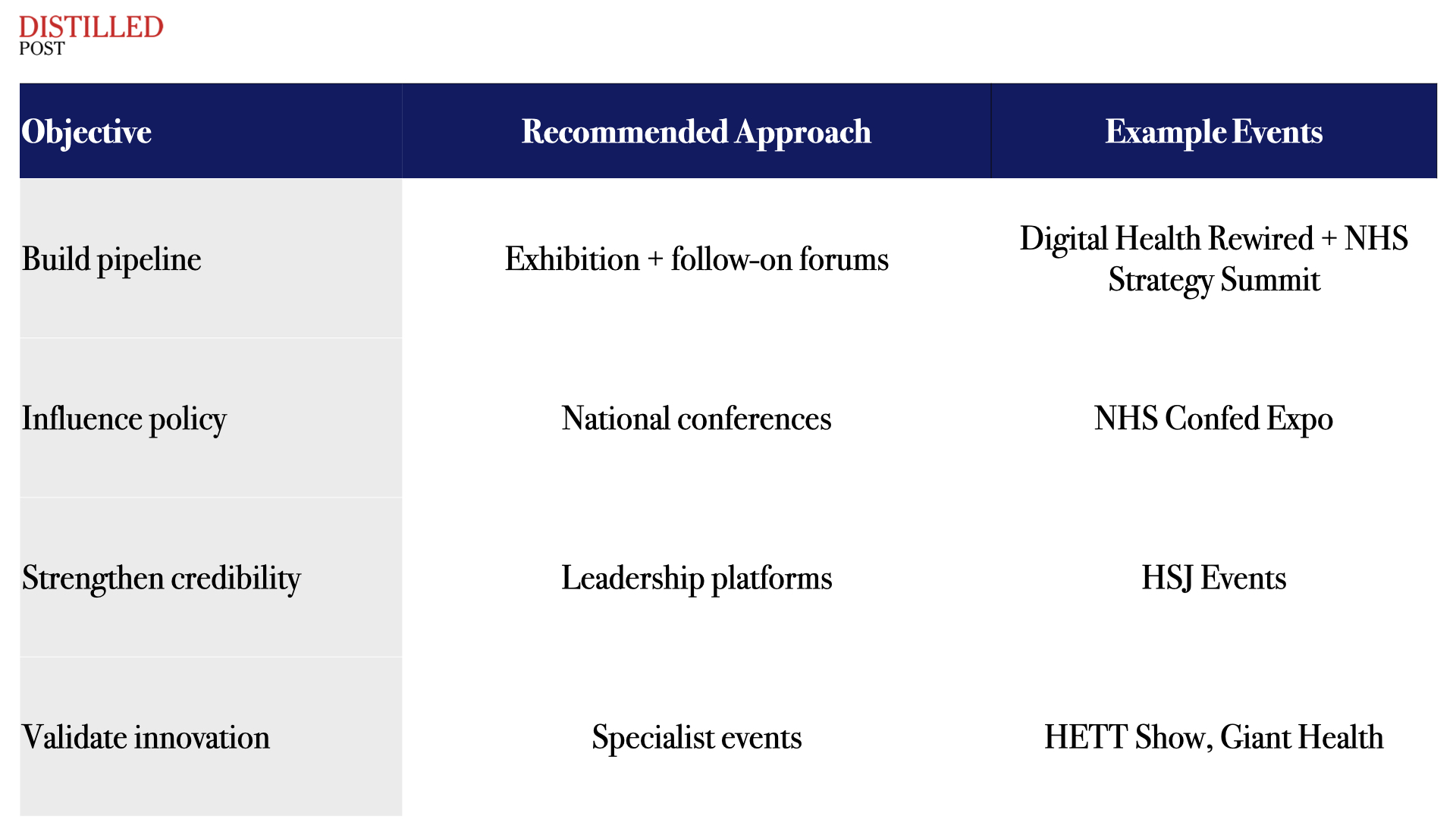
The organisations that outperform are those that treat events as part of a wider commercial system, not standalone activities.
Final Word: The Hidden Infrastructure of NHS Growth
Behind every major NHS initiative, partnership or procurement, there is a network of conversations that rarely make headlines. Events are the infrastructure that enables those conversations to happen. They are where trust is built, where ideas are tested and where future collaborations begin.
In 2026 and beyond, success in the NHS will not come from being everywhere. It will come from being in the right rooms, with the right people, at the right time.


.jpg)