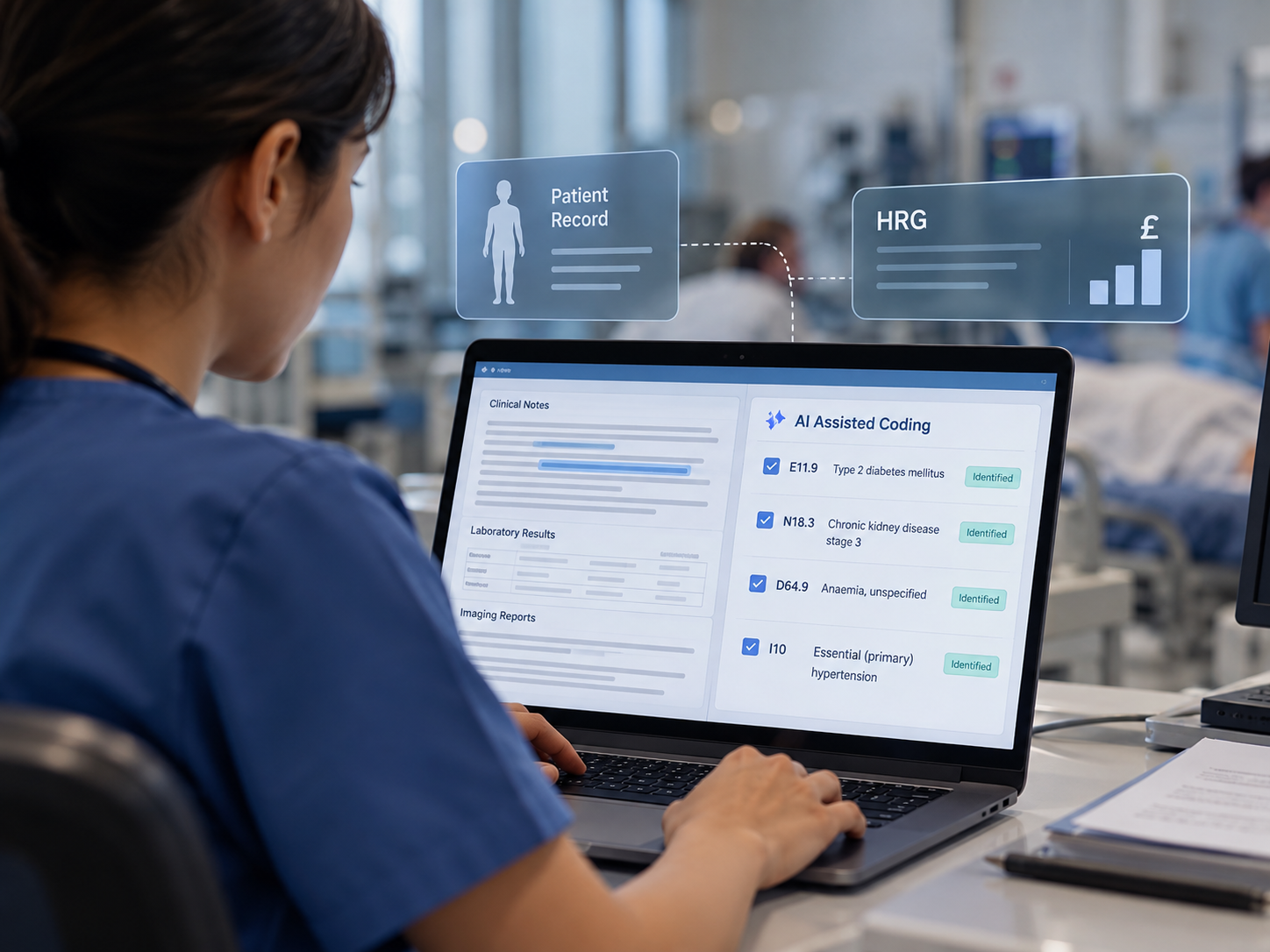
A woman sits at her kitchen table with a cup of tea, phone propped against the sugar bowl. On the screen is a consultant she has never met, calling from a county she has never visited. No plastic chair. No peeling paint. No wait beneath flickering strip lights in a Victorian outbuilding held together by hope and PFI. This is the quiet promise of the NHS’s most radical experiment in a generation.
In June, a national “online hospital” will be formally established as an NHS trust. Known internally as NHS Online, it represents a decisive turn away from bricks and mortar medicine towards something closer to a cloud based national service. Ministers see it as a way to prise elective care from the grip of geography and to do so quickly.
The ambition is straightforward. Separate healthcare from the estate. For decades the service has been organised around buildings that dictate who can be treated, when and by whom. That logic has produced a postcode lottery and a waiting list that has proved stubbornly resistant to conventional fixes. The online trust proposes a different organising principle. Capacity first. Location second. Demand matched to supply wherever it exists. Under the plan, patients will access services through the NHS App. Consultants will deliver care without being tied to a single hospital site. Spare capacity in one part of the country can be directed to unmet need in another. A surgeon with a free afternoon in Leeds can see patients in Cornwall. A menopause specialist in Manchester can pick up a clinic serving thousands nationwide.
This is where the analogy that has caught the political imagination comes in. Officials describe it as an Uber style model for consultants. An on demand workforce platform where senior clinicians can opt into additional sessions, flexing their hours around existing roles. To supporters, this is modern flexible working finally arriving in medicine. To critics, it is the gig economy knocking on the doors of a profession built on continuity and collective responsibility. There is reason for both optimism and caution. The NHS has spent years wrestling with fragmented digital transformation. Local pilots. Incompatible systems. Shiny platforms that never quite scale. By contrast, a single national trust with a clear mandate and central governance could finally bypass that inertia. A clean digital slate. One platform. One operating model.
The bureaucracy is deliberately lean. NHS England has begun recruiting a chair and six non-executive directors, with a full executive board expected by December. The chair role, advertised at around £55,000, is symbolic of a more corporate governance style. Tight. Central. Designed for speed rather than ceremony. Clinical services are due to begin in the 2027 to 28 financial year, initially focusing on nine high volume conditions including prostate issues and the menopause.
Yet the risks are real. Digital first services have a habit of amplifying inequality. The elderly, the isolated and the digitally excluded could find themselves further from care, not closer. Safeguards will matter. So will design. An online hospital must not become an online gatekeeper. Quality control is another open question. Despite its virtual nature, the trust will be subject to the same oversight as any physical hospital, including inspection by the Care Quality Commission. The challenge will be translating duty of care into a setting without wards or corridors. Accountability in the cloud is harder to see. Then there is staffing. Ministers insist this is about unlocking latent capacity, not draining it from struggling trusts. But the arithmetic is uncomfortable. Every hour a consultant spends on the platform is an hour not spent elsewhere. Unless productivity genuinely rises, there is a risk of simply moving queues around the system.
Still, the direction of travel is unmistakable. This is a bold and deliberate gamble tied to the wider 10 Year Health Plan. If the NHS cannot fix its buildings fast enough, it must reduce its dependence on them. The online hospital is not just a new trust. It is an admission that survival in the 21st century may depend on leaving the waiting room behind and moving, decisively, into the cloud.


.jpg)
.jpg)