
.png)
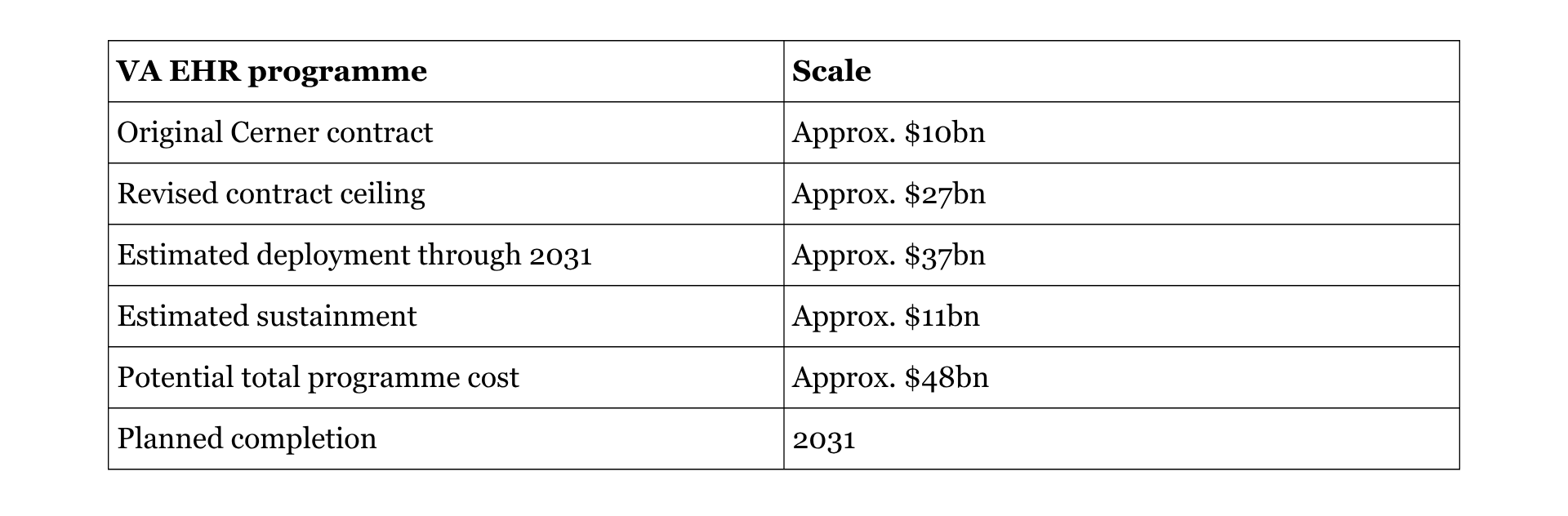
Electronic patient records are supposed to simplify healthcare. One patient, one record, better information and safer decisions. Yet the US Department of Veterans Affairs is providing healthcare leaders with a striking lesson in just how complicated transformation can become. Its Oracle Health programme began with a contract worth around $10 billion. The contract ceiling has now risen to almost $27 billion, while internal VA estimates put deployment and long term sustainment at approximately $48 billion. For the NHS, particularly trusts already using or implementing Oracle Health, this deserves attention. Not because America is England, but because the underlying transformation challenge is remarkably familiar.
The scale of the American programme is extraordinary. The VA originally contracted with Cerner in 2018 to replace its aging electronic health record infrastructure. Oracle subsequently acquired Cerner in 2022. What followed has now stretched across three US presidential administrations, dozens of congressional meetings and years of deployment work.
The ceiling on the core contract increased from approximately $10 billion to almost $27 billion. VA contracting documents cited unexpected complexity, extensive site specific configuration and the demands of completing and sustaining the programme. The department's own estimate cited by FedScoop suggests full deployment through 2031 could cost around $37 billion, with approximately another $11 billion required for sustainment.
There is an important distinction here. A $27 billion contract ceiling does not mean $27 billion has already been spent, and the $48 billion figure includes a much broader estimate of deployment and sustainment. But that distinction does not make the lesson less important. The programme started as an EHR procurement. It became an enterprise transformation programme involving technology, buildings, infrastructure, workforce, training, configuration, interoperability and years of operational change. That is exactly why NHS leaders should pay attention.
It would be easy, and probably wrong, to conclude that this is simply a story about one supplier. The more useful interpretation is that the VA has exposed something healthcare repeatedly underestimates: buying an EPR is very different from transforming a healthcare organisation.
An EPR touches almost everything. Medication workflows, pathology, theatres, nursing, outpatient care, referrals, discharge, coding, revenue, clinical documentation and patient communication all intersect with the record. Then there is infrastructure. VA documents describe additional work involving electrical upgrades, communications cabling, HVAC, telecommunications equipment and data centre requirements. More than half a billion dollars of EHR related construction has already been undertaken since 2017.
This is an important lesson for NHS boards. The licence price is not the programme price. The implementation price is not the lifetime price. And the go live date is certainly not the end of the programme.
Oracle Health already has a substantial footprint in England, while further implementations are progressing. Sheffield Teaching Hospitals has implemented Oracle Health, with Doncaster and Bassetlaw Teaching Hospitals planning to deploy a shared version of the Sheffield platform. Great Western Hospitals, Royal United Hospitals Bath and Salisbury are implementing a shared Oracle Health EPR across their organisations. In Essex, Mid and South Essex NHS Foundation Trust and Essex Partnership University NHS Foundation Trust have also selected Oracle Health for a shared record spanning acute, mental health and community services.
Those programmes could deliver major benefits. A shared record can reduce duplication, give clinicians faster access to information and make pathways across organisations considerably easier for patients. The VA experience does not argue against that ambition. It argues for much stronger control of how we get there.
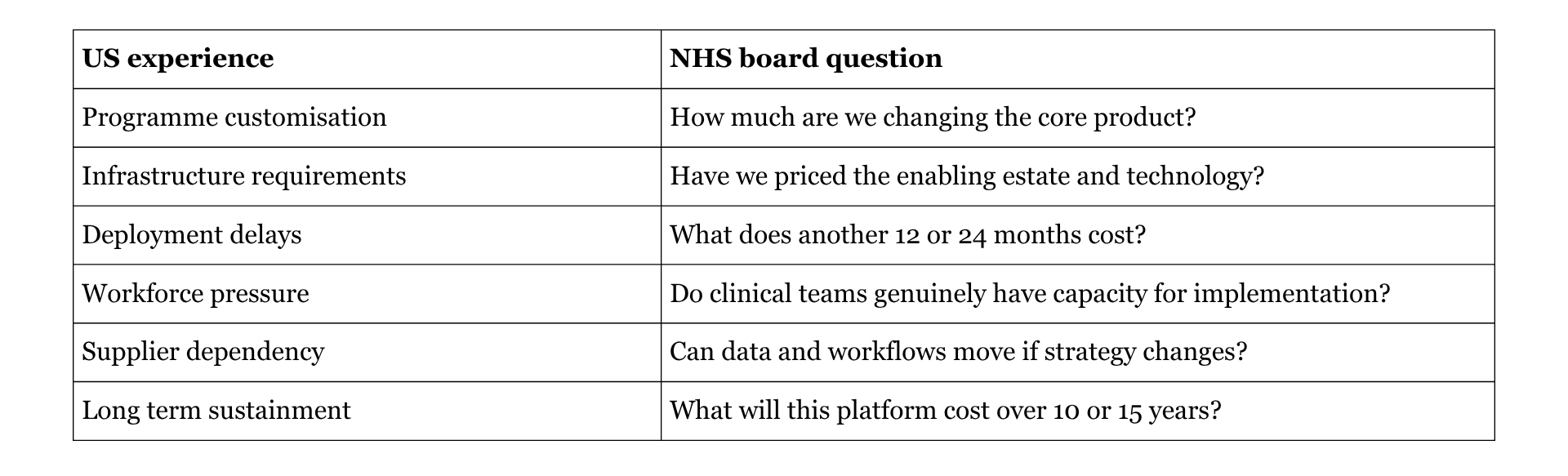
One phrase in the VA documentation should particularly interest NHS executives: extensive site specific customisation. Healthcare organisations naturally believe they are unique. Sometimes they are. But every unique workflow built into an enterprise EPR creates something that must be designed, tested, integrated, trained, upgraded and maintained.
Multiply that across dozens of departments and hospitals and complexity compounds quickly. The NHS should therefore be asking a difficult question before changing the platform: does the technology need to adapt to our workflow, or should our workflow adapt to the technology? Standardisation is rarely popular during implementation. It can become extremely valuable five years later.
The VA also examined whether another supplier could take over the programme, considering vendors including Epic, MEDITECH, Athenahealth and Veradigm. It ultimately concluded that no alternative could meet all of its requirements without enormous disruption. That is perhaps the clearest definition of strategic technology dependency.
Once an EPR becomes deeply integrated into clinical operations, replacing it becomes extraordinarily difficult. NHS boards should therefore treat interoperability, data portability and exit planning as board level issues, not procurement clauses buried near the back of a contract. The question is not whether an organisation intends to replace Oracle, Epic or any other supplier. The question is whether it could.
The lesson from the VA is not to avoid Oracle. It is to avoid believing that installing an EPR is principally an IT project. It is a clinical transformation programme with technology at its centre. That means boards need visibility of the total cost of ownership, customisation, infrastructure, workforce requirements, benefits delivery and supplier dependency from the beginning.
They should also be prepared to measure whether promised benefits actually appear after implementation: reduced duplication, faster documentation, safer medicines, improved productivity, better patient flow and genuinely better access to information. Because there is an enormous prize available. A well implemented shared health record can become the digital backbone of a health system. A poorly governed one can become a transformation programme that is permanently nearly finished.
The US experience gives the NHS something valuable: the opportunity to learn without first spending $48 billion discovering the lesson ourselves.
FedScoop, reporting on the VA Oracle Health EHR Modernization programme and contract expansion, 2026.
NHS trust and programme materials on Oracle Health deployments in Sheffield, Bath, Swindon, Wiltshire and Essex.



.jpg)
.jpg)
.jpg)