
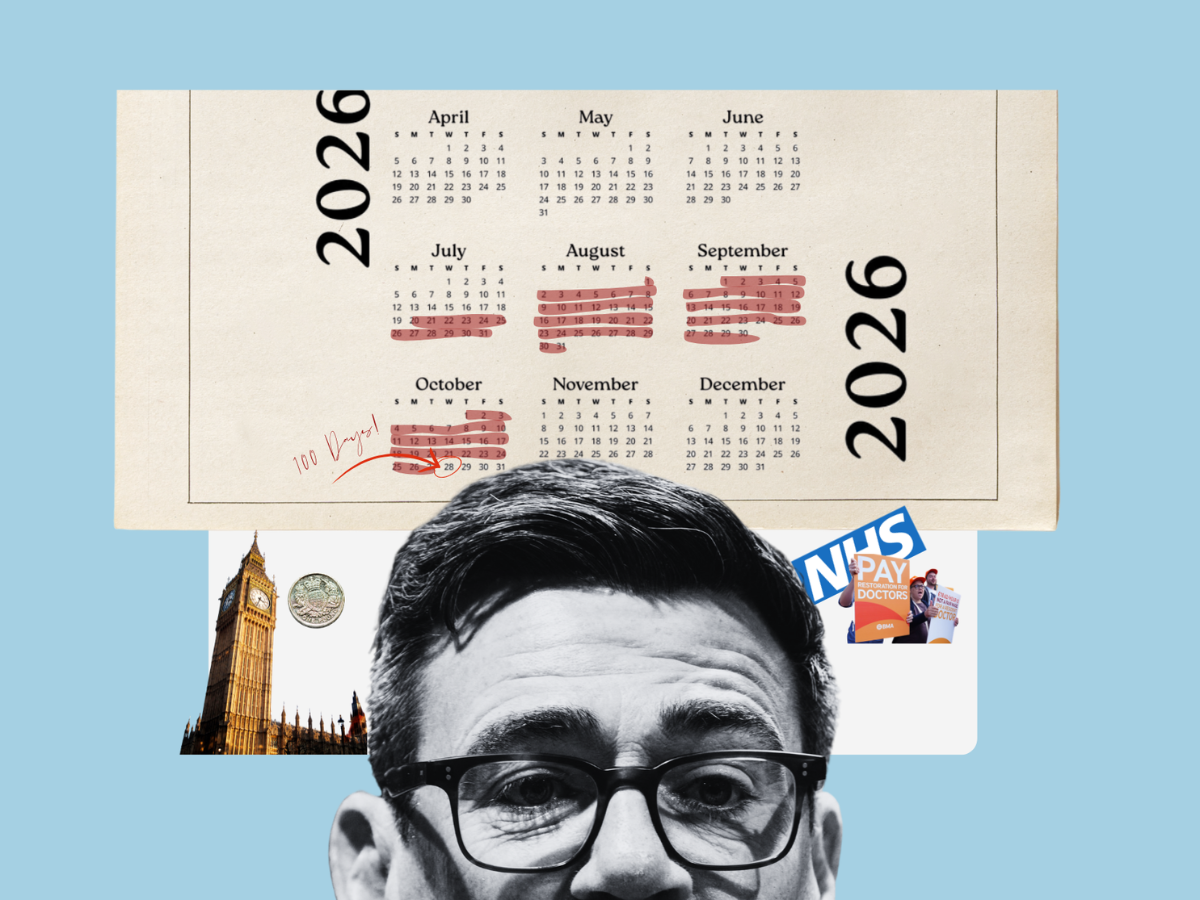
Andy Burnham was sworn in as Prime Minister on 20 July 2026, Britain's seventh in a decade, and the coming hundred days will do more to define his government than anything said in his first speech from Downing Street. Markets, businesses and the NHS all use a new administration's opening months as a proxy for what five years might bring, and this one arrives against an unforgiving backdrop: the OECD expects growth to slow to 0.9% this year, inflation to rise toward 3.7%, and UK productivity to remain roughly a fifth below the United States on a GDP-per-hour basis. Gilt yields, already among the highest in the G7, carry the scar tissue of the 2022 mini-budget crisis and fresh energy-price pressure from the Iran conflict. The test ahead is not whether Burnham intends to govern differently from his predecessor; he plainly does; but whether the next hundred days show he can turn that intent into delivery.
The clearest early signal will come from the bond market, and it has already offered a preview. A single promise of "fiscal flexibility" within existing borrowing rules sent the ten-year gilt yield to 5.04%, the highest in the G7, before it eased once John Healey, a steadying Treasury veteran, was confirmed as Chancellor. Expect that pattern to continue: every spending signal between now and the autumn Budget, a VAT cut on domestic electricity bills, a restored bus-fare cap, will be read by investors as a test of whether Healey can hold the line on discipline while Burnham talks expansively about political capital. The Budget itself, not the opening weeks, will be the moment that actually settles the question.
On growth, the first hundred days should reveal whether Burnham's devolution-first instinct amounts to a genuine economic strategy or a rebranding of familiar tools. A new Manchester-based coordinating body, "Number 10 North," is meant to push funding over housing, transport and industrial policy out to mayors and local authorities, and an early housebuilding push using surplus public land, alongside business-rates relief for high streets, is likely to arrive well before the promised ten-year economic strategy does. What is unlikely to arrive quickly is any serious dent in productivity, which the OECD attributes chiefly to weak business investment rather than the distribution of decision-making; a reminder that devolution, however well-designed, is not a substitute for capital.
Healthcare will be the sharpest test of execution, because the department now has its third secretary of state in fourteen months. Yvette Cooper takes over a health service still mid-reorganisation, with NHS England being absorbed into her department and an inherited ten-year health plan not yet complete, and the loudest message from the sector has been a plea for continuity rather than a fresh agenda. Watch for whether she moves quickly on social care, Burnham has spoken of running it on an "NHS principle," language that suggests where his political capital will actually go, and whether any visible progress on waiting lists or maternity safety is even possible while the organisational churn continues underneath her. A fourth health secretary before the year is out would be the clearest sign that ambition has outrun capacity.
Technology is likely to be the quiet area of continuity: the previous government's push on AI-assisted diagnostics and NHS data infrastructure is too valuable to abandon, but Burnham has so far said far more about housing and devolution than about AI or life sciences as growth drivers, and it is not yet clear whether the forthcoming economic strategy will treat innovation as central or incidental.
Internationally, expect the reaction to stay cautious rather than alarmed. One currency strategist has already described the transition as shifting "from a headwind to a tailwind," though others caution that the rally reflects hope, not delivery. Britain's elevated borrowing costs predate Burnham and are not fully within his control; where he does have agency is defence and industrial policy, where a "sovereign manufacturing" push signals continuity with existing alliance commitments even as diplomatic tone on the Middle East may shift.
The risks worth watching are not exotic. Fiscal flexibility could be read as the first step toward unfunded commitments of the kind that triggered Britain's last full-blown gilt crisis. NHS ministerial turnover could tip from reform into fatigue. Reform UK's sustained polling lead leaves Burnham little room for early missteps before the political story hardens against him regardless of policy substance. And devolved power, as with every previous wave of devolution, risks being announced well before the funding to make it real arrives.
None of this is a prediction of failure. It is simply where the evidence will show up first. By the time the autumn Budget lands, we should know whether Burnham's opening instincts: devolved power, council housebuilding, an NHS built around social care, fiscal room within the rules, are the beginning of sustained delivery or another cycle of ambition outrunning capacity. That is the question the first hundred days are actually designed to answer.



.jpg)
.jpg)
.jpg)