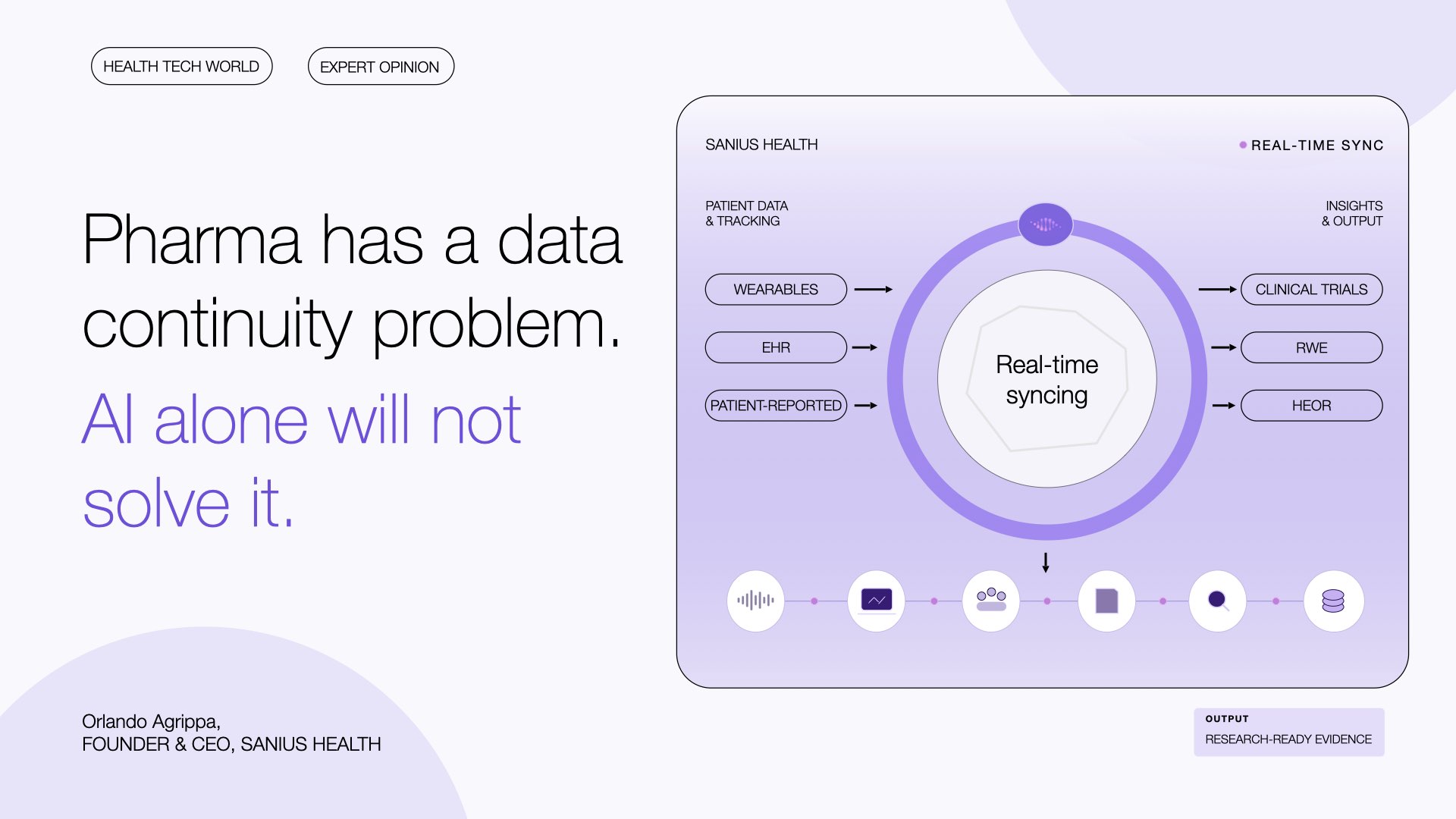
Pharmaceutical research can increasingly model proteins, investigate molecular pathways and screen candidates with artificial intelligence. Yet the evidence describing how patients experience disease and treatment can remain fragmented across clinical encounters, research visits and separate digital systems.
That disconnect presents an important scientific challenge. A therapy may alter a biomarker without delivering the improvement in daily function that a patient hoped for. A stable laboratory result may coexist with worsening fatigue, pain or treatment intolerance. If those experiences are recorded inconsistently, researchers risk studying only part of the response to treatment.
The limitation is not a lack of data, but a lack of continuity, context and comparability across the information that matters.
Electronic health records provide invaluable information about diagnoses, investigations, treatments and healthcare utilisation. Clinical trials add controlled assessments that remain indispensable for establishing treatment effects. However, neither source is intended to capture every change between scheduled contacts.
While longitudinal patient-reported outcomes can provide insight into symptoms, quality of life and functioning, validated digital measures may offer additional information on activity, sleep or relevant physiology. Alongside this, treatment exposure, laboratory findings and clinical events supply essential context.
The scientific opportunity is therefore less about collapsing these signals into a single, simplistic score than about asking whether particular combinations of measurements, collected at appropriate intervals and in defined populations, can help answer a clear research question.
A database stores observations, but a research-ready evidence system also needs to demonstrate provenance, definitions, timing, data completeness, population coverage and analytical suitability.
These requirements become critical when longitudinal information is involved. Patients may stop completing questionnaires when their disease worsens. Wearable data may become sparse because of device adherence, technical interruptions or changing health status. People who remain engaged may differ systematically from those who drop out.
Missing data may therefore be informative rather than random, and without an explicit plan for understanding and addressing it, high-frequency collection can create a false sense of precision.
Interoperability is another part of the challenge. Linking laboratory values, treatment sequences, patient-reported outcomes and device measurements requires consistent identifiers, common definitions, temporal alignment and governance appropriate to each source, and the result must remain traceable back to the original observation.
Multimodal AI methods can examine patterns across time-series measurements and structured or unstructured clinical information. In principle, they can support phenotyping, investigate disease trajectories and help develop hypotheses about treatment response or risk.
But prediction is not the same as clinical utility. Models require assessment of discrimination, calibration, subgroup performance and external validity, and a retrospective association does not prove that acting on the prediction improves outcomes. Nor can bias, confounding and dataset shift be solved merely by increasing model complexity.

At Sanius Health, our core platform connects direct patient engagement, longitudinal clinical information, patient-reported outcomes and relevant wearable measurements with research and analytical capabilities. We are developing applications such as Patient Find, which investigates clinical patterns that may indicate a need for further diagnostic assessment, and predictive models examining whether combinations of patient and physiological signals can anticipate complications. Each is a distinct use case with its own requirements for validation, governance and assessment of clinical usefulness.
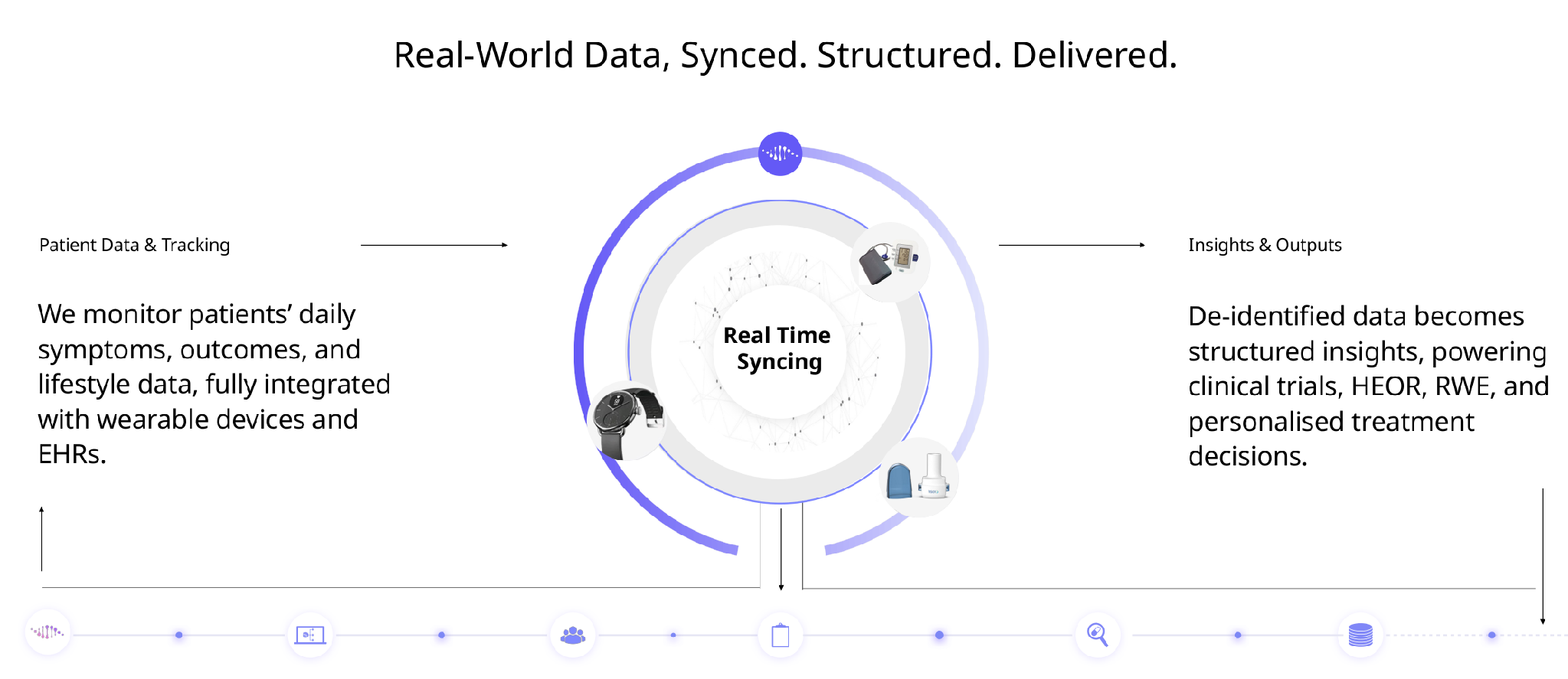
Better continuity in patient evidence could inform several stages of development. Natural-history research may benefit from more detailed disease trajectories. Trial design could incorporate a better understanding of symptom variability and endpoints that patients consider meaningful. Feasibility studies may examine relevant clinical characteristics across more realistic populations.
After authorisation, appropriately designed observational studies can investigate treatment use, safety and outcomes in routine practice. Such studies must be designed around the intended question, using suitable comparators and analytical approaches rather than assuming that a large dataset guarantees credible inference.
Patient preference research adds a related but distinct dimension. Direct engagement with patients can help establish how individuals value treatment burden, risk, efficacy and day-to-day functioning. Connecting these priorities with longitudinal clinical outcomes is one way to make evidence generation more responsive to the people treatments are intended to serve.
In March 2026, the US Food and Drug Administration issued final ICH M14 guidance addressing the planning, design, analysis and reporting of non-interventional studies using real-world data to assess medicine safety. Its emphasis on research questions, fit-for-purpose data and methodological rigour underlines the difference between having information and generating usable evidence.
For platforms supporting pharmaceutical R&D, governance, lawful data use, informed consent where applicable, security, quality control and scientific validation should be architectural requirements. They cannot be bolted on at the end of an AI project.
The next generation of pharmaceutical research infrastructure will need to connect what clinicians measure, what patients experience and what researchers can rigorously establish. It will not eliminate uncertainty, but its value will lie in making that uncertainty visible, limitations understandable and scientific decisions better informed.
If we want AI to help improve the development of medicines, we must first improve the continuity and reliability of the evidence on which it depends.