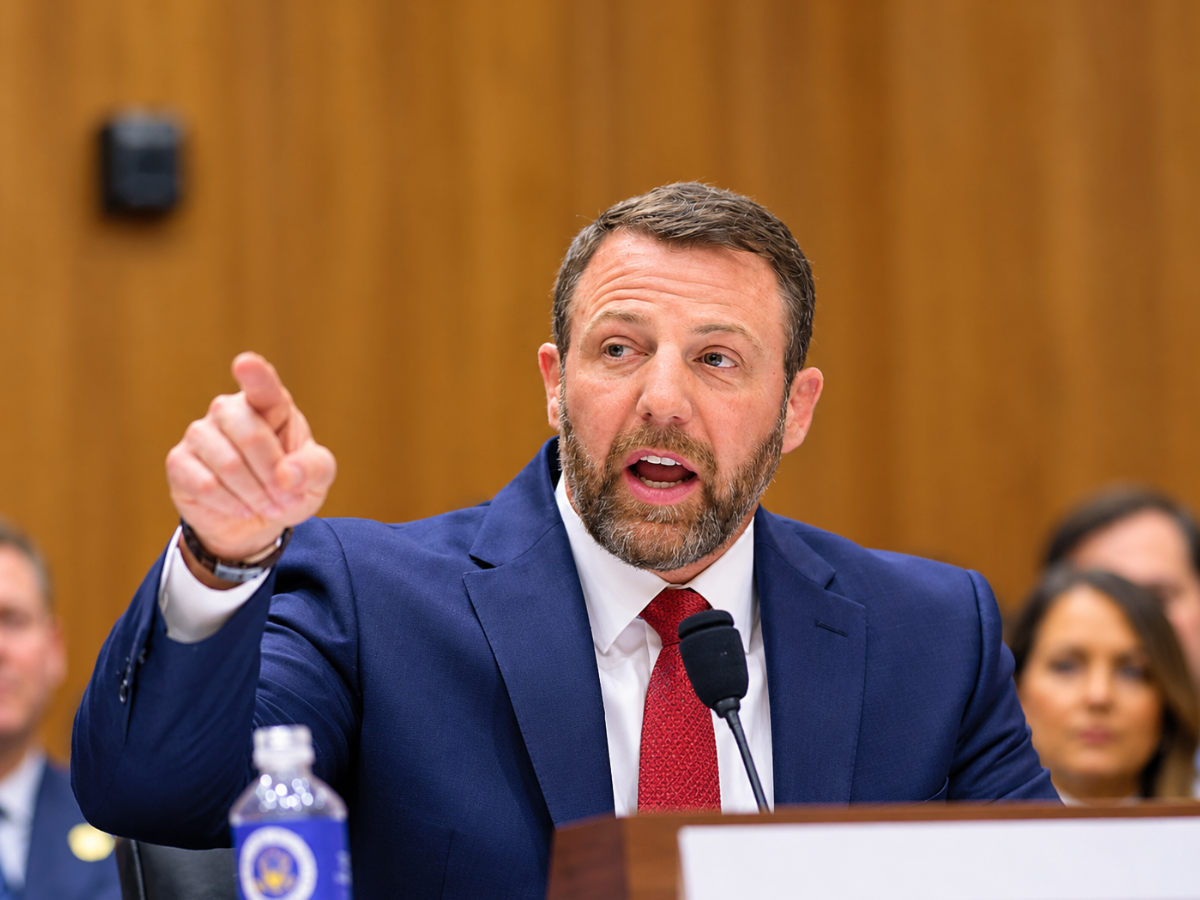
Markwayne Mullin, US Homeland Security Secretary
Homeland Security Secretary Markwayne Mullin has made one thing unmistakably clear, America's deportation drive is not about to slow down. Just a day after Democrats secured control of both the House of Representatives and the Senate in the midterm elections, Mullin delivered a defiant three-word message on X at 7.35pm Eastern time on Wednesday, declaring that deportations would continue. He offered no further explanation, but the brevity of the post left little room for doubt about the administration's intentions.
Although the statement contained no operational detail, it signalled that the Department of Homeland Security (DHS), which oversees Immigration and Customs Enforcement (ICE), has no immediate plans to alter its approach to arrests, detention or removals in response to the election result. The White House says more than 605,000 people have been deported during President Donald Trump's second term, while a further 1.9 million have left the country voluntarily.
Democrats made significant gains on election day, flipping seven Republican-held Senate seats in Kansas, Iowa, Texas, Ohio, Maine, North Carolina and South Carolina. Republicans had entered polling day with a 53-47 Senate majority and a 219-214 advantage in the House of Representatives. Although several races remained uncalled on Wednesday, the result marked a major shift in the political balance of power. Yet the change will not take effect immediately: the new Congress does not convene until January, leaving Republicans in control of both chambers until then.
Mullin, a former Republican senator for Oklahoma, succeeded Kristi Noem as head of the department. His appointment was opposed by Democrats, who have questioned the administration's approach to immigration enforcement and the conduct of federal officers. Senator Jacky Rosen said she wanted ICE officers held to the same standards as other law enforcement agencies, pointing to the killings of two Americans in Minneapolis earlier this year as evidence of the need for stronger safeguards. Before polling day, Mullin had also sought to address concerns about enforcement around elections, saying ICE agents would not be stationed near polling places unless a threat emerged.
For Democrats, however, the election victory offers an opportunity to turn criticism into scrutiny. Bennie Thompson, the senior Democrat on the House Homeland Security Committee, is seeking its chairmanship and has indicated that he would use his authority to compel administration officials to testify. The pressure could extend well beyond congressional hearings. One Democratic member of the committee has argued that deaths involving people held by ICE and Customs and Border Protection, as well as those deported, provide sufficient grounds to dismantle the department. Representative Delia Ramirez went further last month, introducing legislation to overhaul the immigration agencies and replace DHS with a new department.
The most immediate weapon available to the incoming Democratic majority may be money. Congress controls annual appropriations, giving lawmakers the power to withhold or attach conditions to future funding for the department. DHS funding had already lapsed earlier this year, disrupting pay for Transportation Security Administration staff, according to a statement from Rosen. But turning that leverage into meaningful restrictions will be far from straightforward. Democrats are projected to hold at least 54 Senate seats, still short of the 60 required to overcome a filibuster. Republican lawmakers are expected to resist attempts to curb immigration enforcement, while any legislation that does pass could face a presidential veto, an option Trump has threatened both before and after the midterms.
The coming period of divided government will therefore test just how far congressional oversight can reach when an administration is determined to defend its policies. Committee chairs can issue subpoenas and demand answers, but the White House and federal agencies can challenge their scope, turning investigations into prolonged political and legal disputes. Such confrontations have often ended in negotiation or the courts. And on immigration, the administration has recently found support in the judiciary.In June, the Supreme Court delivered a 6-3 ruling in Mullin v. Doe, limiting the ability of courts to review challenges to the termination of a country's Temporary Protected Status designation, except on constitutional grounds. The decision paved the way for the Department of Homeland Security to withdraw protections from approximately 350,000 Haitians and 6,000 Syrians.
Both parties are already offering competing explanations for the election result, and immigration is likely to remain central to that argument. A New York Times/Siena poll conducted before voting day found that 52 per cent of likely voters trusted Democrats more to handle immigration, compared with 45 per cent who favoured Republicans. Vice-President JD Vance, however, attributed Republican losses to the war with Iran. Those rival interpretations are likely to shape how both sides defend their positions when the new Congress convenes. But one issue is already emerging as the clearest flashpoint between the White House and its incoming Democratic opponents: the future of America's deportation drive.